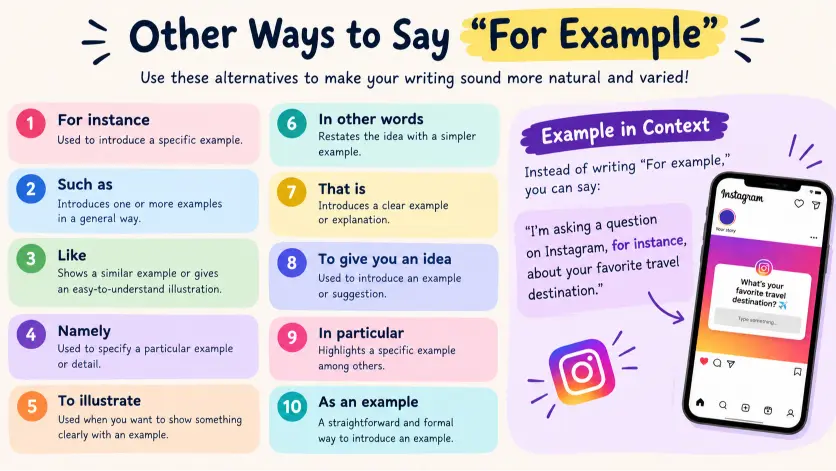
Have you ever used “for example” so many times in your writing that it starts to sound repetitive? For you are writing an essay, email, report, article, or academic assignment, knowing different ways to introduce examples can make your English sound clearer, more polished, and professional. Fortunately, there are many useful alternatives you can choose depending on your tone and context.
In this guide, you’ll discover practical alternatives to “for example” that work naturally in formal, academic, professional, and everyday writing. Each expression is explained with a clear meaning and example sentence so you can understand exactly when to use it. Drawing on standard English usage and common writing conventions, this guide focuses on phrases that help English learners communicate ideas accurately and avoid unnecessary repetition. From formal options such as “for instance” and “such as” to more natural expressions used in everyday communication, you’ll learn how to give examples in English with greater confidence and variety.
Quick Categories
Formal alternatives to “for example”
- For instance
- To illustrate
- By way of example
- As an illustration
Pro Tips Box: Use these expressions in academic papers, reports, presentations, and formal correspondence when you want a polished tone.
Casual alternatives
- Like
- Say
- For one
- Take
Pro Tips Box: Casual alternatives work best in conversations, informal messages, and relaxed writing. Avoid them when a formal academic style is required.
Professional alternatives
- Including
- Specifically
- In particular
- Namely
Pro Tips Box: Choose professional expressions when presenting evidence, examples, products, processes, or specific details in workplace communication.
Informal expressions
- For one thing
- Take this example
- Consider this
- Think of
Pro Tips Box: Informal expressions can make explanations feel conversational, but always consider your reader before using them in professional writing.
“Variety improves readability, but precision should always come before vocabulary.”
Common Mistakes When Using “For Example”
1. Using “for example” too many times
Repeating the same phrase can make writing feel monotonous.
Example:
“For example, students can read. For example, students can write. For example, students can practice.”
Better:
“For instance, students can read, write, and practice regularly.”
2. Confusing “such as” with a complete example clause
“Such as” normally introduces examples within a sentence rather than functioning like a standalone introductory phrase.
Incorrect:
“Such as, students can improve their vocabulary by reading.”
Better:
“Students can improve their vocabulary through activities such as reading and writing.”
3. Using “like” in highly formal writing
“Like” is natural in conversation but can sound less formal when introducing examples in academic or professional writing.
Example:
“Use resources like blogs and podcasts.”
More formal:
“Use resources such as blogs and podcasts.”
4. Using “namely” when the examples are not exact
“Namely” is generally used to identify specific items rather than provide a broad range of possibilities.
Example:
“The company has two priorities, namely quality and reliability.”
5. Adding unnecessary punctuation
Do not automatically place a comma after every alternative to “for example.”
Incorrect:
“For instance, employees can improve communication skills.”
The comma after “For instance” can be appropriate depending on sentence structure, but punctuation should follow the grammatical construction rather than a fixed rule.
What Does “Other Ways to Say for Example in Writing” Mean?
“Other ways to say for example in writing” refers to different words and phrases that introduce an illustration, specific case, supporting detail, or representative example.
The expressions can perform slightly different grammatical functions. For instance can introduce a complete example, while such as commonly introduces examples within a sentence.
Example:
“Many activities, such as reading and journaling, can improve vocabulary.”
The goal is not simply to replace “for example” with a synonym. The goal is to select an expression that matches the sentence structure and intended tone.
When to Use “For Example” and Its Alternatives
You can use these expressions in many contexts, including:
- Academic essays and assignments
- Business reports
- Professional emails
- Presentations
- Blog posts
- Explanatory articles
- Everyday conversations
- Speeches and discussions
- Educational materials
- Research based writing
Spoken vs. Written
In spoken English, expressions such as like, say, take, and for instance can sound natural.
In written English, particularly formal writing, for instance, to illustrate, such as, namely, and specifically are often more suitable.
Formal vs. Informal
Formal:
“To illustrate, consider the following situation.”
Professional:
“Several factors influence productivity, including workload and communication.”
Informal:
“Try something like reading for 20 minutes a day.”
Is “For Example” Professional or Polite?
“For example” is both polite and professional. It is a standard expression used to introduce supporting information and examples.
However, professional writers may vary their wording when the phrase appears repeatedly in the same document. Choosing alternatives can improve flow without making the writing unnecessarily complicated.
Business style example:
“Several factors can affect customer satisfaction, including response time, product quality, and communication.”
Polite? ✔️ Yes
Professional? ✔️ Yes
“Professional writing does not require bigger words. It requires clearer choices.”
Pros and Cons of Using “For Example”
Pros
- Simple and natural: Almost every English learner understands it.
- Friendly tone: It makes explanations easy to follow.
- Common usage: It works in both speech and writing.
- Easy to understand: It clearly signals that an example is coming.
Cons
- Can become repetitive: Frequent use may weaken sentence variety.
- May sound formulaic: Repeated use can make writing feel mechanical.
- Limited stylistic range: It does not always communicate the exact relationship between an idea and its example.
- Not always the best fit: Expressions such as “namely” or “specifically” may be more precise in certain contexts.
Other Ways to Say “For Example” in Writing
These alternatives will help you sound more fluent, confident, and natural in different situations.
Use them according to tone, context, and audience to express excitement, admiration, approval, clarification, or supporting information.
1. Phrase: For Instance
Meaning: Introduces a specific example that supports a general statement.
Explanation: “For instance” is one of the closest and most natural alternatives to “for example.”
Example Sentence:
“Many habits can improve productivity. For instance, planning your day can help you stay focused.”
Best Use: Academic writing
Worst Use: Repetitive writing
Tone: Formal, clear, neutral
Context Variability: Casual: “For instance, you could try walking.” Professional: “For instance, this process reduces processing time.” Spoken: “For instance, look at this case.”
2. Phrase: Such As
Meaning: Introduces specific examples belonging to a larger category.
Explanation: “Such as” is particularly useful when examples are placed directly within a sentence.
Example Sentence:
“Skills such as communication and teamwork are valuable in the workplace.”
Best Use: General examples
Worst Use: Complete clauses
Tone: Natural, concise, professional
Context Variability: Casual: “I enjoy activities such as hiking.” Professional: “Services such as training are available.” Spoken: “Try foods such as rice or vegetables.”
3. Phrase: To Illustrate
Meaning: Introduces an example that makes an idea clearer.
Explanation: This phrase works especially well when explaining concepts or arguments.
Example Sentence:
“To illustrate, consider how small changes can improve workplace efficiency.”
Best Use: Formal explanation
Worst Use: Casual chat
Tone: Formal, precise, explanatory
Context Variability: Casual: “To illustrate, think about your daily routine.” Professional: “To illustrate, consider the following results.” Spoken: “To illustrate, let me give you an example.”
4. Phrase: Including
Meaning: Identifies some members or examples within a larger group.
Explanation: “Including” is concise and frequently used in professional writing.
Example Sentence:
“The course covers several skills, including writing, speaking, and presentation.”
Best Use: Professional lists
Worst Use: Standalone examples
Tone: Concise, professional, direct
Context Variability: Casual: “I like several sports, including tennis.” Professional: “The package includes services including consultation.” Spoken: “We discussed several topics, including grammar.”
5. Phrase: Namely
Meaning: Identifies specific items that have just been mentioned generally.
Explanation: “Namely” is more precise than “for example” because it usually introduces the exact items being referred to.
Example Sentence:
“The project has two main goals, namely improving quality and reducing costs.”
Best Use: Exact details
Worst Use: Broad possibilities
Tone: Formal, precise, authoritative
Context Variability: Casual: Limited. Professional: “The report identifies two concerns, namely cost and timing.” Spoken: “There are two options, namely A and B.”
6. Phrase: Specifically
Meaning: Introduces a particular detail or example.
Explanation: Use “specifically” when you want to move from a general statement to a precise point.
Example Sentence:
“Several changes are needed, specifically improvements to customer support.”
Best Use: Precise details
Worst Use: Broad lists
Tone: Direct, precise, professional
Context Variability: Casual: “Specifically, I mean the second option.” Professional: “Specifically, the company needs stronger documentation.” Spoken: “Specifically, I am referring to this section.”
7. Phrase: In Particular
Meaning: Highlights one specific example or detail.
Explanation: It is useful when one item deserves special attention.
Example Sentence:
“Several skills are important, but communication is particularly valuable.”
Best Use: Highlighting examples
Worst Use: Long lists
Tone: Professional, focused, clear
Context Variability: Casual: “I like many books, in particular biographies.” Professional: “The report addresses several issues, in particular customer retention.” Spoken: “I enjoyed several parts, in particular the conclusion.”
8. Phrase: As an Illustration
Meaning: Introduces something that demonstrates an idea.
Explanation: This formal expression is useful when explaining concepts or evidence.
Example Sentence:
“As an illustration, consider the impact of regular feedback on employee performance.”
Best Use: Formal writing
Worst Use: Casual conversation
Tone: Formal, academic, explanatory
Context Variability: Casual: Less common. Professional: “As an illustration, consider this customer case.” Spoken: “As an illustration, let me explain what happened.”
9. Phrase: By Way of Example
Meaning: Introduces an example for clarification or demonstration.
Explanation: This is a distinctly formal expression often found in professional or academic prose.
Example Sentence:
“By way of example, a company might reduce costs by automating routine tasks.”
Best Use: Formal explanation
Worst Use: Casual chat
Tone: Formal, polished, structured
Context Variability: Casual: Uncommon. Professional: “By way of example, consider the following scenario.” Spoken: Possible in formal presentations.
10. Phrase: To Give an Example
Meaning: Directly introduces a specific example.
Explanation: This phrase is clear and flexible in both speech and writing.
Example Sentence:
“To give an example, a short daily practice session can improve vocabulary.”
Best Use: Clear explanations
Worst Use: Excessive repetition
Tone: Natural, clear, educational
Context Variability: Casual: “To give an example, try this exercise.” Professional: “To give an example, consider the following result.” Spoken: “To give an example, imagine this situation.”
11. Phrase: As an Example
Meaning: Signals that the following information demonstrates the previous point.
Explanation: It is straightforward and works well in explanatory writing.
Example Sentence:
“As an example, regular reading can expose learners to new vocabulary.”
Best Use: Educational writing
Worst Use: Repeated openings
Tone: Neutral, clear, instructional
Context Variability: Casual: “As an example, try this method.” Professional: “As an example, this approach reduces errors.” Spoken: “As an example, think about this situation.”
12. Phrase: Consider
Meaning: Directs the reader or listener toward a specific example or situation.
Explanation: “Consider” can introduce an example without explicitly saying “for example.”
Example Sentence:
“Consider a company that receives hundreds of customer inquiries every day.”
Best Use: Analytical writing
Worst Use: Simple lists
Tone: Professional, engaging, analytical
Context Variability: Casual: “Consider what happens when you skip breakfast.” Professional: “Consider a business operating across multiple markets.” Spoken: “Consider this situation.”
13. Phrase: Take
Meaning: Introduces a particular person, situation, or item as an example.
Explanation: “Take” is conversational and works well when explaining an idea informally.
Example Sentence:
“Take online learning as an example of how technology has changed education.”
Best Use: Conversational explanation
Worst Use: Highly formal papers
Tone: Conversational, direct, approachable
Context Variability: Casual: “Take exercise, for instance.” Professional: “Take customer service as a practical example.” Spoken: “Take this situation.”
14. Phrase: Say
Meaning: Introduces a hypothetical example or possibility.
Explanation: “Say” is useful when creating an imagined situation.
Example Sentence:
“Say you receive an unexpected deadline at work. How would you respond?”
Best Use: Hypothetical situations
Worst Use: Formal reports
Tone: Casual, conversational, approachable
Context Variability: Casual: “Say you have only ten minutes.” Professional: Less common. Spoken: “Say you need to explain the problem.”
15. Phrase: One Example Is
Meaning: Identifies one specific example of a broader idea.
Explanation: This phrase is useful when presenting one supporting case.
Example Sentence:
“One example is the growing use of digital tools in education.”
Best Use: Supporting evidence
Worst Use: Repeated lists
Tone: Clear, neutral, explanatory
Context Variability: Casual: “One example is this book.” Professional: “One example is the company’s new training system.” Spoken: “One example is what happened yesterday.”
16. Phrase: A Good Example Is
Meaning: Introduces an example that clearly demonstrates an idea.
Explanation: It is useful when you want to emphasize the relevance of a particular example.
Example Sentence:
“A good example is the way regular feedback can improve employee performance.”
Best Use: Explanatory writing
Worst Use: Formal research
Tone: Natural, clear, accessible
Context Variability: Casual: “A good example is this exercise.” Professional: “A good example is the company’s customer feedback system.” Spoken: “A good example is what happened last week.”
17. Phrase: One Case Is
Meaning: Introduces one particular case that supports a statement.
Explanation: This expression works especially well in analytical and professional contexts.
Example Sentence:
“One case is the company’s successful transition to remote work.”
Best Use: Case discussion
Worst Use: Casual chat
Tone: Analytical, professional, concise
Context Variability: Casual: Less common. Professional: “One case is the recent market expansion.” Spoken: “One case is the situation we discussed earlier.”
18. Phrase: As Demonstrated By
Meaning: Introduces evidence that demonstrates a particular point.
Explanation: It is useful when connecting a claim with supporting evidence.
Example Sentence:
“The strategy has produced results, as demonstrated by the increase in customer retention.”
Best Use: Evidence based writing
Worst Use: Casual speech
Tone: Formal, analytical, evidence based
Context Variability: Casual: Uncommon. Professional: “This improvement is demonstrated by the latest figures.” Spoken: Possible in presentations.
19. Phrase: As Shown By
Meaning: Introduces evidence or an example that supports a statement.
Explanation: It is commonly used in reports, analysis, and explanatory writing.
Example Sentence:
“The campaign was effective, as shown by the increase in website traffic.”
Best Use: Reports and analysis
Worst Use: Informal messages
Tone: Professional, factual, concise
Context Variability: Casual: Uncommon. Professional: “The results are clear, as shown by the data.” Spoken: “This is shown by the survey results.”
20. Phrase: As Seen In
Meaning: Refers to an example or situation that can be observed in a particular source or context.
Explanation: It is useful when connecting an idea to a visible or documented case.
Example Sentence:
“This approach is common in modern workplaces, as seen in many technology companies.”
Best Use: Observed examples
Worst Use: Unsupported claims
Tone: Professional, descriptive, informative
Context Variability: Casual: “As seen in many movies.” Professional: “As seen in recent industry reports.” Spoken: “As seen in this example.”
21. Phrase: Particularly
Meaning: Highlights a specific example or area of importance.
Explanation: “Particularly” can replace an example phrase when you want to emphasize one item.
Example Sentence:
“Several skills matter in leadership, particularly communication and decision making.”
Best Use: Emphasis
Worst Use: Complete examples
Tone: Professional, precise, focused
Context Variability: Casual: “I enjoy many subjects, particularly history.” Professional: “Several factors matter, particularly reliability.” Spoken: “I liked several parts, particularly the ending.”
22. Phrase: Among Them
Meaning: Identifies one or more items from a previously mentioned group.
Explanation: It works well when the larger category has already been introduced.
Example Sentence:
“The company offers several benefits, among them flexible working hours.”
Best Use: Formal lists
Worst Use: First introduction
Tone: Formal, concise, polished
Context Variability: Casual: Less common. Professional: “Several options are available, among them remote training.” Spoken: Possible in formal speech.
23. Phrase: One Such Example
Meaning: Refers to a particular example belonging to the previously mentioned category.
Explanation: It creates a smooth connection between a general statement and a specific case.
Example Sentence:
“Many organizations use digital training tools. One such example is an online learning platform.”
Best Use: Formal explanation
Worst Use: Simple conversation
Tone: Formal, cohesive, academic
Context Variability: Casual: Less common. Professional: “One such example is the company’s mentoring program.” Spoken: Possible in presentations.
24. Phrase: A Case in Point
Meaning: Refers to an example that strongly supports or demonstrates an idea.
Explanation: This expression is useful when the example is particularly relevant.
Example Sentence:
“Customer service can influence brand loyalty. A case in point is the company’s rapid response system.”
Best Use: Strong examples
Worst Use: Weak evidence
Tone: Professional, idiomatic, confident
Context Variability: Casual: “A case in point is my own experience.” Professional: “A case in point is the recent customer survey.” Spoken: “A case in point is what happened yesterday.”
25. Phrase: A Case of
Meaning: Identifies a particular instance of a broader situation.
Explanation: It works well when describing a specific occurrence or phenomenon.
Example Sentence:
“This is a case of effective communication improving team performance.”
Best Use: Specific situations
Worst Use: General lists
Tone: Analytical, professional, precise
Context Variability: Casual: “It is a case of bad timing.” Professional: “This is a case of effective risk management.” Spoken: “It is a case of poor planning.”
26. Phrase: In Other Words, Such As
Meaning: Provides specific examples after explaining a broader idea.
Explanation: This construction can help clarify an abstract category through concrete examples.
Example Sentence:
“Use practical learning methods, in other words, activities such as discussions and exercises.”
Best Use: Clarification
Worst Use: Concise writing
Tone: Explanatory, conversational, accessible
Context Variability: Casual: “Try practical activities such as cooking.” Professional: “Use measurable methods such as surveys.” Spoken: “Choose activities such as reading.”
27. Phrase: To Name One
Meaning: Gives one example from several possible examples.
Explanation: This expression is useful when you do not need to list every possible example.
Example Sentence:
“Several companies have adopted flexible schedules, to name one example.”
Best Use: Selective examples
Worst Use: Exact lists
Tone: Conversational, concise, natural
Context Variability: Casual: “There are many options, to name one.” Professional: “Several methods are available, to name one.” Spoken: “There are many reasons, to name one.”
28. Phrase: Among Other Things
Meaning: Indicates that the example is one of several relevant points.
Explanation: It is useful when mentioning one detail without suggesting that it is the only example.
Example Sentence:
“The training program covers communication, leadership, and, among other things, time management.”
Best Use: Broad discussions
Worst Use: Exact evidence
Tone: Natural, flexible, professional
Context Variability: Casual: “We talked about work and, among other things, travel.” Professional: “The report examines costs and, among other things, productivity.” Spoken: “We discussed several topics, among other things.”
29. Phrase: To Give You an Idea
Meaning: Introduces information intended to help someone understand the scale, nature, or appearance of something.
Explanation: It is especially natural in conversational and explanatory English.
Example Sentence:
“To give you an idea, the project involved more than 100 participants.”
Best Use: Contextual explanation
Worst Use: Formal research
Tone: Conversational, friendly, explanatory
Context Variability: Casual: “To give you an idea, it took three hours.” Professional: “To give you an idea of the scale, the project involved 20 teams.” Spoken: “To give you an idea, we started with 50 participants.”
30. Phrase: To Give You an Example
Meaning: Directly introduces a specific example for clarification.
Explanation: This phrase is natural, accessible, and particularly useful in teaching and conversation.
Example Sentence:
“To give you an example, regular writing practice can improve both vocabulary and sentence structure.”
Best Use: Teaching and explanation
Worst Use: Repeated formal prose
Tone: Friendly, clear, educational
Context Variability: Casual: “To give you an example, try this exercise.” Professional: “To give you an example, consider the following situation.” Spoken: “To give you an example, let me explain what happened.”
“Do not choose an alternative simply because it sounds sophisticated. Choose the phrase that communicates your meaning most accurately.”
See Also
See also: Explore other practical vocabulary choices in our guide to other ways to say “on the same page” for clearer everyday and professional communication.
See also: Review our Professional English guide for useful expressions, workplace vocabulary, and communication strategies.
How to Choose the Right Alternative
Choosing among other ways to say for example in writing depends on what you want the expression to accomplish.
For academic writing
Prefer:
- For instance
- To illustrate
- Such as
- Specifically
- Namely
For professional writing
Prefer:
- Including
- Specifically
- In particular
- As shown by
- As demonstrated by
For conversational English
Prefer:
- Like
- Say
- Take
- To give you an example
For highly formal writing
Prefer:
- By way of example
- As an illustration
- To illustrate
- Namely
For evidence based writing
Prefer:
- As shown by
- As demonstrated by
- A case in point
- One such example
“Fluent English is not just knowing more words. It is knowing when each word belongs.”
Mini Quiz and Self Check
1. Which expression is most suitable for a formal academic explanation?
A. Like
B. Say
C. To illustrate
D. Take
Answer: C. To illustrate
2. Which option best introduces examples within a sentence?
A. Such as
B. By way of example
C. To give you an example
D. Say
Answer: A. Such as
3. You are writing a business report and want to highlight evidence. Which expression is most suitable?
A. Like
B. As shown by
C. Say
D. Take
Answer: B. As shown by
4. Which sentence sounds most natural in casual conversation?
A. “By way of example, you could try walking.”
B. “Namely, you could try walking.”
C. “Say you want to improve your fitness. You could start walking.”
D. “As demonstrated by, you could start walking.”
Answer: C.
Comparison Table: Top Alternatives
| Phrase | Tone | Best Use |
| For instance | Formal, neutral | Academic writing |
| Such as | Natural, professional | Lists and categories |
| To illustrate | Formal, explanatory | Academic explanations |
| Including | Concise, professional | Business writing |
| Namely | Precise, formal | Exact details |
| Specifically | Direct, professional | Clarification |
| In particular | Focused, polished | Highlighting details |
| As shown by | Analytical, factual | Evidence |
| A case in point | Confident, professional | Strong examples |
| To give you an example | Friendly, clear | Teaching and conversation |
FAQs About Other Ways to Say “For Example” in Writing
1. What is the best alternative to “for example” in formal writing?
For instance, to illustrate, and by way of example are strong choices for formal writing. The best option depends on the sentence structure and level of formality.
2. What can I use instead of “for example” in an academic essay?
You can use for instance, to illustrate, such as, specifically, namely, and as an illustration. Avoid changing the phrase merely for variety if the replacement does not fit grammatically.
3. Is “such as” better than “for example”?
Neither is universally better. “Such as” is particularly useful for introducing examples within a sentence, while “for example” can introduce a complete example or supporting statement.
4. What are professional reaction phrases similar to “for example”?
Professional reaction phrases are not direct synonyms for “for example,” because they serve different purposes. However, expressions such as specifically, in particular, to illustrate, and as shown by can make professional explanations clearer.
5. Can I use “like” instead of “for example” in formal writing?
“Like” can introduce examples in informal English, but such as is generally more appropriate when you want a formal or professional tone.
Conclusion
Learning other ways to say things, for example in writing can make your English more flexible, precise, and engaging. Expressions such as, for instance, to illustrate, including, specifically, and namely allow you to adapt your language to academic, professional, conversational, and informal contexts.
The key is to practice tone awareness rather than memorizing synonyms mechanically. When you understand how each expression works, you can avoid repetition, improve sentence variety, and communicate your ideas more naturally. Try replacing “for example” with one suitable alternative each day, and gradually build a vocabulary of professional and informal expressions in English that you can use confidently.









