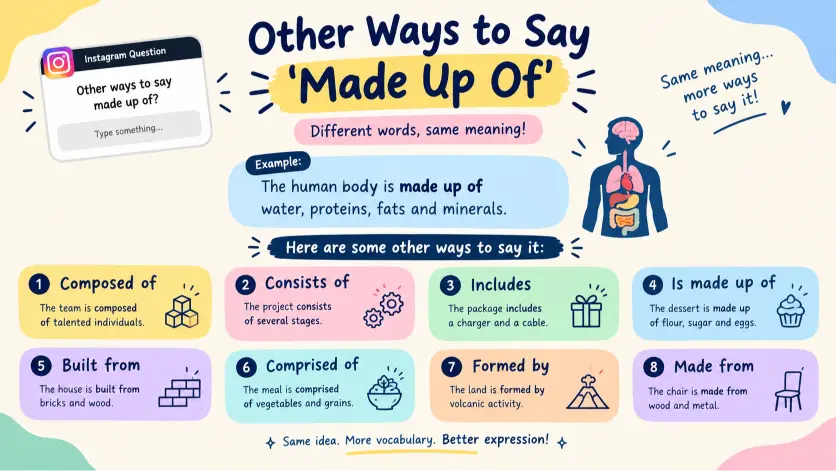
Looking for a more natural way to say “made up of”? Using the same phrase repeatedly can make your English sound predictable, especially in academic writing, professional communication, or everyday conversations. The good news is that English offers many useful alternatives, including composed of, consists of, contains, includes, comprises, formed from, and built from. Choosing the right expression depends on your sentence, audience, and level of formality. Learning these alternatives can help you express ideas more precisely and confidently.
In this guide, you’ll discover practical alternatives to “made up of” with clear meanings, example sentences, tone information, and usage tips. These expressions are especially helpful for English learners who want to improve both spoken and written communication. Whether you’re describing a team, explaining ingredients, discussing a structure, or writing a professional report, understanding these alternatives will help you avoid repetition and choose language that fits the context naturally
Formal alternatives to “made up of”
Formal English often requires precise vocabulary, especially in reports, essays, presentations, and academic writing.
- Composed of
- Consists of
- Comprises
- Constituted by
Pro Tips Box
Use “composed of” or “consists of” when you want clear, polished wording. Use “comprises” carefully because it already means “consists of.”
Casual alternatives
For everyday conversations, these options sound natural and easy to understand.
- Contains
- Includes
- Has
- Is formed from
Pro Tips Box
In casual speech, “has” or “includes” can sound more natural than a formal word such as “constituted.”
Professional alternatives
Professional communication benefits from precise expressions that clearly describe components or membership.
- Consists of
- Comprises
- Is composed of
- Is comprised of
Pro Tips Box
For business writing, “consists of” and “comprises” are usually concise and precise choices.
Informal expressions
Informal expressions are useful in conversations, messages, and relaxed workplace discussions.
- Is made from
- Has
- Is built from
- Is put together from
Pro Tips Box
Choose informal expressions according to context. “Is put together from” works best when discussing something assembled from separate parts.
Key takeaway: “Formal vocabulary is not always better vocabulary. The best phrase is the one that matches your audience and context.”
Common Mistakes When Using “Made Up Of”
1. Confusing “made of” with “made up of”
Mistake: Using “made of” when describing the members or components of a group.
Incorrect: The committee is made of ten experts.
Better: The committee is made up of ten experts.
2. Using “comprises of”
Mistake: Adding “of” after “comprises.”
Incorrect: The course comprises of six modules.
Better: The course comprises six modules.
3. Using “consists from”
Mistake: Using “from” instead of “of.”
Incorrect: The team consists from five departments.
Better: The team consists of five departments.
4. Using “comprised of” without understanding the distinction
Mistake: Treating “comprised of” as identical to every formal construction.
Example: The panel is comprised of three specialists.
Better formal alternative: The panel comprises three specialists.
5. Choosing a formal word in casual conversation
Mistake: Making ordinary speech unnecessarily formal.
Awkward: “My family is constituted by five people.”
Natural: “My family is made up of five people.”
What Does “Made Up Of” Mean?
“Made up of” means consisting of or being formed from particular people, parts, materials, or elements.
It is a phrasal construction commonly used after a form of be:
Subject + be + made up of + components
Example:
The project team is made up of six engineers.
The phrase can describe physical components, groups of people, organizations, categories, systems, or abstract elements.
Grammar Note
The expression normally takes “of”:
- The class is made up of 20 students.
- The report is made up of five sections.
- The mixture is made up of several ingredients.
“Use ‘made up of’ when you want simple, natural English that immediately tells readers what something consists of.”
When to Use “Made Up Of”
You can use the phrase in many situations, including:
- Describing a team or organization
- Explaining the parts of a system
- Describing ingredients or materials
- Explaining the structure of a report
- Talking about groups of people
- Describing categories or sections
- Explaining what an object contains
Spoken vs. Written English
Spoken:
“My team is made up of five people.”
Written:
“The research team consists of five specialists.”
Both are correct, but “consists of” may sound more polished in formal writing.
Formal vs. Informal
| Context | Suitable Expression |
| Casual conversation | made up of |
| Everyday writing | made up of |
| Business writing | consists of |
| Academic writing | composed of |
| Technical writing | comprises |
| Formal report | is composed of |
Is It Professional or Polite to Say “Made Up Of”?
Yes. “Made up of” is both polite and grammatically acceptable, but it has a more conversational and accessible tone than some formal alternatives.
In professional communication, it is perfectly appropriate when clarity and naturalness are more important than formality.
Business example:
“Our marketing team is made up of specialists from five different departments.”
Polite? ✔️ Yes
Professional? ✔️ Yes, although more formal alternatives may suit reports and academic documents better.
Professional English tip: “Consists of” is a useful upgrade when you need a concise and formal alternative without changing the meaning.
Pros and Cons of Using “Made Up Of”
Pros
- Simple and natural: Easy for most English speakers to understand.
- Friendly tone: Works well in everyday communication.
- Common usage: Frequently heard in spoken and written English.
- Easy to understand: Clearly identifies the components of something.
Cons
- Less formal: Some alternatives may sound more polished in academic writing.
- Can become repetitive: Frequent use can make writing less varied.
- Limited stylistic range: It does not always provide the precision of technical vocabulary.
- Not ideal for every formal context: Reports may benefit from “consists of,” “comprises,” or “composed of.”
Other Ways to Say “Made Up Of” With Examples
These other ways to say made up will help you sound more fluent, confident, and natural in different situations.
Use them according to tone, context, and audience. The right alternative can also help you describe professional reaction phrases, informal expressions in English, structures, groups, and components more precisely.
1. Phrase: Composed of
Meaning: Formed or constructed from particular parts or elements.
Explanation: This is a polished alternative commonly used in formal and academic English.
Example Sentence: The committee is composed of experienced professionals.
Best Use: Academic writing
Worst Use: Very casual chat
Tone: Formal, precise, polished
Context Variability: Casual: “The team is composed of five people.” Professional: “The panel is composed of industry experts.” Spoken: “The group is composed of volunteers.”
2. Phrase: Consists of
Meaning: Has particular parts, members, or elements.
Explanation: This is one of the clearest and most widely accepted alternatives.
Example Sentence: The training program consists of six modules.
Best Use: Professional writing
Worst Use: None significant
Tone: Clear, formal, neutral
Context Variability: Casual: “The meal consists of three dishes.” Professional: “The department consists of four divisions.” Spoken: “The course consists of five lessons.”
3. Phrase: Comprises
Meaning: Includes or consists of particular parts.
Explanation: “Comprises” is concise and particularly useful in formal writing.
Example Sentence: The organization comprises twelve regional offices.
Best Use: Formal reports
Worst Use: Casual conversation
Tone: Formal, concise, professional
Context Variability: Casual: “The collection comprises old books.” Professional: “The company comprises several business units.” Spoken: “The committee comprises five members.”
4. Phrase: Contains
Meaning: Has something inside or as part of a whole.
Explanation: Use “contains” when emphasizing what is included within something.
Example Sentence: The package contains several important documents.
Best Use: Contents description
Worst Use: People groups
Tone: Neutral, direct, practical
Context Variability: Casual: “The box contains toys.” Professional: “The report contains three sections.” Spoken: “The package contains everything we need.”
5. Phrase: Includes
Meaning: Has something as one of its parts or members.
Explanation: “Includes” is useful when you want to identify some or all components.
Example Sentence: The package includes a charger and two cables.
Best Use: Product descriptions
Worst Use: Exact composition
Tone: Neutral, flexible, clear
Context Variability: Casual: “The set includes four cups.” Professional: “The plan includes several key stages.” Spoken: “The team includes two designers.”
6. Phrase: Is formed from
Meaning: Is created using particular parts or materials.
Explanation: This expression emphasizes the process or materials used to create something.
Example Sentence: The sculpture is formed from recycled metal.
Best Use: Material descriptions
Worst Use: Simple group descriptions
Tone: Descriptive, neutral, clear
Context Variability: Casual: “The model is formed from plastic.” Professional: “The structure is formed from several layers.” Spoken: “It is formed from different materials.”
7. Phrase: Is composed of
Meaning: Consists of particular components.
Explanation: This passive construction is especially common in professional and academic writing.
Example Sentence: The system is composed of three interconnected units.
Best Use: Technical writing
Worst Use: Casual speech
Tone: Formal, technical, precise
Context Variability: Casual: “The group is composed of students.” Professional: “The system is composed of multiple components.” Spoken: “The panel is composed of experts.”
8. Phrase: Is comprised of
Meaning: Is made up of particular parts or members.
Explanation: This expression is widely used, although some style guides prefer the active construction “comprises.”
Example Sentence: The department is composed of several specialized teams.
Best Use: General professional English
Worst Use: Strict formal style
Tone: Professional, common, formal
Context Variability: Casual: “The group is composed of friends.” Professional: “The board is composed of specialists.” Spoken: “The team is composed of volunteers.”
9. Phrase: Is built from
Meaning: Is constructed using particular components.
Explanation: This is especially appropriate for structures, systems, products, and physical objects.
Example Sentence: The prototype is built from lightweight materials.
Best Use: Technical contexts
Worst Use: Abstract groups
Tone: Practical, descriptive, clear
Context Variability: Casual: “The table is built from wood.” Professional: “The system is built from modular components.” Spoken: “It is built from recycled materials.”
10. Phrase: Is constructed from
Meaning: Is created or assembled from specific components.
Explanation: This is a formal alternative for describing physical structures and systems.
Example Sentence: The bridge is constructed from reinforced steel.
Best Use: Technical writing
Worst Use: Casual conversation
Tone: Technical, formal, precise
Context Variability: Casual: “The model is constructed from plastic.” Professional: “The framework is constructed from durable materials.” Spoken: “The structure is constructed from steel.”
11. Phrase: Is assembled from
Meaning: Is put together using separate components.
Explanation: Use this when individual pieces are combined to create a finished object.
Example Sentence: The device is assembled from several interchangeable parts.
Best Use: Manufacturing contexts
Worst Use: Abstract ideas
Tone: Technical, practical, precise
Context Variability: Casual: “The model is assembled from small parts.” Professional: “The unit is assembled from standardized components.” Spoken: “It is assembled from separate pieces.”
12. Phrase: Is made from
Meaning: Is produced using a particular material or set of materials.
Explanation: This is especially useful when discussing the materials used to create something.
Example Sentence: The packaging is made from recycled paper.
Best Use: Material descriptions
Worst Use: Team membership
Tone: Simple, neutral, natural
Context Variability: Casual: “This chair is made from wood.” Professional: “The packaging is made from recycled materials.” Spoken: “It is made from natural ingredients.”
13. Phrase: Is made up of
Meaning: Consists of particular parts or members.
Explanation: This is the direct passive form and works naturally in many contexts.
Example Sentence: The project team is made up of designers and developers.
Best Use: Everyday English
Worst Use: Highly technical prose
Tone: Natural, neutral, accessible
Context Variability: Casual: “The group is made up of friends.” Professional: “The committee is made up of specialists.” Spoken: “The team is made up of five people.”
14. Phrase: Is comprised of several parts
Meaning: Consists of multiple components.
Explanation: This expanded form emphasizes that something has several distinct elements.
Example Sentence: The assessment consists of several separate sections.
Best Use: Explanatory writing
Worst Use: Concise prose
Tone: Formal, explanatory, structured
Context Variability: Casual: “The set is composed of several pieces.” Professional: “The assessment consists of multiple sections.” Spoken: “The course consists of different units.”
15. Phrase: Encompasses
Meaning: Includes or covers a range of things.
Explanation: Use this when describing a broad range rather than simply listing physical components.
Example Sentence: The program encompasses training, research, and community outreach.
Best Use: Broad descriptions
Worst Use: Simple objects
Tone: Formal, broad, sophisticated
Context Variability: Casual: “The project encompasses many activities.” Professional: “The strategy encompasses several departments.” Spoken: “The program encompasses different areas.”
16. Phrase: Incorporates
Meaning: Includes something as an integrated part.
Explanation: This word emphasizes that components have been deliberately included in a larger whole.
Example Sentence: The new design incorporates several sustainable features.
Best Use: Design discussions
Worst Use: Basic descriptions
Tone: Professional, precise, modern
Context Variability: Casual: “The design incorporates new ideas.” Professional: “The strategy incorporates customer feedback.” Spoken: “The plan incorporates several changes.”
17. Phrase: Integrates
Meaning: Combines separate elements into a unified whole.
Explanation: Use “integrates” when different components work together within one system.
Example Sentence: The platform integrates several communication tools.
Best Use: Technology contexts
Worst Use: Simple lists
Tone: Technical, professional, modern
Context Variability: Casual: “The app integrates several features.” Professional: “The system integrates multiple data sources.” Spoken: “The platform integrates several tools.”
18. Phrase: Incorporates elements of
Meaning: Includes specific characteristics or components.
Explanation: This is useful when describing a design, strategy, or concept containing selected elements.
Example Sentence: The proposal incorporates elements of both traditional and modern design.
Best Use: Analytical writing
Worst Use: Basic descriptions
Tone: Analytical, formal, precise
Context Variability: Casual: “The style incorporates elements of nature.” Professional: “The strategy incorporates elements of both models.” Spoken: “The design incorporates elements of both approaches.”
19. Phrase: Is formed by
Meaning: Comes together through particular components or contributors.
Explanation: This expression can describe how a whole is created.
Example Sentence: The committee is formed by representatives from six departments.
Best Use: Group descriptions
Worst Use: Material composition
Tone: Neutral, formal, descriptive
Context Variability: Casual: “The group is formed by local volunteers.” Professional: “The committee is formed by department representatives.” Spoken: “The team is formed by experienced members.”
20. Phrase: Is constituted by
Meaning: Is formally formed or established by particular members or elements.
Explanation: This is a highly formal expression often found in institutional or legal contexts.
Example Sentence: The board is constituted by representatives from several organizations.
Best Use: Institutional writing
Worst Use: Casual speech
Tone: Formal, institutional, official
Context Variability: Casual: “The group is constituted by several members.” Professional: “The board is constituted by elected representatives.” Spoken: “The committee is constituted by senior officials.”
21. Phrase: Is made from a combination of
Meaning: Is created using several different elements together.
Explanation: This phrase clearly emphasizes multiple contributing materials or ingredients.
Example Sentence: The product is made from a combination of natural and synthetic materials.
Best Use: Product descriptions
Worst Use: Simple groups
Tone: Descriptive, clear, professional
Context Variability: Casual: “The drink is made from a combination of fruits.” Professional: “The material is made from a combination of polymers.” Spoken: “It is made from a combination of ingredients.”
22. Phrase: Is a combination of
Meaning: Consists of two or more different elements brought together.
Explanation: This is a flexible expression for describing mixtures, concepts, or characteristics.
Example Sentence: The course is a combination of lectures and practical exercises.
Best Use: Course descriptions
Worst Use: Exact membership lists
Tone: Neutral, flexible, clear
Context Variability: Casual: “The meal is a combination of flavors.” Professional: “The program is a combination of theory and practice.” Spoken: “It is a combination of several ideas.”
23. Phrase: Is composed from
Meaning: Is created using specified components.
Explanation: This construction can describe how something is created, although “composed of” is generally more natural for existing components.
Example Sentence: The artwork is composed from several recycled materials.
Best Use: Creative descriptions
Worst Use: Standard formal prose
Tone: Descriptive, artistic, formal
Context Variability: Casual: “The artwork is composed from different materials.” Professional: “The installation is composed from recycled elements.” Spoken: “It is composed from several pieces.”
24. Phrase: Draws on
Meaning: Uses or incorporates ideas, resources, or influences from something.
Explanation: This is useful when discussing sources, knowledge, approaches, or influences rather than physical components.
Example Sentence: The training program draws on research from several fields.
Best Use: Academic writing
Worst Use: Physical composition
Tone: Academic, analytical, sophisticated
Context Variability: Casual: “The idea draws on several influences.” Professional: “The strategy draws on industry research.” Spoken: “The approach draws on different methods.”
25. Phrase: Brings together
Meaning: Combines different people, ideas, or elements.
Explanation: This natural expression emphasizes the act of combining separate things.
Example Sentence: The conference brings together experts from several industries.
Best Use: Events and groups
Worst Use: Exact material composition
Tone: Natural, positive, engaging
Context Variability: Casual: “The event brings together friends.” Professional: “The conference brings together industry leaders.” Spoken: “The project brings together several teams.”
26. Phrase: Combines
Meaning: Joins two or more elements into one whole.
Explanation: “Combines” is concise and works across professional, academic, and everyday contexts.
Example Sentence: The program combines classroom learning with practical experience.
Best Use: Professional writing
Worst Use: Exact inventory lists
Tone: Clear, versatile, professional
Context Variability: Casual: “The recipe combines several flavors.” Professional: “The strategy combines research and analysis.” Spoken: “The course combines theory and practice.”
27. Phrase: Contains elements of
Meaning: Includes particular features or characteristics.
Explanation: Use this expression when a whole incorporates selected qualities rather than identical components.
Example Sentence: The design contains elements of traditional architecture.
Best Use: Design analysis
Worst Use: Exact composition
Tone: Analytical, neutral, descriptive
Context Variability: Casual: “The style contains elements of nature.” Professional: “The proposal contains elements of several established models.” Spoken: “The design contains elements of both styles.”
28. Phrase: Features
Meaning: Includes particular characteristics or components.
Explanation: “Features” is useful when highlighting notable parts rather than explaining complete composition.
Example Sentence: The new model features several advanced safety systems.
Best Use: Product writing
Worst Use: Exact composition
Tone: Modern, concise, promotional
Context Variability: Casual: “The phone features a large screen.” Professional: “The platform features several reporting tools.” Spoken: “The new model features better controls.”
29. Phrase: Has as its components
Meaning: Includes specific parts as components.
Explanation: This is an explicit construction useful when identifying the elements of a system.
Example Sentence: The framework has three major components.
Best Use: Technical explanations
Worst Use: Casual conversation
Tone: Technical, direct, precise
Context Variability: Casual: “The kit has three components.” Professional: “The framework has three major components.” Spoken: “The system has several components.”
30. Phrase: Is put together from
Meaning: Is assembled using separate parts or elements.
Explanation: This is a natural but less formal alternative that emphasizes assembly.
Example Sentence: The model is put together from several individual parts.
Best Use: Everyday explanations
Worst Use: Academic reports
Tone: Informal, natural, conversational
Context Variability: Casual: “The model is put together from small pieces.” Professional: “The prototype is put together from modular components.” Spoken: “It is put together from several parts.”
“Fluent English is not about using the most complicated word. It is about choosing the most appropriate word for the situation.”
See Also
- Other Ways to Say “On the Same Page”: Learn natural alternatives for agreeing, understanding, and communicating clearly.
- Professional English Guide: Explore practical vocabulary and expressions for clearer workplace communication.
Mini Quiz / Self-Check
1. Which alternative is most appropriate for a formal report?
A. Has
B. Consists of
C. Put together from
D. Made up of
Answer: B. Consists of
2. Which sentence is grammatically correct?
A. The team comprises five members.
B. The team consists of five members.
C. The team comprises five members.
D. The team consists of five members.
Answer: C. The team comprises five members.
3. You are describing a relaxed conversation with a friend. Which sounds most natural?
A. The group is constituted of five people.
B. The group is made up of five people.
C. The group comprises five individuals.
D. The group is constituted of five people.
Answer: B. The group is made up of five people.
4. Which expression is best for materials used to create an object?
A. Is made from
B. Comprises
C. Encompasses
D. Brings together
Answer: A. Is made from
Comparison Table: Top Alternatives
| Phrase | Tone | Best Use |
| Composed of | Formal | Academic writing |
| Consists of | Formal-neutral | Professional writing |
| Comprises | Formal | Reports |
| Contains | Neutral | Contents |
| Includes | Neutral | General descriptions |
| Is formed from | Neutral | Materials |
| Is composed of | Formal | Technical writing |
| Incorporates | Professional | Strategies and designs |
| Combines | Versatile | Ideas and methods |
| Brings together | Natural | Groups and events |
FAQs
1. What are the best alternatives to “made up of”?
The most useful alternatives are composed of, consists of, comprises, contains, includes, and is formed from. Your choice depends on the context.
2. Is “comprises” more formal than “made up of”?
Yes. “Comprises” generally has a more formal and concise tone, making it useful for academic, technical, and professional writing.
3. Can I use “made up of” in professional English?
Yes. “Made up of” is grammatically correct and professional enough for many situations, particularly when you want natural and accessible communication.
4. What is the difference between “made of” and “made up of”?
“Made of” commonly describes the material an object consists of, while “made up of” often describes the members, components, or elements forming a whole.
5. Is “comprised of” grammatically correct?
“Comprised of” is widely used, but many formal style guides prefer “comprises” in active constructions, such as “The team comprises five specialists.”
Conclusion
Learning other ways to say made up” gives you more flexibility when speaking and writing English. Expressions such as “consists of,” “composed of,” “comprises,” and “includes” can help you adapt your language to professional, academic, casual, and technical contexts.
The key is not to replace every occurrence automatically. Instead, consider your audience, purpose, and level of formality. Practice using one or two alternatives each day, and your vocabulary will gradually become more varied and precise. When choosing professional reaction phrases or informal expressions in English, remember that natural communication depends on both vocabulary and tone.









