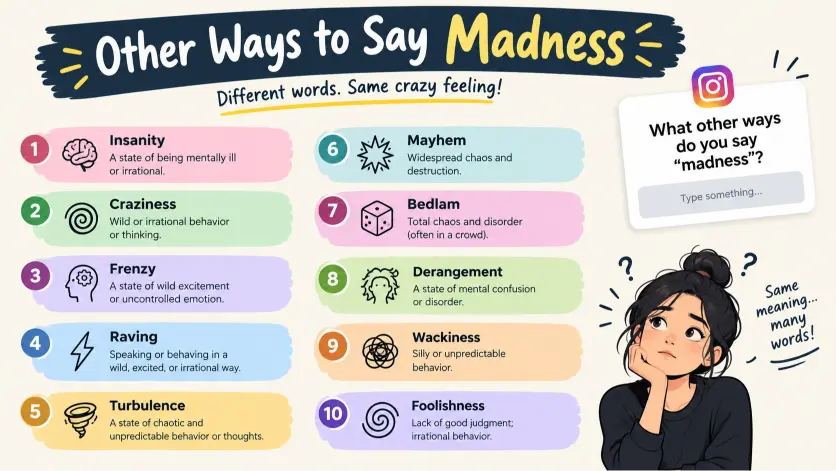
Have you ever used the word “madness” and wondered if there is a more natural, precise, or interesting way to express the same idea? For you are describing chaotic behavior, extreme excitement, confusion, or a situation that feels completely unreasonable, choosing the right expression can make your English sound much more fluent and confident. Learning alternatives to madness helps you communicate the exact tone you want in conversations, writing, social media, and professional settings.
In this guide, you’ll discover 30+ other ways to say madness, including formal, casual, conversational, and expressive alternatives with practical examples. The expressions are selected to help English learners understand differences in meaning, tone, and context rather than simply memorize synonyms. You’ll also learn when certain phrases sound natural—and when they may be too informal or exaggerated. Whether you are improving your vocabulary, writing more effectively, or looking for natural ways to describe chaotic situations, this guide provides clear, real-world English you can confidently use.
Quick Categories
Formal alternatives to “madness”
- Absurdity
- Irrationality
- Folly
- Unreasonableness
Pro Tip: Use these choices when discussing decisions, behavior, or situations in formal writing rather than using emotionally strong language.
Casual alternatives
- Craziness
- Chaos
- Mayhem
- Frenzy
Pro Tip: These expressions work naturally in everyday conversations, especially when describing hectic or unusually intense situations.
Professional alternatives
- Disorder
- Confusion
- Extreme activity
- An unreasonable situation
Pro Tip: In professional communication, describe the specific problem rather than labeling a person or decision as “madness.”
Informal expressions
- Things have gone wild
- Total chaos
- A complete mess
- Pure mayhem
Pro Tip: Keep these informal expressions in conversations and relaxed messages rather than formal reports or business correspondence.
“Precision beats exaggeration when you want your English to sound professional.”
Common Mistakes When Using “Madness”
1. Using “madness” for every type of excitement
Mistake: Treating every exciting event as madness.
Example: “The concert was madness because everyone enjoyed the music.”
Better: “The concert was a frenzy of energy.”
2. Using “madness” in formal business writing
Mistake: Calling a workplace decision “madness.”
Example: “Changing the strategy at this stage is madness.”
Better: “Changing the strategy at this stage may be unwise.”
3. Confusing “madness” with mental illness
Mistake: Using the word as a clinical description.
Example: “His madness needs treatment.”
Better: Use appropriate clinical terminology when discussing actual mental health conditions.
4. Using “craziness” with a professional audience
Mistake: “The project deadline was complete craziness.”
Better: “The project deadline created considerable pressure.”
5. Assuming every synonym has the same meaning
Mistake: Replacing madness with chaos in every sentence.
Better: Choose chaos for disorder, frenzy for intense activity, and absurdity for something unreasonable.
What Does “Madness” Mean?
Madness is a noun that can refer to extremely irrational behavior, a chaotic situation, or an unusually intense or uncontrolled state.
It can also be used informally to emphasize how extraordinary a situation feels.
Example: “The madness of the holiday shopping season surprised everyone.”
In modern everyday English, madness does not necessarily refer to a medical condition. Its meaning depends on context.
When to Use “Madness”
You can use madness in several contexts:
- To describe chaotic situations
- To emphasize extreme activity
- To describe an unreasonable decision
- To express disbelief about an event
- To describe an unusually intense atmosphere
- In informal conversations about hectic experiences
Spoken vs. Written English
Spoken: “What a madness!”
Written: “The situation descended into chaos.”
Formal vs. Informal
Formal: “The proposal appears highly unreasonable.”
Informal: “That sounds like madness!”
“Context determines whether a synonym sounds natural, dramatic, humorous, or inappropriate.”
Is It Professional or Polite to Say “Madness”?
Polite? ✔️ Yes, depending on context.
Professional? ❌ No, in most cases.
The word itself is not necessarily rude, but it can sound emotional, exaggerated, or judgmental in professional communication. When discussing workplace decisions, projects, or problems, more precise terms such as confusion, disorder, impracticality, or an unreasonable approach are usually clearer.
Business-style example:
“Given the current timeline, proceeding without additional resources would be impractical.”
That sounds more professional than:
“Proceeding without additional resources would be madness.”
Pros and Cons of Using “Madness”
Pros
- Simple and natural
- Friendly tone
- Common usage
- Easy to understand
Cons
- Too informal for work
- Can be overused
- Limited emotional range
- Not suitable for formal writing
Other Ways to Say “Madness” With Examples
These alternatives will help you sound more fluent, confident, and natural in different situations.
Use them according to tone, context, and audience to express excitement, admiration, or approval.
1. Phrase: Chaos
- Meaning: A situation with extreme disorder or confusion.
- Explanation: Use chaos when events are difficult to control or organize.
- Example Sentence: “The station was complete chaos after the announcement.”
- Best Use: Hectic situations
- Worst Use: Formal diagnosis
- Tone: Neutral, vivid, direct
- Context Variability: Casual: “It was chaos.” Professional: “The situation caused considerable disorder.” Spoken: “Everything turned into chaos.”
2. Phrase: Craziness
- Meaning: Behavior or circumstances that seem unusually extreme or irrational.
- Explanation: It is an informal alternative that often emphasizes how surprising something feels.
- Example Sentence: “I can’t believe the craziness we experienced during the trip.”
- Best Use: Casual conversation
- Worst Use: Formal reports
- Tone: Informal, expressive, conversational
- Context Variability: Casual: “What craziness!” Professional: avoid. Spoken: “The whole day was craziness.”
3. Phrase: Insanity
- Meaning: An extreme or apparently irrational situation or action.
- Explanation: In everyday language, insanity can emphasize something that seems extraordinarily unreasonable.
- Example Sentence: “The amount of work expected in one week was almost insanity.”
- Best Use: Strong emphasis
- Worst Use: Clinical discussion
- Tone: Strong, dramatic, emphatic
- Context Variability: Casual: “That’s insanity.” Professional: “That expectation seems unreasonable.” Spoken: “This schedule is insanity.”
4. Phrase: Frenzy
- Meaning: A state of intense excitement or activity.
- Explanation: Frenzy focuses more on energetic activity than irrationality.
- Example Sentence: “Fans rushed to buy tickets, creating a frenzy online.”
- Best Use: Intense activity
- Worst Use: Quiet situations
- Tone: Energetic, vivid, descriptive
- Context Variability: Casual: “The sale caused a frenzy.” Professional: “The announcement triggered intense activity.” Spoken: “Everyone was in a frenzy.”
5. Phrase: Mayhem
- Meaning: Extreme disorder, confusion, or uncontrolled activity.
- Explanation: Use it when many things appear to be happening chaotically at once.
- Example Sentence: “There was complete mayhem outside the stadium.”
- Best Use: Chaotic events
- Worst Use: Routine tasks
- Tone: Dramatic, vivid, informal
- Context Variability: Casual: “It was total mayhem.” Professional: “The event resulted in significant disruption.” Spoken: “What happened was mayhem.”
6. Phrase: Absurdity
- Meaning: Something that is unreasonable or ridiculous.
- Explanation: This word emphasizes a lack of logic rather than disorder.
- Example Sentence: “The absurdity of the rule quickly became obvious.”
- Best Use: Unreasonable ideas
- Worst Use: Physical disorder
- Tone: Formal, analytical, critical
- Context Variability: Casual: “The whole thing was absurd.” Professional: “The proposal contains several significant absurdities.” Spoken: “The absurdity was difficult to ignore.”
7. Phrase: Irrationality
- Meaning: A lack of logical or reasonable thinking.
- Explanation: It is useful when madness refers to an illogical decision or reaction.
- Example Sentence: “The irrationality of the decision concerned the entire team.”
- Best Use: Formal analysis
- Worst Use: Casual excitement
- Tone: Formal, analytical, objective
- Context Variability: Casual: “That decision makes no sense.” Professional: “The decision reflects considerable irrationality.” Spoken: “I don’t understand the reasoning.”
8. Phrase: Folly
- Meaning: A foolish or unwise action.
- Explanation: Folly is especially useful for describing poor judgment.
- Example Sentence: “Ignoring the warning would be pure folly.”
- Best Use: Poor decisions
- Worst Use: Busy environments
- Tone: Formal, literary, critical
- Context Variability: Casual: “That was foolish.” Professional: “Such a decision would be unwise.” Spoken: “It would be folly to ignore the evidence.”
9. Phrase: Disorder
- Meaning: A lack of organization or control.
- Explanation: It is a more neutral alternative when describing an unstable or disorganized situation.
- Example Sentence: “The sudden change created considerable disorder.”
- Best Use: Professional settings
- Worst Use: Personal excitement
- Tone: Neutral, professional, objective
- Context Variability: Casual: “Everything was disorganized.” Professional: “The transition caused operational disorder.” Spoken: “The room was in disorder.”
10. Phrase: Confusion
- Meaning: A state in which people do not understand what is happening.
- Explanation: Use it when the central problem is uncertainty rather than excitement.
- Example Sentence: “The announcement caused confusion among employees.”
- Best Use: Unclear situations
- Worst Use: Celebration
- Tone: Neutral, clear, professional
- Context Variability: Casual: “Everyone was confused.” Professional: “The announcement created confusion.” Spoken: “There was a lot of confusion.”
11. Phrase: Turmoil
- Meaning: A state of serious confusion, uncertainty, or disturbance.
- Explanation: Turmoil works especially well for prolonged or serious disruption.
- Example Sentence: “The organization experienced months of internal turmoil.”
- Best Use: Serious disruption
- Worst Use: Minor inconvenience
- Tone: Serious, formal, descriptive
- Context Variability: Casual: “Everything was a mess.” Professional: “The organization experienced significant turmoil.” Spoken: “The team went through a period of turmoil.”
12. Phrase: Upheaval
- Meaning: A major and often sudden change that disrupts normal conditions.
- Explanation: Use it when the situation involves significant change rather than simple disorder.
- Example Sentence: “The industry experienced considerable upheaval after the new regulations.”
- Best Use: Major change
- Worst Use: Small problems
- Tone: Formal, serious, descriptive
- Context Variability: Casual: “Everything changed suddenly.” Professional: “The industry experienced substantial upheaval.” Spoken: “It caused a lot of upheaval.”
13. Phrase: Pandemonium
- Meaning: A situation filled with noise, confusion, and uncontrolled activity.
- Explanation: It is a vivid way to describe a highly chaotic environment.
- Example Sentence: “Pandemonium broke out when the doors opened.”
- Best Use: Crowded events
- Worst Use: Formal analysis
- Tone: Dramatic, vivid, expressive
- Context Variability: Casual: “It was pandemonium.” Professional: “The opening generated significant crowd disruption.” Spoken: “The place turned into pandemonium.”
14. Phrase: Turbulence
- Meaning: A period of instability, difficulty, or disruption.
- Explanation: It can describe difficult organizational, economic, or social conditions metaphorically.
- Example Sentence: “The company went through a period of financial turbulence.”
- Best Use: Instability
- Worst Use: Simple excitement
- Tone: Professional, metaphorical, measured
- Context Variability: Casual: “It was a rough period.” Professional: “The company experienced financial turbulence.” Spoken: “We’ve had some turbulence lately.”
15. Phrase: Disarray
- Meaning: A state of being disorganized or confused.
- Explanation: It is a useful professional alternative to describe a lack of organization.
- Example Sentence: “The department was left in disarray after the sudden restructuring.”
- Best Use: Organizational problems
- Worst Use: Exciting events
- Tone: Formal, precise, serious
- Context Variability: Casual: “Everything was a mess.” Professional: “The department was in disarray.” Spoken: “The office was in complete disarray.”
16. Phrase: Confusion and disorder
- Meaning: A situation lacking clarity and organization.
- Explanation: This combination provides a precise description when both problems exist.
- Example Sentence: “The incomplete instructions resulted in confusion and disorder.”
- Best Use: Workplace problems
- Worst Use: Simple excitement
- Tone: Neutral, professional, precise
- Context Variability: Casual: “Nobody knew what was happening.” Professional: “The process created confusion and disorder.” Spoken: “There was confusion everywhere.”
17. Phrase: Unreasonableness
- Meaning: A lack of sound judgment or reasonable thinking.
- Explanation: Use it when madness refers specifically to an unreasonable choice.
- Example Sentence: “The unreasonableness of the demand was difficult to overlook.”
- Best Use: Formal criticism
- Worst Use: Party atmosphere
- Tone: Formal, objective, critical
- Context Variability: Casual: “That demand is unreasonable.” Professional: “The request demonstrates considerable unreasonableness.” Spoken: “That’s simply unreasonable.”
18. Phrase: Absurd behavior
- Meaning: Actions that seem unreasonable or ridiculous.
- Explanation: This phrase is more specific than simply calling something madness.
- Example Sentence: “The manager criticized the absurd behavior during the meeting.”
- Best Use: Specific actions
- Worst Use: Neutral reporting
- Tone: Critical, direct, formal
- Context Variability: Casual: “That behavior is ridiculous.” Professional: “The conduct was inappropriate.” Spoken: “That was absurd behavior.”
19. Phrase: Extreme excitement
- Meaning: A very high level of enthusiasm or anticipation.
- Explanation: Use this instead of madness when the situation is energetic but not irrational.
- Example Sentence: “The announcement created extreme excitement among fans.”
- Best Use: Positive energy
- Worst Use: Serious disorder
- Tone: Positive, neutral, clear
- Context Variability: Casual: “Everyone was so excited.” Professional: “The announcement generated considerable enthusiasm.” Spoken: “There was incredible excitement.”
20. Phrase: Wild excitement
- Meaning: Very strong and uncontrolled enthusiasm.
- Explanation: This informal phrase works well for celebrations and exciting events.
- Example Sentence: “The winning goal was greeted with wild excitement.”
- Best Use: Celebrations
- Worst Use: Formal reports
- Tone: Energetic, informal, positive
- Context Variability: Casual: “Everyone was wildly excited.” Professional: “The result generated strong enthusiasm.” Spoken: “The crowd erupted with excitement.”
21. Phrase: Hysteria
- Meaning: Extremely intense and uncontrolled emotion or excitement.
- Explanation: It can describe collective emotional reactions, but it may sound dramatic or dated in some contexts.
- Example Sentence: “The announcement caused widespread public hysteria.”
- Best Use: Intense reactions
- Worst Use: Routine situations
- Tone: Dramatic, strong, expressive
- Context Variability: Casual: “Everyone was freaking out.” Professional: “The announcement prompted an intense public reaction.” Spoken: “There was hysteria everywhere.”
22. Phrase: Uproar
- Meaning: A loud or highly emotional reaction to something.
- Explanation: Use it when people strongly react to an event, decision, or announcement.
- Example Sentence: “The new policy caused an uproar among customers.”
- Best Use: Public reactions
- Worst Use: Quiet disagreement
- Tone: Vivid, neutral, expressive
- Context Variability: Casual: “People were furious.” Professional: “The decision generated considerable public criticism.” Spoken: “The announcement caused an uproar.”
23. Phrase: Commotion
- Meaning: A state of noisy confusion or disturbance.
- Explanation: It is useful for describing a busy scene without the intensity of pandemonium.
- Example Sentence: “A sudden commotion outside distracted the students.”
- Best Use: Noisy disruption
- Worst Use: Formal strategy
- Tone: Neutral, descriptive, conversational
- Context Variability: Casual: “There was a lot of noise.” Professional: “The incident caused a brief commotion.” Spoken: “What’s all the commotion about?”
24. Phrase: Mayhem and disorder
- Meaning: A combination of extreme confusion and lack of control.
- Explanation: This expression strongly emphasizes the severity of a chaotic situation.
- Example Sentence: “The unexpected closure created mayhem and disorder at the station.”
- Best Use: Major disruption
- Worst Use: Minor issue
- Tone: Dramatic, descriptive, strong
- Context Variability: Casual: “It was complete chaos.” Professional: “The closure caused significant disruption.” Spoken: “There was mayhem everywhere.”
25. Phrase: Complete chaos
- Meaning: A situation with virtually no organization or control.
- Explanation: It is a common and natural conversational alternative.
- Example Sentence: “The kitchen was complete chaos before the guests arrived.”
- Best Use: Informal description
- Worst Use: Academic analysis
- Tone: Informal, vivid, direct
- Context Variability: Casual: “It was complete chaos.” Professional: “The process lacked adequate coordination.” Spoken: “Everything was complete chaos.”
26. Phrase: Total disorder
- Meaning: A complete lack of organization or control.
- Explanation: This expression is more neutral than emotionally charged alternatives.
- Example Sentence: “Without clear instructions, the process descended into total disorder.”
- Best Use: Formal description
- Worst Use: Celebration
- Tone: Neutral, serious, precise
- Context Variability: Casual: “Everything was a mess.” Professional: “The process resulted in total disorder.” Spoken: “The place was in total disorder.”
27. Phrase: Extreme turmoil
- Meaning: A very serious period of instability or disturbance.
- Explanation: This phrase works well when the situation is prolonged and difficult.
- Example Sentence: “The organization went through extreme turmoil during the transition.”
- Best Use: Serious instability
- Worst Use: Minor disruption
- Tone: Serious, formal, emphatic
- Context Variability: Casual: “Things were extremely difficult.” Professional: “The organization experienced significant turmoil.” Spoken: “It was a period of extreme turmoil.”
28. Phrase: A chaotic situation
- Meaning: A situation that lacks order, clarity, or control.
- Explanation: It is a safe, straightforward alternative for many everyday and professional contexts.
- Example Sentence: “We were dealing with a chaotic situation after the system failed.”
- Best Use: General description
- Worst Use: Precise analysis
- Tone: Neutral, clear, professional
- Context Variability: Casual: “It was chaotic.” Professional: “We encountered a chaotic situation.” Spoken: “It became a chaotic situation.”
29. Phrase: An unreasonable situation
- Meaning: A situation that does not seem logical, fair, or sensible.
- Explanation: This phrase is particularly appropriate for professional communication.
- Example Sentence: “Expecting the team to complete everything overnight created an unreasonable situation.”
- Best Use: Workplace discussion
- Worst Use: Festive atmosphere
- Tone: Professional, measured, diplomatic
- Context Variability: Casual: “That’s unreasonable.” Professional: “This creates an unreasonable situation.” Spoken: “We’re in an unreasonable situation.”
30. Phrase: A complete mess
- Meaning: A situation that is badly organized or difficult to manage.
- Explanation: This informal expression is natural when describing everyday problems.
- Example Sentence: “After the unexpected changes, the schedule was a complete mess.”
- Best Use: Casual problems
- Worst Use: Formal reports
- Tone: Informal, direct, conversational
- Context Variability: Casual: “The schedule is a complete mess.” Professional: “The schedule requires significant revision.” Spoken: “Everything is a mess.”
“Choose chaos for disorder, frenzy for intense activity, and absurdity for unreasonable ideas.”
Mini Quiz / Self-Check
1. Which alternative best describes a highly energetic crowd?
A. Absurdity
B. Frenzy
C. Disarray
D. Unreasonableness
Answer: B. Frenzy
2. Which phrase is most suitable for a professional report?
A. Total craziness
B. Complete madness
C. Considerable disorder
D. Pure mayhem
Answer: C. Considerable disorder
3. You want to describe a decision that makes little logical sense. Which word fits best?
A. Absurdity
B. Frenzy
C. Commotion
D. Celebration
Answer: A. Absurdity
4. Someone asks, “What’s all the noise and activity outside?” Which word fits naturally?
A. Commotion
B. Folly
C. Irrationality
D. Unreasonableness
Answer: A. Commotion
Comparison Table: Top Alternatives
| Phrase | Tone | Best Use |
| Chaos | Neutral, vivid | Disorder |
| Craziness | Informal | Casual conversation |
| Insanity | Strong, dramatic | Extreme situations |
| Frenzy | Energetic | Intense activity |
| Mayhem | Dramatic | Major disorder |
| Absurdity | Formal | Unreasonable ideas |
| Irrationality | Formal | Logical analysis |
| Folly | Literary | Poor decisions |
| Disorder | Professional | Workplace situations |
| Turmoil | Serious | Prolonged instability |
See Also
- Other Ways to Say “Sort Of” for more precise ways to express uncertainty and approximation.
- Professional English Guide for practical vocabulary choices in workplace communication.
FAQs About Other Ways to Say Madness
1. What are the best alternatives to madness?
Common alternatives include chaos, craziness, insanity, frenzy, mayhem, absurdity, disorder, turmoil, and pandemonium. The best choice depends on whether you mean disorder, excitement, or unreasonable behavior.
2. What is a professional way to say madness?
In professional English, consider disorder, confusion, irrationality, unreasonableness, impracticality, or a chaotic situation, depending on the intended meaning.
3. Is “madness” formal or informal?
“Madness” can appear in both written and spoken English, but it often sounds informal, expressive, or dramatic. More precise alternatives are usually preferable in formal professional writing.
4. What is another way to say “madness” when something is exciting?
Frenzy, extreme excitement, wild excitement, or intense activity can work when you mean energetic excitement rather than irrationality.
5. Can “madness” describe a chaotic situation?
Yes. In everyday English, madness can describe a situation that feels extremely chaotic or difficult to control. Chaos, mayhem, pandemonium, and commotion can provide more specific alternatives.
Conclusion
Learning different ways to express madness helps you communicate more precisely. Instead of using the same word repeatedly, you can choose chaos for disorder, frenzy for intense activity, absurdity for unreasonable ideas, or turmoil for prolonged instability. This variety makes your spoken and written English more flexible.
Practice these expressions in short sentences and pay attention to your audience. Professional communication usually benefits from measured and precise vocabulary, while informal conversations allow more vivid expressions. The key is not simply learning synonyms but understanding when each expression sounds natural.









