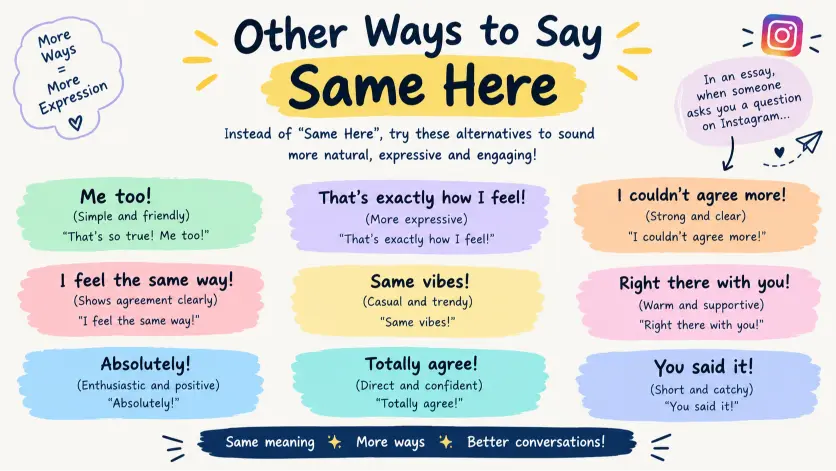
Have you ever found yourself saying “same here” again and again during a conversation? Although this expression is natural and widely understood, using different phrases can make your English sound more fluent, engaging, and expressive. For you are chatting with friends, responding to a colleague, or sharing your feelings online, choosing the right alternative helps you communicate your thoughts more naturally. Learning other ways to say “same here” also allows you to agree with someone without repeating the same words in every conversation.
In this guide, we explore 30+ alternatives to “same here,” complete with clear meanings, practical examples, and helpful usage tips. The expressions are organized to help English learners understand which phrases work best in casual conversations, professional communication, and everyday writing. Each alternative focuses on natural English usage, with attention to tone, context, and clarity. By learning these expressions and practicing them in realistic situations, you can expand your vocabulary, improve your conversational confidence, and express agreement more effectively. Whether you are an intermediate learner or an advanced English user, these examples will help you choose the right phrase for the right situation
Formal Alternatives to “Same Here”
When you need a more polished or respectful response, these alternatives work well:
- I feel the same way
- I agree
- Likewise
- I share that view
Pro Tips Box
Use “I agree” for opinions and “I feel the same way” for personal feelings. “Likewise” is concise and works especially well in professional conversations.
Casual Alternatives
For friendly conversations, these natural expressions are easy to use:
- Me too
- So do I
- Me as well
- I’m with you
Pro Tips Box
Use “Me too” when the other person’s statement describes a feeling or experience you share. It is one of the most common informal expressions in English.
Professional Alternatives
In workplace conversations, meetings, and professional correspondence, consider:
- I agree with you
- I share your perspective
- I have the same view
- I feel similarly
Pro Tips Box
For professional communication, choose a complete expression when precision matters. “I share your perspective” sounds more deliberate than a short conversational response.
Informal Expressions
These options are useful with friends, family, and people you know well:
- Me too
- Same
- So am I
- I feel that too
Pro Tips Box
Keep informal expressions for relaxed settings. A phrase such as “Same” can sound natural in a text message but may be too casual for a formal email.
“Fluent English is not only about knowing more words; it is about knowing which words fit the moment.”
Common Mistakes When Using “Same Here”
1. Using “same here” when the ideas are not actually shared
The phrase should communicate genuine agreement or a shared experience.
Incorrect:
“I love spicy food.”
“Same here.”
If you actually dislike spicy food, the response is inappropriate.
2. Using “same here” for every type of statement
“Same here” does not naturally replace every agreement structure.
Example:
“I completed the report yesterday.”
“Same here” can work conversationally, but “I completed mine yesterday too” may be clearer.
3. Using it in highly formal writing
“Same here” is generally conversational.
Example:
Instead of writing, “Same here, I agree with the proposal,” use “I agree with the proposal.”
4. Confusing “same here” with “I agree”
“Same here” usually means you share someone’s experience, feeling, or situation. “I agree” more directly expresses agreement with an opinion or argument.
Example:
“I think this strategy is effective.”
Better: “I agree.”
5. Using “same here” when a more specific response is needed
Sometimes repeating the relevant idea makes your meaning clearer.
Example:
“I’m available on Thursday.”
Instead of simply saying “Same here,” say “I’m available on Thursday too.”
What Does “Same Here” Mean?
“Same here” means “I am in the same situation,” “I feel the same way,” or “I have the same opinion.”
It is an elliptical conversational expression. The words that would normally complete the sentence are understood from context.
For example:
Person A: “I’m excited about the trip.”
Person B: “Same here.”
The complete idea is essentially: “I’m excited about the trip too.”
Grammar Note
“Same here” is an informal conversational response rather than a complete traditional sentence. Its meaning depends heavily on the statement immediately before it.
“Use context to decide whether your agreement should sound casual, neutral, or professional.”
When to Use “Same Here”
You can use “same here” in several everyday situations:
- When sharing a feeling
- When agreeing with a personal preference
- When describing the same experience
- When confirming a similar situation
- During friendly conversations
- In text messages and chats
- During informal workplace conversations
- When responding quickly to someone
Spoken vs. Written
Spoken English:
“I’m really tired today.”
“Same here.”
Informal written English:
“I’m looking forward to the weekend!”
“Same here!”
Professional writing:
“I agree with your assessment.”
This is generally more appropriate than “Same here.”
Formal vs. Informal
“Same here” is primarily informal to neutral conversational English. It is perfectly understandable but may sound too casual when writing formal reports, business proposals, academic assignments, or official correspondence.
Is It Professional or Polite to Say “Same Here”?
“Same here” is generally polite when used appropriately, but politeness and professionalism are not exactly the same thing.
In a friendly workplace conversation, saying “Same here” can sound natural. However, in a formal email or presentation, a more specific expression such as “I agree” or “I share your perspective” is usually clearer.
Business-style example:
“I believe improving customer communication should be our priority.”
“I agree. I think it would also improve client retention.”
Polite? ✔ Yes
Professional? ✔ In casual workplace conversation, but less suitable for formal writing
Pros and Cons of Using “Same Here”
Pros
- Simple and natural: Easy to understand and use.
- Friendly tone: Creates a sense of connection.
- Common usage: Frequently heard in everyday conversations.
- Easy to understand: Its meaning is usually clear from context.
Cons
- Too informal for some work situations: Formal communication may require more precise wording.
- Can become repetitive: Using it too frequently can make conversations sound limited.
- Limited emotional range: It does not explain exactly what you share.
- Not suitable for formal writing: A more specific phrase is often preferable.
“A short response is useful when the meaning is obvious; a specific response is better when precision matters.”
Other Ways to Say “Same Here” With Examples
These alternatives will help you sound more fluent, confident, and natural in different situations.
Use them according to tone, context, and audience to express excitement, admiration, agreement, or approval.
1. Phrase: Me Too
- Meaning: I have the same feeling, experience, or preference.
- Explanation: This is one of the most common alternatives in everyday English.
- Example Sentence: “I’m really excited about the weekend.” “Me too.”
- Best Use: Casual conversation
- Worst Use: Formal reports
- Tone: Friendly, natural, casual
- Context Variability: casual / professional chat / spoken
2. Phrase: I Feel the Same Way
- Meaning: I have the same emotional response or opinion.
- Explanation: It clearly communicates that your feelings match the other person’s.
- Example Sentence: “I’m disappointed with the result.” “I feel the same way.”
- Best Use: Shared feelings
- Worst Use: Formal data
- Tone: Empathetic, clear, sincere
- Context Variability: casual / professional / spoken
3. Phrase: Likewise
- Meaning: The same applies to me or my situation.
- Explanation: “Likewise” is concise and somewhat more polished than “same here.”
- Example Sentence: “It was great working with you.” “Likewise.”
- Best Use: Polite responses
- Worst Use: Detailed arguments
- Tone: Polished, concise, courteous
- Context Variability: casual / professional / spoken
4. Phrase: I Agree
- Meaning: I have the same opinion or accept your point.
- Explanation: This is a direct way to express agreement.
- Example Sentence: “I think we should review the proposal again.” “I agree.”
- Best Use: Opinions
- Worst Use: Shared feelings
- Tone: Direct, professional, clear
- Context Variability: casual / professional / spoken
5. Phrase: So Do I
- Meaning: I do the same thing or have the same response.
- Explanation: This structure agrees with statements using a main verb.
- Example Sentence: “I enjoy reading business books.” “So do I.”
- Best Use: Shared actions
- Worst Use: Wrong verb structures
- Tone: Natural, conversational, confident
- Context Variability: casual / professional / spoken
6. Phrase: Me As Well
- Meaning: I also share the same experience or feeling.
- Explanation: It is similar to “me too” but can sound slightly more polished.
- Example Sentence: “I’m interested in attending the workshop.” “Me as well.”
- Best Use: Neutral conversation
- Worst Use: Academic analysis
- Tone: Neutral, friendly, polished
- Context Variability: casual / professional chat / spoken
7. Phrase: I’m With You
- Meaning: I agree with you or support your point.
- Explanation: It often expresses agreement with an idea rather than merely sharing a feeling.
- Example Sentence: “I think we need a simpler approach.” “I’m with you.”
- Best Use: Shared opinions
- Worst Use: Formal reports
- Tone: Supportive, conversational, direct
- Context Variability: casual / professional discussion / spoken
8. Phrase: I Share Your View
- Meaning: I have the same opinion.
- Explanation: This is a professional alternative for expressing agreement.
- Example Sentence: “I believe communication should come first.” “I share your view.”
- Best Use: Workplace discussions
- Worst Use: Casual texting
- Tone: Professional, respectful, measured
- Context Variability: casual / professional / spoken
9. Phrase: I Have the Same View
- Meaning: My opinion is the same as yours.
- Explanation: It clearly communicates agreement with a viewpoint.
- Example Sentence: “I think customer feedback should guide the next update.” “I have the same view.”
- Best Use: Business discussions
- Worst Use: Emotional responses
- Tone: Formal, clear, objective
- Context Variability: casual / professional / written
10. Phrase: I Feel Similarly
- Meaning: I have a similar emotional response.
- Explanation: This works particularly well when discussing feelings or reactions.
- Example Sentence: “I’m concerned about the deadline.” “I feel similarly.”
- Best Use: Shared concerns
- Worst Use: Simple greetings
- Tone: Neutral, thoughtful, professional
- Context Variability: casual / professional / spoken
11. Phrase: I Think So Too
- Meaning: I have the same opinion.
- Explanation: It is a natural way to agree with someone’s statement or conclusion.
- Example Sentence: “This could be our best option.” “I think so too.”
- Best Use: Casual agreement
- Worst Use: Formal reports
- Tone: Natural, agreeable, conversational
- Context Variability: casual / professional chat / spoken
12. Phrase: I Agree With You
- Meaning: I have the same opinion as you.
- Explanation: It makes your agreement explicit.
- Example Sentence: “We need to improve the onboarding process.” “I agree with you.”
- Best Use: Professional discussion
- Worst Use: Emotional sharing
- Tone: Direct, respectful, professional
- Context Variability: casual / professional / spoken
13. Phrase: I’m in the Same Situation
- Meaning: My circumstances are similar to yours.
- Explanation: Use this when you share a practical situation rather than merely an opinion.
- Example Sentence: “I’m waiting for the client’s response too.” “I’m in the same situation.”
- Best Use: Shared circumstances
- Worst Use: Abstract opinions
- Tone: Clear, practical, neutral
- Context Variability: casual / professional / spoken
14. Phrase: I’m Experiencing the Same Thing
- Meaning: I am going through the same experience.
- Explanation: This is useful when two people are facing similar circumstances.
- Example Sentence: “The new software keeps freezing.” “I’m experiencing the same thing.”
- Best Use: Shared problems
- Worst Use: Formal conclusions
- Tone: Clear, empathetic, neutral
- Context Variability: casual / professional / spoken
15. Phrase: I Can Relate
- Meaning: I understand because I have experienced something similar.
- Explanation: It shows personal connection rather than simple agreement.
- Example Sentence: “I always get nervous before presentations.” “I can relate.”
- Best Use: Personal experiences
- Worst Use: Formal correspondence
- Tone: Empathetic, casual, friendly
- Context Variability: casual / professional chat / spoken
16. Phrase: I Know What You Mean
- Meaning: I understand and often share a similar experience.
- Explanation: This phrase focuses more on understanding than direct agreement.
- Example Sentence: “It’s difficult to stay focused after a long day.” “I know what you mean.”
- Best Use: Empathetic conversation
- Worst Use: Formal approval
- Tone: Warm, conversational, empathetic
- Context Variability: casual / professional chat / spoken
17. Phrase: I’m Experiencing That Too
- Meaning: I am having the same experience.
- Explanation: It directly confirms a shared situation.
- Example Sentence: “The website is loading slowly.” “I’m experiencing that too.”
- Best Use: Shared experiences
- Worst Use: Formal essays
- Tone: Clear, natural, neutral
- Context Variability: casual / professional / spoken
18. Phrase: I Have a Similar Experience
- Meaning: My experience is similar to yours.
- Explanation: It works well when the experiences are alike but not identical.
- Example Sentence: “I struggled with public speaking at first.” “I have a similar experience.”
- Best Use: Personal discussions
- Worst Use: Simple agreement
- Tone: Thoughtful, neutral, professional
- Context Variability: casual / professional / spoken
19. Phrase: I Share That Sentiment
- Meaning: I have the same feeling or attitude.
- Explanation: This polished phrase is useful when responding to an expressed sentiment.
- Example Sentence: “We should recognize the team’s effort.” “I share that sentiment.”
- Best Use: Professional communication
- Worst Use: Casual texting
- Tone: Formal, respectful, measured
- Context Variability: casual / professional / written
20. Phrase: I Feel the Same
- Meaning: I have the same emotional reaction.
- Explanation: It is a concise alternative when the context already makes the feeling clear.
- Example Sentence: “I’m really proud of what we accomplished.” “I feel the same.”
- Best Use: Emotional agreement
- Worst Use: Technical analysis
- Tone: Warm, sincere, natural
- Context Variability: casual / professional / spoken
21. Phrase: I’m of the Same Opinion
- Meaning: I hold the same opinion.
- Explanation: This is a more formal way to communicate agreement.
- Example Sentence: “I’m of the same opinion regarding the proposed changes.”
- Best Use: Formal discussion
- Worst Use: Friendly texting
- Tone: Formal, precise, professional
- Context Variability: casual / professional / written
22. Phrase: I Share Your Perspective
- Meaning: I see the situation in a similar way.
- Explanation: This is particularly useful in professional and collaborative environments.
- Example Sentence: “We should focus on long-term customer relationships.” “I share your perspective.”
- Best Use: Business communication
- Worst Use: Casual greetings
- Tone: Professional, thoughtful, diplomatic
- Context Variability: casual / professional / spoken
23. Phrase: I’m in Agreement
- Meaning: I agree with the stated point or proposal.
- Explanation: It is a formal expression commonly associated with professional communication.
- Example Sentence: “I’m in agreement with the proposed approach.”
- Best Use: Formal meetings
- Worst Use: Casual chat
- Tone: Formal, precise, professional
- Context Variability: casual / professional / written
24. Phrase: I Second That
- Meaning: I support or agree with what has just been said.
- Explanation: It is especially common when supporting a suggestion in a discussion.
- Example Sentence: “We should schedule another training session.” “I second that.”
- Best Use: Group discussions
- Worst Use: Formal reports
- Tone: Conversational, supportive, direct
- Context Variability: casual / professional meetings / spoken
25. Phrase: That’s True for Me Too
- Meaning: The statement also applies to me.
- Explanation: It is useful when confirming that a general observation describes your situation.
- Example Sentence: “Working remotely can be distracting.” “That’s true for me too.”
- Best Use: Shared experiences
- Worst Use: Formal writing
- Tone: Natural, conversational, clear
- Context Variability: casual / professional chat / spoken
26. Phrase: I’m Right There With You
- Meaning: I strongly identify with or agree with what you said.
- Explanation: This friendly expression emphasizes solidarity.
- Example Sentence: “I need a break after this busy week.” “I’m right there with you.”
- Best Use: Friendly agreement
- Worst Use: Formal emails
- Tone: Warm, supportive, informal
- Context Variability: casual / professional chat / spoken
27. Phrase: That Applies to Me Too
- Meaning: The same statement or condition is true for me.
- Explanation: It is especially useful when responding to a general statement.
- Example Sentence: “Everyone on the team needs more time.” “That applies to me too.”
- Best Use: Shared conditions
- Worst Use: Emotional greetings
- Tone: Clear, neutral, practical
- Context Variability: casual / professional / spoken
28. Phrase: I Feel Similarly About That
- Meaning: I have a similar emotional response or opinion.
- Explanation: It gives more detail than the short expression “same here.”
- Example Sentence: “I’m concerned about the proposed timeline.” “I feel similarly about that.”
- Best Use: Thoughtful discussion
- Worst Use: Quick texting
- Tone: Thoughtful, neutral, professional
- Context Variability: casual / professional / spoken
29. Phrase: I’m of the Same Mind
- Meaning: I think or feel the same way.
- Explanation: This is a polished expression of agreement that can sound somewhat formal.
- Example Sentence: “We should wait for more information.” “I’m of the same mind.”
- Best Use: Formal discussion
- Worst Use: Casual texting
- Tone: Formal, measured, articulate
- Context Variability: casual / professional / spoken
30. Phrase: That’s My Feeling Too
- Meaning: I have the same feeling or reaction.
- Explanation: It directly connects your emotional response to the other person’s statement.
- Example Sentence: “I’m optimistic about the new project.” “That’s my feeling too.”
- Best Use: Shared feelings
- Worst Use: Technical reports
- Tone: Warm, clear, conversational
- Context Variability: casual / professional / spoken
“The best alternative is not always the most formal one; it is the one that fits your audience and purpose.”
See Also
- See also: Other Ways to Say “Me Too” for additional expressions of agreement and shared feelings.
- See also: Professional English Phrases for Workplace Communication to improve clarity and confidence in business conversations.
How to Choose the Right Alternative
Choosing among different ways to say “same here” depends on what exactly you are agreeing with.
For Feelings
Use:
- I feel the same way
- I feel the same
- I feel similarly
- That’s my feeling too
For Opinions
Use:
- I agree
- I agree with you
- I share your view
- I share your perspective
For Experiences
Use:
- Me too
- I can relate
- I’m experiencing that too
- I’m in the same situation
For Professional Settings
Use:
- I agree with you
- I share your perspective
- I have the same view
- I share that sentiment
For Informal Conversations
Use:
- Me too
- So do I
- Me as well
- I’m with you
Mini Quiz: Test Your Understanding
1. Your colleague says, “I agree that we need more customer feedback.” What is the most professional response?
A. Same
B. I agree with you.
C. Me too, lol
D. Same here, buddy
Answer: B
2. Your friend says, “I’m exhausted after that long trip.” What sounds natural?
A. Me too.
B. I am in agreement with your exhaustion.
C. I share your formal position.
D. I am of the same opinion.
Answer: A
3. Someone says, “I’m really excited about the new project.” Which response clearly communicates the same feeling?
A. I feel the same way.
B. I reject that idea.
C. I have another perspective.
D. I disagree.
Answer: A
4. Which expression is most appropriate for a formal business discussion?
A. Same
B. Me too
C. I share your perspective.
D. Same here!
Answer: C
Comparison Table: Top Alternatives
| Phrase | Tone | Best Use |
| Me too | Casual | Everyday conversation |
| I feel the same way | Neutral | Shared feelings |
| Likewise | Polished | Polite responses |
| I agree | Professional | Opinions |
| So do I | Casual | Shared actions |
| I agree with you | Professional | Workplace discussions |
| I share your view | Formal | Business communication |
| I can relate | Friendly | Personal experiences |
| I share your perspective | Professional | Meetings and discussions |
| That applies to me too | Neutral | Shared situations |
FAQs
1. What is another way to say “same here”?
Common alternatives include “me too,” “I feel the same way,” “likewise,” “I agree,” and “so do I.” The best option depends on whether you are sharing a feeling, opinion, or experience.
2. Is “same here” formal or informal?
“Same here” is mainly conversational and informal to neutral. It is natural in everyday speech but may be too casual for formal reports, academic writing, and official business correspondence.
3. What is a professional way to say “same here”?
Professional alternatives include “I agree,” “I agree with you,” “I share your perspective,” “I share your view,” and “I have the same view.”
4. Can I use “same here” in an email?
You can use it in a casual email or message when the relationship and context are informal. For professional emails, a more specific phrase such as “I agree” or “I share your perspective” is usually clearer.
5. Is “me too” the same as “same here”?
They are often interchangeable when responding to feelings, preferences, or experiences. However, “me too” is generally more common in everyday conversation, while “same here” can emphasize that your situation or experience is also the same.
Conclusion
Learning different ways to say “same here” gives you more control over your English. Instead of relying on one repetitive response, you can choose “me too” for casual conversations, “I feel the same way” for shared feelings, or “I share your perspective” for professional discussions.
The most important skill is tone awareness. Practice replacing “same here” with different expressions in real conversations, messages, meetings, and writing. With regular practice, these alternatives will become natural parts of your English vocabulary and help you communicate with greater clarity and confidence.
.









