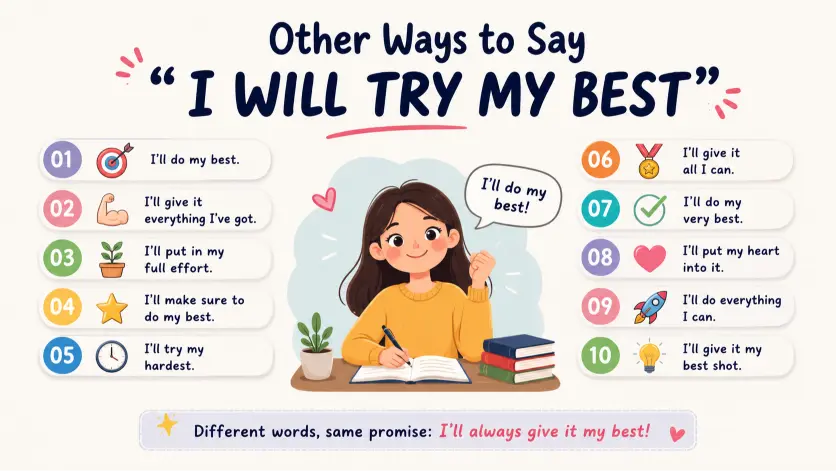
Have you ever written “I will try my best” in an essay and wondered if there is a more polished way to express the same idea? While this phrase is clear and grammatically correct, repeating it can make academic or professional writing sound less precise. Learning different alternatives can help you communicate determination, commitment, confidence, and willingness more effectively. Whether you are writing a school essay, university assignment, application, or professional document, choosing the right expression can make your English sound more natural and sophisticated.
In this guide, you will discover practical and context-appropriate alternatives to “I will try my best,” with examples showing how each phrase works in real English writing. The expressions are selected according to common usage, tone, formality, and suitability for academic and professional contexts. You will also learn when to use stronger phrases such as “I will do my utmost” or “I will make every effort,” and when a simpler option is more natural. By understanding these alternatives, you can express determination confidently while making your writing clearer, more professional, and engaging.
Quick Categories
Formal alternatives to “I will try my best”
- I will make every effort.
- I will do everything within my ability.
- I will make every reasonable effort.
- I will endeavor to achieve this.
Pro Tips Box: Use these expressions in formal emails, academic communication, official correspondence, and situations where you want to sound respectful and measured.
Casual alternatives
- I’ll do my best.
- I’ll give it a shot.
- I’ll give it my all.
- I’ll see what I can do.
Pro Tips Box: Use casual expressions with friends, classmates, coworkers you know well, and in relaxed conversations.
Professional alternatives
- I’ll make every effort to meet the deadline.
- I’ll do everything I can to resolve this.
- I’ll give this my full attention.
- I’ll work toward the best possible outcome.
Pro Tips Box: Professional English often sounds stronger when you describe a specific action instead of simply promising to “try.”
Informal expressions
- I’ll give it my best shot.
- I’ll give it everything I’ve got.
- I’ll put my best effort into it.
- I’ll see how far I can take it.
Pro Tips Box: These expressions are suitable for friendly conversations but may sound too relaxed for formal business writing.
“A stronger alternative does not always mean a more complicated phrase. It means a phrase that fits the context.”
Common Mistakes When Using “I Will Try My Best”
1. Using “try my best” when a stronger commitment is needed
“I will try my best” can sometimes sound uncertain.
Example:
“I will try my best to finish the report today.”
Better:
“I will make every effort to finish the report today.”
2. Using an overly casual expression in formal writing
Phrases such as “I’ll give it a shot” may sound too informal in a business email.
Example:
“I’ll give it a shot and send the proposal tomorrow.”
Better:
“I’ll make every effort to send the proposal tomorrow.”
3. Using “try my best” without explaining the action
A vague promise can be less effective than a specific commitment.
Example:
“I’ll try my best to solve the problem.”
Better:
“I’ll review the issue carefully and work toward a solution.”
4. Confusing “try my best” with guaranteed success
The phrase communicates effort, not certainty.
Example:
“I’ll try my best to guarantee the result.”
Better:
“I’ll do everything I can to achieve the desired result.”
5. Repeating the same expression too often
Using “I will try my best” repeatedly can make your communication sound repetitive.
Example:
“I’ll try my best with the presentation, and I’ll try my best to answer every question.”
Better:
“I’ll prepare thoroughly for the presentation and do everything I can to answer every question.”
What Does “I Will Try My Best” Mean?
“I will try my best” means I will make a sincere effort to accomplish something or help someone, even though success may not be guaranteed.
Grammatically, “will” is a modal auxiliary verb used here to express a future intention or commitment. “Try” functions as the main verb, while “my best” means the greatest effort the speaker can reasonably make.
Example:
“I will try my best to complete the assignment before Friday.”
The phrase is grammatically correct and widely understood in both spoken and written English.
When to Use “I Will Try My Best”
You can use this expression when:
- Someone asks you to complete a task.
- You want to reassure another person.
- You accept a challenge.
- You are uncertain about the final result.
- You want to communicate willingness to make an effort.
- You are speaking with friends, family, classmates, or coworkers.
- You want a simple and familiar expression.
Spoken vs Written English
Spoken:
“I’ll try my best to be there.”
Written:
“I will make every effort to attend the meeting.”
Formal vs Informal English
Formal:
“I will make every reasonable effort to complete the project on schedule.”
Informal:
“I’ll give it my best shot.”
For professional communication, specific expressions often communicate confidence more effectively than a general promise.
Is “I Will Try My Best” Professional or Polite?
“I will try my best” is polite and grammatically correct, but its professional impact depends on the situation. In workplace communication, “try” can sometimes suggest uncertainty when the listener expects a clear commitment.
Polite? ✔️ Yes
Professional? ✔️ Yes, but context dependent
Business Example
Instead of:
“I will try my best to finish the report by Friday.”
You could write:
“I will make every effort to complete the report by Friday.”
The second version sounds more deliberate and business focused without promising something that may be outside your control.
“In professional English, confidence comes from being specific about what you will do.”
Pros and Cons of Using “I Will Try My Best”
Pros
- Simple and natural: Easy for English learners and native speakers to understand.
- Friendly tone: Works well in everyday conversations.
- Common usage: Widely recognized in spoken English.
- Easy to understand: Communicates willingness without complicated vocabulary.
Cons
- Can sound uncertain: “Try” may imply that success is not certain.
- Can become overused: Repeating it may make communication sound repetitive.
- Limited emotional range: It does not clearly communicate enthusiasm, determination, or urgency.
- Less suitable for formal writing: Some professional situations benefit from more precise language.
Other Ways to Say “I Will Try My Best” With Examples
These alternatives will help you sound more fluent, confident, and natural in different situations.
Use them according to tone, context, and audience. They can help you communicate determination, reassurance, commitment, and even the appropriate level of enthusiasm.
1. Phrase: I’ll do my best
Meaning: I will make a sincere effort to succeed.
Explanation: This is the most natural everyday alternative to “I will try my best.”
Example Sentence: “I’ll do my best to finish everything before the meeting.”
Best Use: Everyday conversation
Worst Use: Formal guarantee
Tone: Natural, friendly, confident
Context Variability: Casual: “I’ll do my best.” Professional: “I’ll do my best to meet the deadline.” Spoken: Very common.
2. Phrase: I’ll make every effort
Meaning: I will make a serious and deliberate attempt.
Explanation: This expression sounds more formal and professional than “I’ll do my best.”
Example Sentence: “I’ll make every effort to resolve the issue today.”
Best Use: Business communication
Worst Use: Casual chat
Tone: Formal, serious, professional
Context Variability: Casual: Less common. Professional: Highly suitable. Spoken: Appropriate in formal discussions.
3. Phrase: I’ll do everything I can
Meaning: I will use every reasonable opportunity or resource available to me.
Explanation: It communicates strong willingness and commitment.
Example Sentence: “I’ll do everything I can to help you meet the deadline.”
Best Use: Strong commitment
Worst Use: Guaranteed outcome
Tone: Determined, supportive, sincere
Context Variability: Casual: “I’ll do everything I can.” Professional: “I’ll do everything I can to resolve this.” Spoken: Very natural.
4. Phrase: I’ll give it my all
Meaning: I will use all my effort and energy.
Explanation: This phrase emphasizes determination and enthusiasm.
Example Sentence: “I’ll give it my all during the presentation.”
Best Use: Motivational situations
Worst Use: Formal reports
Tone: Energetic, determined, enthusiastic
Context Variability: Casual: Very natural. Professional: Suitable in motivational settings. Spoken: Common.
5. Phrase: I’ll give it my best shot
Meaning: I will make a strong attempt.
Explanation: This is a natural informal expression for making an effort.
Example Sentence: “I’ve never done this before, but I’ll give it my best shot.”
Best Use: Friendly conversation
Worst Use: Formal email
Tone: Casual, optimistic, confident
Context Variability: Casual: Excellent. Professional: Limited. Spoken: Very natural.
6. Phrase: I’ll make a serious effort
Meaning: I will make a deliberate and sincere attempt.
Explanation: This phrase highlights commitment rather than simply expressing willingness.
Example Sentence: “I’ll make a serious effort to improve the report.”
Best Use: Serious commitments
Worst Use: Light conversation
Tone: Serious, sincere, determined
Context Variability: Casual: Acceptable. Professional: Strong choice. Spoken: Natural.
7. Phrase: I’ll put in my best effort
Meaning: I will work as hard as I reasonably can.
Explanation: It emphasizes the effort invested in completing a task.
Example Sentence: “I’ll put in my best effort to complete the project on time.”
Best Use: Work situations
Worst Use: Casual greetings
Tone: Professional, sincere, focused
Context Variability: Casual: Slightly formal. Professional: Excellent. Spoken: Appropriate.
8. Phrase: I’ll give it everything I’ve got
Meaning: I will use all my available energy and ability.
Explanation: This is an expressive way to communicate strong determination.
Example Sentence: “I’ll give it everything I’ve got in tomorrow’s competition.”
Best Use: Encouraging situations
Worst Use: Formal correspondence
Tone: Energetic, passionate, determined
Context Variability: Casual: Excellent. Professional: Context dependent. Spoken: Very natural.
9. Phrase: I’ll see what I can do
Meaning: I will investigate what is possible and make an effort.
Explanation: It is useful when you cannot promise a particular result.
Example Sentence: “I’ll see what I can do about moving the appointment.”
Best Use: Flexible requests
Worst Use: Firm commitments
Tone: Polite, flexible, cautious
Context Variability: Casual: Very common. Professional: Useful. Spoken: Extremely natural.
10. Phrase: I’ll work on it
Meaning: I will actively spend time addressing the task or problem.
Explanation: This expression focuses on action rather than the promise of success.
Example Sentence: “I’ll work on the proposal this afternoon.”
Best Use: Workplace tasks
Worst Use: Emotional reassurance
Tone: Direct, practical, professional
Context Variability: Casual: Natural. Professional: Excellent. Spoken: Common.
11. Phrase: I’ll work toward the best possible result
Meaning: I will actively aim for the strongest achievable outcome.
Explanation: This is useful when the final result depends on several factors.
Example Sentence: “I’ll work toward the best possible result for the team.”
Best Use: Professional goals
Worst Use: Casual requests
Tone: Professional, focused, measured
Context Variability: Casual: Formal sounding. Professional: Excellent. Spoken: Suitable.
12. Phrase: I’ll make every reasonable effort
Meaning: I will make all appropriate efforts within practical limits.
Explanation: This formal phrase avoids promising an outcome beyond your control.
Example Sentence: “I’ll make every reasonable effort to address your concerns.”
Best Use: Formal communication
Worst Use: Friendly chat
Tone: Formal, measured, responsible
Context Variability: Casual: Uncommon. Professional: Excellent. Spoken: Formal but natural.
13. Phrase: I’ll do everything within my ability
Meaning: I will use all the skills and resources available to me.
Explanation: It clearly communicates effort while recognizing personal limitations.
Example Sentence: “I’ll do everything within my ability to support the project.”
Best Use: Professional support
Worst Use: Casual banter
Tone: Formal, sincere, responsible
Context Variability: Casual: Formal. Professional: Strong. Spoken: Appropriate.
14. Phrase: I’ll make a strong effort
Meaning: I will make a serious attempt to accomplish something.
Explanation: This phrase emphasizes determination and commitment.
Example Sentence: “I’ll make a strong effort to improve our response time.”
Best Use: Workplace goals
Worst Use: Casual promises
Tone: Professional, determined, focused
Context Variability: Casual: Acceptable. Professional: Excellent. Spoken: Natural.
15. Phrase: I’ll put my best foot forward
Meaning: I will make a strong first or overall effort.
Explanation: This idiomatic expression is especially useful when making a good impression.
Example Sentence: “I’ll put my best foot forward during the interview.”
Best Use: First impressions
Worst Use: Technical tasks
Tone: Positive, confident, encouraging
Context Variability: Casual: Natural. Professional: Suitable. Spoken: Common.
16. Phrase: I’ll strive to achieve it
Meaning: I will make a determined effort to reach a goal.
Explanation: “Strive” is a more formal verb that emphasizes sustained effort.
Example Sentence: “I’ll strive to achieve the targets we discussed.”
Best Use: Professional goals
Worst Use: Casual conversation
Tone: Formal, ambitious, focused
Context Variability: Casual: Formal. Professional: Excellent. Spoken: Suitable in formal contexts.
17. Phrase: I’ll endeavor to do so
Meaning: I will make a serious attempt to accomplish it.
Explanation: “Endeavor” is a formal alternative that works particularly well in official communication.
Example Sentence: “I’ll endeavor to provide the requested information promptly.”
Best Use: Formal writing
Worst Use: Friendly chat
Tone: Formal, respectful, serious
Context Variability: Casual: Unnatural. Professional: Excellent. Spoken: Formal.
18. Phrase: I’ll make it a priority
Meaning: I will treat the task as especially important.
Explanation: This communicates commitment by emphasizing priority rather than effort alone.
Example Sentence: “I’ll make it a priority to respond by tomorrow.”
Best Use: Workplace commitments
Worst Use: Minor requests
Tone: Professional, confident, responsible
Context Variability: Casual: Suitable. Professional: Excellent. Spoken: Natural.
19. Phrase: I’ll take care of it
Meaning: I will handle the task or responsibility.
Explanation: This expression can sound more confident than saying you will simply try.
Example Sentence: “Leave the scheduling to me. I’ll take care of it.”
Best Use: Task ownership
Worst Use: Unclear authority
Tone: Confident, direct, reassuring
Context Variability: Casual: Very natural. Professional: Excellent when appropriate. Spoken: Common.
20. Phrase: I’ll work hard to achieve it
Meaning: I will put significant effort into reaching the goal.
Explanation: It directly emphasizes dedication and effort.
Example Sentence: “I’ll work hard to achieve the results we discussed.”
Best Use: Goal setting
Worst Use: Formal guarantees
Tone: Motivated, sincere, positive
Context Variability: Casual: Natural. Professional: Suitable. Spoken: Common.
21. Phrase: I’ll commit to doing my best
Meaning: I will deliberately dedicate myself to making a strong effort.
Explanation: This phrase adds a stronger sense of personal commitment.
Example Sentence: “I’ll commit to doing my best throughout the project.”
Best Use: Personal commitment
Worst Use: Quick requests
Tone: Sincere, determined, professional
Context Variability: Casual: Slightly formal. Professional: Excellent. Spoken: Natural.
22. Phrase: I’ll give this my full attention
Meaning: I will concentrate fully on the matter.
Explanation: This alternative works especially well when the task requires careful consideration.
Example Sentence: “I’ll give this my full attention and get back to you tomorrow.”
Best Use: Serious matters
Worst Use: Routine tasks
Tone: Professional, attentive, reassuring
Context Variability: Casual: Appropriate. Professional: Excellent. Spoken: Natural.
23. Phrase: I’ll make sure I do my part
Meaning: I will fulfill my responsibility.
Explanation: It is useful when success depends on contributions from multiple people.
Example Sentence: “Everyone has a role, and I’ll make sure I do my part.”
Best Use: Teamwork
Worst Use: Individual promises
Tone: Cooperative, responsible, positive
Context Variability: Casual: Natural. Professional: Excellent. Spoken: Common.
24. Phrase: I’ll put in the necessary effort
Meaning: I will provide the effort required to complete the task.
Explanation: This is a practical professional expression that avoids exaggerating your promise.
Example Sentence: “I’ll put in the necessary effort to meet the project requirements.”
Best Use: Work commitments
Worst Use: Friendly reassurance
Tone: Practical, formal, responsible
Context Variability: Casual: Formal. Professional: Excellent. Spoken: Appropriate.
25. Phrase: I’ll take every step I can
Meaning: I will use all reasonable actions available to me.
Explanation: It communicates determination without guaranteeing a specific outcome.
Example Sentence: “I’ll take every step I can to prevent this issue from happening again.”
Best Use: Problem solving
Worst Use: Guaranteed results
Tone: Determined, responsible, reassuring
Context Variability: Casual: Natural. Professional: Strong. Spoken: Common.
26. Phrase: I’ll work toward making it happen
Meaning: I will actively try to turn the desired outcome into reality.
Explanation: This phrase communicates optimism while avoiding an absolute promise.
Example Sentence: “I’ll work toward making it happen before the end of the month.”
Best Use: Future goals
Worst Use: Certain outcomes
Tone: Positive, motivated, optimistic
Context Variability: Casual: Natural. Professional: Suitable. Spoken: Common.
27. Phrase: I’ll give this my best effort
Meaning: I will use my strongest reasonable effort.
Explanation: It is a clear and flexible alternative for both personal and professional situations.
Example Sentence: “I’ll give this my best effort and keep you updated.”
Best Use: General commitment
Worst Use: Absolute promises
Tone: Sincere, professional, confident
Context Variability: Casual: Natural. Professional: Excellent. Spoken: Common.
28. Phrase: I’ll work diligently on it
Meaning: I will work carefully and consistently on the task.
Explanation: “Diligently” emphasizes careful and persistent work.
Example Sentence: “I’ll work diligently on the report and send you an updated version.”
Best Use: Professional writing
Worst Use: Casual conversation
Tone: Formal, focused, responsible
Context Variability: Casual: Formal. Professional: Excellent. Spoken: Appropriate.
29. Phrase: I’ll make a sincere effort
Meaning: I will genuinely attempt to accomplish something.
Explanation: This phrase emphasizes honesty and genuine intention.
Example Sentence: “I’ll make a sincere effort to understand your concerns.”
Best Use: Sensitive situations
Worst Use: Routine tasks
Tone: Sincere, respectful, thoughtful
Context Variability: Casual: Natural. Professional: Excellent. Spoken: Suitable.
30. Phrase: I’ll do whatever I reasonably can
Meaning: I will take reasonable action within my ability.
Explanation: This expression shows willingness while recognizing practical limitations.
Example Sentence: “I’ll do whatever I reasonably can to help resolve the situation.”
Best Use: Supportive situations
Worst Use: Guaranteed outcomes
Tone: Helpful, measured, sincere
Context Variability: Casual: Natural. Professional: Strong. Spoken: Very suitable.
“Choose language that matches your level of commitment. ‘I’ll see what I can do’ sounds cautious, while ‘I’ll make every effort’ sounds deliberate and professional.”
See Also
- See also: Other Ways to Say “Thank You for All You Do” for more natural appreciation phrases in everyday and professional English.
- See also: Professional English: Useful Phrases for Workplace Communication to build a stronger vocabulary for emails, meetings, and workplace conversations.
Mini Quiz: Test Your Understanding
1. Which phrase is most suitable for a formal business email?
A. I’ll give it a shot.
B. I’ll make every effort.
C. I’ll give it everything I’ve got.
D. I’ll see how it goes.
Answer: B
2. Which expression sounds most natural in a casual conversation?
A. I’ll endeavor to do so.
B. I’ll make every reasonable effort.
C. I’ll give it my best shot.
D. I’ll work diligently on it.
Answer: C
3. Your manager asks you to address a customer complaint. Which phrase communicates professional commitment?
A. I’ll take care of it.
B. Maybe I’ll try.
C. I’ll give it a shot.
D. I’ll see what happens.
Answer: A
4. Which phrase avoids guaranteeing a specific result?
A. I guarantee I’ll solve it.
B. I’ll definitely make it happen.
C. I’ll do whatever I reasonably can.
D. It will certainly be completed.
Answer: C
Comparison Table: Top Alternatives
| Phrase | Tone | Best Use |
| I’ll do my best | Friendly, natural | Everyday communication |
| I’ll make every effort | Formal, professional | Business writing |
| I’ll do everything I can | Determined, sincere | Support and commitments |
| I’ll give it my all | Energetic, confident | Challenges and goals |
| I’ll see what I can do | Polite, cautious | Flexible requests |
| I’ll take care of it | Direct, confident | Task ownership |
| I’ll make it a priority | Professional, responsible | Workplace commitments |
| I’ll give it my best shot | Casual, optimistic | Informal conversations |
| I’ll give this my full attention | Professional, attentive | Serious matters |
| I’ll make a sincere effort | Respectful, thoughtful | Sensitive situations |
FAQs
What is a professional way to say “I will try my best”?
“I will make every effort” is a strong professional alternative. You can also say, “I’ll do everything I can” or “I’ll give this my full attention.”
Is “I’ll do my best” better than “I’ll try my best”?
Both are correct and natural. “I’ll do my best” often sounds slightly more direct and confident in everyday English.
How can I say “I will try my best” in a formal email?
Use expressions such as “I will make every effort,” “I will make every reasonable effort,” or “I will endeavor to” depending on the level of formality.
What are informal alternatives to “I will try my best”?
Natural informal expressions include “I’ll give it my best shot,” “I’ll give it my all,” “I’ll give it everything I’ve got,” and “I’ll see what I can do.”
Does “I will try my best” guarantee success?
No. The phrase communicates willingness and effort rather than a guaranteed result. If the outcome depends on several factors, it is better to describe the action you will take.
Conclusion
Learning different ways to say “I will try my best” gives you greater control over tone, confidence, and context. Whether you are speaking with a friend, writing a professional email, responding to a request, or discussing an important goal, the right expression can make your English sound more natural and precise.
Do not simply memorize these alternatives. Practice using them in realistic sentences and conversations. Pay attention to whether the situation is formal, casual, professional, spoken, or written. With regular practice, these professional reaction phrases and everyday expressions will become a natural part of your English vocabulary.









