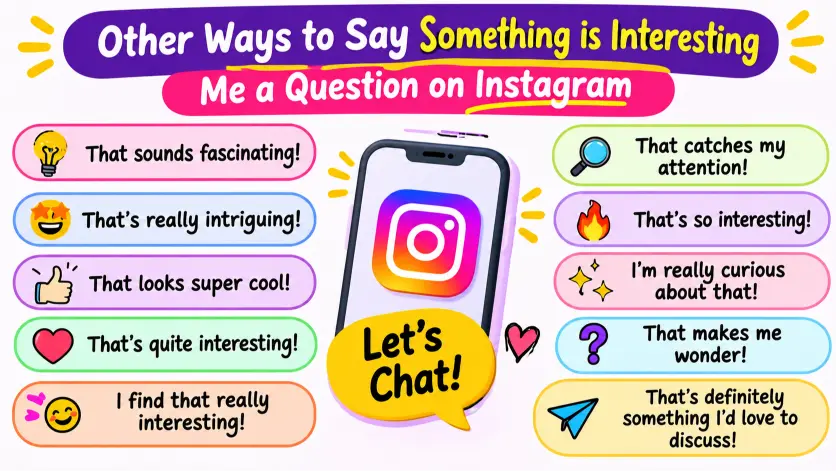
Have you ever found yourself saying “That’s interesting” again and again in conversations, emails, or essays? Although this phrase is useful, repeating it too often can make your English sound less expressive. Learning other ways to say something is interesting helps you communicate your thoughts more naturally, describe ideas with greater precision, and keep your audience engaged. For you are discussing a fascinating book, responding to an unexpected discovery, or sharing an opinion in a professional meeting, choosing the right expression can make a meaningful difference. From everyday phrases like “That’s fascinating” to more formal expressions such as “This is noteworthy,” there are plenty of alternatives to suit different situations.
In this guide, you will discover practical expressions for spoken English, academic writing, workplace communication, and casual conversations. Each alternative includes a clear explanation and a natural example sentence to help you understand how it works in context. These examples are designed to support vocabulary development, improve writing variety, and build confidence in expressing interest appropriately. By the end, you will have a useful collection of phrases to make your English clearer, more engaging, and more versatile
Quick Categories: Alternatives to “Something Is Interesting”
Formal alternatives to “Something Is Interesting”
- That is a fascinating subject.
- That is worthy of further investigation.
- That is a thought-provoking observation.
- That is an intellectually stimulating idea.
Pro Tips Box: Use formal expressions in academic discussions, research papers, presentations, and situations where you want to sound analytical rather than overly enthusiastic.
Casual alternatives
- That’s fascinating.
- That’s pretty cool.
- That’s really intriguing.
- That’s quite something.
Pro Tips Box: Choose short, natural expressions when talking with friends, classmates, or colleagues in relaxed conversations.
Professional alternatives
- That is an insightful observation.
- That is a compelling perspective.
- That is a valuable insight.
- That is an interesting development.
Pro Tips Box: In meetings and emails, explain briefly why an idea interests you. Specific feedback sounds more thoughtful than a general reaction.
Informal expressions
- That caught my attention.
- I hadn’t thought of it that way.
- That’s food for thought.
- Now that’s something to think about.
Pro Tips Box: Use informal expressions to show curiosity and encourage further discussion. Avoid overly casual wording in formal reports unless the context supports it.
“Fluent English is not just about knowing more words. It is about choosing the right words for the right moment.”
Common Mistakes When Expressing Interest
When learning other ways to say something is interesting, English learners sometimes choose expressions that do not match their intended meaning or the situation.
1. Repeating “very interesting” too often
Incorrect: “Your presentation was very interesting. The report was very interesting, too.”
Better: “Your presentation was fascinating, and the report offered valuable insights.”
2. Confusing “interesting” with “interested”
Incorrect: “I am very interesting in this topic.”
Correct: “I am very interested in this topic.”
Explanation: Interesting describes something that attracts attention, while interested describes how a person feels.
3. Using overly casual expressions in formal writing
Incorrect: “That research is pretty cool” in a formal academic report.
Better: “That research offers a compelling perspective.”
4. Using “fascinating” without considering the context
Incorrect: “The routine filing process was absolutely fascinating” when you simply mean it was useful.
Better: “The filing process was efficient and useful.”
5. Giving a vague response without explaining your reaction
Weak: “That’s interesting.”
Better: “That’s interesting because it challenges our current understanding of the problem.”
What Does “Something Is Interesting” Mean?
The expression “something is interesting” means that a person, object, idea, event, or situation attracts attention, creates curiosity, or encourages further thought.
The adjective interesting describes the quality of a subject that makes people want to learn more about it. Its meaning can range from mildly engaging to intellectually stimulating, depending on context and tone.
Grammar explanation:
The basic structure is:
Subject + linking verb + adjective
Examples:
- The documentary is interesting.
- Her explanation sounds interesting.
- The results were particularly interesting.
You can also use the phrase with a person as the subject when describing their qualities.
Example: “She is an interesting speaker because she explains complex ideas clearly.”
Remember that interesting describes what attracts attention, whereas interested describes the feeling of the person experiencing that attraction.
When to Use Alternatives to “Something Is Interesting”
Different situations call for different expressions. Choosing an appropriate phrase helps you communicate your reaction naturally and respectfully.
Common contexts
- Everyday conversations: React to an unusual story, a new hobby, or an unexpected discovery.
- Academic discussions: Describe research findings, theories, and complex arguments.
- Professional meetings: Respond to colleagues’ proposals and observations.
- Presentations: Highlight important findings or surprising developments.
- Writing: Describe books, articles, experiments, trends, and ideas.
- Social interactions: Show curiosity and encourage someone to continue talking.
Spoken vs. written English
| Context | Recommended expression |
| Casual conversation | That’s fascinating. |
| Workplace discussion | That’s a valuable insight. |
| Academic writing | This is a thought-provoking finding. |
| Business email | This is an interesting development. |
| Analytical report | This warrants further investigation. |
Formal vs. informal English
Formal language emphasizes precision, analysis, and professionalism. Informal language focuses on spontaneity, warmth, and conversational ease.
For example, you might tell a friend, “That’s pretty cool,” but say to a client, “That’s a compelling perspective.”
“A thoughtful reaction does more than acknowledge an idea. It invites the other person to keep sharing.”
Is It Professional or Polite to Say “Something Is Interesting”?
Yes. Saying something is interesting is generally polite and acceptable in professional communication. However, the phrase can sometimes sound vague, particularly when you are expected to provide meaningful feedback.
Polite? Yes.
Professional? Yes, in most situations, although more specific alternatives may be stronger.
Business-style example:
“That’s an interesting proposal. I particularly appreciate how it addresses our customers’ main concerns.”
This response acknowledges the proposal and provides a reason for your interest.
For more polished communication, consider expressions such as “That’s a valuable insight,” “I appreciate that perspective,” or “This warrants further discussion.”
Pros and Cons of Saying “Something Is Interesting”
Pros
- Simple and natural: Easy to use in everyday English.
- Friendly tone: Shows that you are listening.
- Common usage: Widely understood by native and non-native speakers.
- Easy to understand: Works across many conversational situations.
Cons
- Too informal for some work: It may lack precision in highly formal reports.
- Overused: Repetition can make your reactions sound predictable.
- Limited emotional range: It does not always communicate excitement, surprise, or admiration clearly.
- Not always suitable for formal writing: Academic and professional contexts may require more precise vocabulary.
Other Ways to Say Something Is Interesting (With Examples)
These alternatives will help you sound more fluent, confident, and natural in different situations.
Choose each expression according to your tone, context, and audience to communicate curiosity, admiration, or approval effectively.
30 Alternatives to “Something Is Interesting”
1. Phrase: That’s Fascinating
Meaning: Something is extremely interesting and captures your attention.
Explanation: Use this phrase when a subject makes you genuinely curious or eager to learn more.
Example Sentence: “Your explanation of how the brain processes memories is fascinating.”
Best Use: Engaging discussions
Worst Use: Routine acknowledgments
Tone: Enthusiastic, curious, positive
Context Variability:
- Casual: “That’s fascinating!”
- Professional: “Your findings are fascinating and deserve further discussion.”
- Spoken: “Really? That’s fascinating. Tell me more.”
2. Phrase: That’s Intriguing
Meaning: Something is interesting because it is unusual, mysterious, or thought-provoking.
Explanation: Use this expression when an idea raises questions or makes you want to investigate further.
Example Sentence: “That’s an intriguing theory about how consumer behavior changes.”
Best Use: Unusual ideas
Worst Use: Simple confirmations
Tone: Curious, analytical, thoughtful
Context Variability:
- Casual: “That’s intriguing. How did you discover it?”
- Professional: “That’s an intriguing possibility worth exploring.”
- Spoken: “That’s intriguing. I’d like to know more.”
3. Phrase: That’s Thought-Provoking
Meaning: Something encourages serious thought or reflection.
Explanation: This phrase is especially useful for ideas that challenge assumptions or introduce new perspectives.
Example Sentence: “Your article raises several thought-provoking questions about education.”
Best Use: Intellectual discussions
Worst Use: Trivial topics
Tone: Reflective, analytical, intellectual
Context Variability:
- Casual: “That movie was really thought-provoking.”
- Professional: “Your presentation offered a thought-provoking perspective.”
- Spoken: “That’s a thought-provoking point.”
4. Phrase: That’s Remarkable
Meaning: Something is unusual or impressive enough to deserve attention.
Explanation: Use this phrase when an achievement, discovery, or result stands out.
Example Sentence: “The team’s progress in such a short time is remarkable.”
Best Use: Impressive achievements
Worst Use: Ordinary details
Tone: Appreciative, impressed, positive
Context Variability:
- Casual: “That’s remarkable!”
- Professional: “The improvement in customer satisfaction is remarkable.”
- Spoken: “That’s a remarkable achievement.”
5. Phrase: I Find That Compelling
Meaning: Something is convincing, engaging, or persuasive.
Explanation: This expression communicates that an argument or idea holds your attention and has merit.
Example Sentence: “I find that compelling because it is supported by clear evidence.”
Best Use: Evidence-based discussions
Worst Use: Casual small talk
Tone: Analytical, professional, thoughtful
Context Variability:
- Casual: “I find that pretty compelling.”
- Professional: “I find that argument compelling given the available data.”
- Spoken: “That’s a compelling explanation.”
6. Phrase: That’s Engaging
Meaning: Something holds your attention and encourages involvement.
Explanation: Use this phrase for presentations, lessons, conversations, or content that keeps an audience interested.
Example Sentence: “Your presentation was engaging and easy to follow.”
Best Use: Presentations and lessons
Worst Use: Uninspiring content
Tone: Positive, attentive, appreciative
Context Variability:
- Casual: “That video is really engaging.”
- Professional: “The training session was engaging and informative.”
- Spoken: “That’s an engaging way to explain it.”
7. Phrase: That’s Captivating
Meaning: Something attracts and holds your attention strongly.
Explanation: This expression works particularly well for stories, performances, visuals, and compelling speakers.
Example Sentence: “The documentary offers a captivating look at marine life.”
Best Use: Stories and performances
Worst Use: Routine paperwork
Tone: Enthusiastic, admiring, expressive
Context Variability:
- Casual: “That story is captivating.”
- Professional: “The speaker delivered a captivating presentation.”
- Spoken: “I found the story captivating.”
8. Phrase: That’s Eye-Opening
Meaning: Something reveals information that changes or broadens your understanding.
Explanation: Use it when a discovery or experience teaches you something unexpected.
Example Sentence: “The customer survey was eye-opening because it revealed several overlooked problems.”
Best Use: New discoveries
Worst Use: Familiar information
Tone: Surprised, insightful, reflective
Context Variability:
- Casual: “That was an eye-opening experience.”
- Professional: “The findings were eye-opening for our entire team.”
- Spoken: “That’s really eye-opening.”
9. Phrase: That’s Enlightening
Meaning: Something provides useful knowledge or improves your understanding.
Explanation: This expression emphasizes learning rather than simple entertainment.
Example Sentence: “Your explanation of the legal process was enlightening.”
Best Use: Learning experiences
Worst Use: Uninformative exchanges
Tone: Educational, appreciative, thoughtful
Context Variability:
- Casual: “That conversation was enlightening.”
- Professional: “The workshop provided an enlightening overview of the issue.”
- Spoken: “That’s an enlightening explanation.”
10. Phrase: That’s Informative
Meaning: Something provides useful facts or knowledge.
Explanation: Use this phrase when the main value of a discussion or resource is the information it offers.
Example Sentence: “The report was informative and helped us understand the market.”
Best Use: Educational content
Worst Use: Pure entertainment
Tone: Neutral, professional, factual
Context Variability:
- Casual: “That video was informative.”
- Professional: “Thank you for the informative presentation.”
- Spoken: “That’s very informative.”
11. Phrase: That’s Intriguing to Consider
Meaning: An idea is worth thinking about because it raises interesting possibilities.
Explanation: This phrase helps you acknowledge an idea without immediately agreeing with it.
Example Sentence: “That’s intriguing to consider, especially given the recent changes in the industry.”
Best Use: Exploratory discussions
Worst Use: Urgent decisions
Tone: Curious, measured, reflective
Context Variability:
- Casual: “That’s intriguing to think about.”
- Professional: “That’s intriguing to consider in our long-term planning.”
- Spoken: “It’s intriguing to consider that possibility.”
12. Phrase: That’s a Fresh Perspective
Meaning: Something presents an idea in a new or different way.
Explanation: Use this expression to appreciate a viewpoint that differs from familiar approaches.
Example Sentence: “Your proposal offers a fresh perspective on employee development.”
Best Use: Brainstorming sessions
Worst Use: Repeated arguments
Tone: Appreciative, open-minded, constructive
Context Variability:
- Casual: “That’s a fresh perspective.”
- Professional: “Your analysis brings a fresh perspective to the discussion.”
- Spoken: “I hadn’t considered that fresh perspective before.”
13. Phrase: That’s a Valuable Insight
Meaning: Something provides useful understanding that can inform a decision or action.
Explanation: This phrase is especially effective when responding to an observation that helps solve a problem.
Example Sentence: “Your feedback offers a valuable insight into our customers’ expectations.”
Best Use: Business discussions
Worst Use: Empty compliments
Tone: Professional, appreciative, constructive
Context Variability:
- Casual: “That’s a valuable insight.”
- Professional: “That’s a valuable insight for our upcoming strategy.”
- Spoken: “I appreciate that valuable insight.”
14. Phrase: That’s a Compelling Idea
Meaning: An idea is persuasive, attractive, or worthy of serious consideration.
Explanation: Use this expression when a suggestion has a strong rationale or potential benefits.
Example Sentence: “Expanding the service to smaller markets is a compelling idea.”
Best Use: Proposal reviews
Worst Use: Unsupported claims
Tone: Persuasive, positive, analytical
Context Variability:
- Casual: “That’s a compelling idea.”
- Professional: “I believe this is a compelling idea worth evaluating.”
- Spoken: “That’s a compelling idea. Let’s explore it.”
15. Phrase: That’s Worth Exploring
Meaning: Something deserves additional investigation or discussion.
Explanation: This phrase expresses interest while leaving room for further analysis.
Example Sentence: “Your suggestion about flexible scheduling is worth exploring.”
Best Use: Planning discussions
Worst Use: Settled matters
Tone: Practical, constructive, professional
Context Variability:
- Casual: “That’s definitely worth exploring.”
- Professional: “This opportunity is worth exploring in greater detail.”
- Spoken: “That’s worth exploring. What would it involve?”
16. Phrase: That’s Unexpected
Meaning: Something differs from what you anticipated.
Explanation: Use this expression to communicate surprise, particularly when new information challenges your expectations.
Example Sentence: “It’s unexpected that sales increased during such a quiet period.”
Best Use: Surprising results
Worst Use: Predictable events
Tone: Surprised, neutral, observant
Context Variability:
- Casual: “That’s unexpected!”
- Professional: “The outcome was unexpected but informative.”
- Spoken: “That’s unexpected. What might explain it?”
17. Phrase: That’s Impressive
Meaning: Something deserves admiration because of its quality, scale, or achievement.
Explanation: This phrase is ideal when the interesting aspect of something is its excellence or difficulty.
Example Sentence: “Your ability to explain such complex concepts is impressive.”
Best Use: Notable achievements
Worst Use: Ordinary details
Tone: Appreciative, admiring, positive
Context Variability:
- Casual: “That’s impressive!”
- Professional: “The results are impressive, particularly given the limited resources.”
- Spoken: “That’s genuinely impressive.”
18. Phrase: That’s Unusual
Meaning: Something differs from what is normal, expected, or commonly observed.
Explanation: Use this phrase when a situation catches your attention because it is uncommon, without necessarily judging it positively or negatively.
Example Sentence: “It’s unusual to see such a dramatic shift in customer preferences.”
Best Use: Uncommon situations
Worst Use: Sensitive criticism
Tone: Observational, neutral, curious
Context Variability:
- Casual: “That’s unusual.”
- Professional: “This is an unusual pattern that merits review.”
- Spoken: “That’s unusual. Have you seen it before?”
19. Phrase: That’s Extraordinary
Meaning: Something is far beyond what is ordinary or expected.
Explanation: This expression communicates strong surprise or admiration for an exceptional event or achievement.
Example Sentence: “The researchers made extraordinary progress in understanding the disease.”
Best Use: Exceptional achievements
Worst Use: Minor improvements
Tone: Enthusiastic, emphatic, admiring
Context Variability:
- Casual: “That’s extraordinary!”
- Professional: “The project has achieved extraordinary results.”
- Spoken: “That’s an extraordinary discovery.”
20. Phrase: That’s Stimulating
Meaning: Something encourages mental activity, discussion, or creative thinking.
Explanation: Use this phrase to describe experiences that challenge your thinking or inspire new ideas.
Example Sentence: “The seminar offered a stimulating discussion about emerging technologies.”
Best Use: Intellectual activities
Worst Use: Routine updates
Tone: Intellectual, energetic, thoughtful
Context Variability:
- Casual: “That was a stimulating conversation.”
- Professional: “The workshop provided a stimulating environment for collaboration.”
- Spoken: “That’s a stimulating question.”
21. Phrase: That’s Worth Noting
Meaning: Something is sufficiently important or unusual to deserve attention.
Explanation: This expression is useful when highlighting a detail without overstating its significance.
Example Sentence: “It’s worth noting that customer retention improved despite the price increase.”
Best Use: Reports and analysis
Worst Use: Trivial details
Tone: Analytical, measured, professional
Context Variability:
- Casual: “That’s worth noting.”
- Professional: “It’s worth noting that the results varied across regions.”
- Spoken: “That’s an important detail worth noting.”
22. Phrase: That’s Food for Thought
Meaning: Something provides an idea that deserves further reflection.
Explanation: Use this idiomatic expression when a statement or experience gives you something meaningful to think about.
Example Sentence: “Your comments about work-life balance are food for thought.”
Best Use: Reflective conversations
Worst Use: Urgent instructions
Tone: Reflective, conversational, thoughtful
Context Variability:
- Casual: “That’s food for thought.”
- Professional: “Your observations provide useful food for thought as we review the proposal.”
- Spoken: “That’s certainly food for thought.”
23. Phrase: That Caught My Attention
Meaning: Something made you notice it or become curious about it.
Explanation: This expression emphasizes the moment when a detail, statement, or event became noticeable.
Example Sentence: “The unusual trend in the survey caught my attention.”
Best Use: Notable details
Worst Use: Unnoticed information
Tone: Observant, curious, natural
Context Variability:
- Casual: “That really caught my attention.”
- Professional: “One finding that caught my attention was the increase in repeat purchases.”
- Spoken: “That caught my attention. Can you explain it?”
24. Phrase: I Hadn’t Thought of It That Way
Meaning: Something presents a perspective you had not previously considered.
Explanation: This phrase acknowledges another person’s contribution and shows openness to reconsidering your own thinking.
Example Sentence: “I hadn’t thought of it that way, but your explanation makes sense.”
Best Use: Collaborative discussions
Worst Use: Dismissive debates
Tone: Open-minded, reflective, respectful
Context Variability:
- Casual: “I hadn’t thought of it that way!”
- Professional: “I hadn’t considered that perspective, and it adds useful context.”
- Spoken: “That’s a good point. I hadn’t thought of it that way.”
25. Phrase: That’s a Curious Development
Meaning: Something has happened that raises questions or invites investigation.
Explanation: This expression works when an event is noteworthy but its explanation is not yet clear.
Example Sentence: “The sudden change in demand is a curious development.”
Best Use: Emerging trends
Worst Use: Routine updates
Tone: Analytical, measured, inquisitive
Context Variability:
- Casual: “That’s a curious development.”
- Professional: “This is a curious development that warrants closer examination.”
- Spoken: “That’s a curious development. What do you think caused it?”
26. Phrase: That’s Quite Something
Meaning: Something is noteworthy, surprising, or impressive.
Explanation: This flexible conversational expression communicates a reaction whose exact meaning depends on your tone and context.
Example Sentence: “Completing the entire project in two days is quite something.”
Best Use: Casual reactions
Worst Use: Formal reports
Tone: Conversational, impressed, expressive
Context Variability:
- Casual: “That’s quite something!”
- Professional: “Finishing ahead of schedule is quite an achievement.”
- Spoken: “That’s quite something, isn’t it?”
27. Phrase: That’s Pretty Cool
Meaning: Something is appealing, enjoyable, or interesting in a relaxed conversational sense.
Explanation: Use this informal expression when reacting positively to an idea, discovery, or experience.
Example Sentence: “You built your own website? That’s pretty cool.”
Best Use: Friendly conversations
Worst Use: Formal correspondence
Tone: Relaxed, friendly, enthusiastic
Context Variability:
- Casual: “That’s pretty cool!”
- Professional: “That’s an innovative approach.”
- Spoken: “That’s pretty cool. How did you do it?”
28. Phrase: I’m Curious to Learn More
Meaning: You want additional information about a subject.
Explanation: This phrase expresses genuine interest and encourages the other person to elaborate.
Example Sentence: “I’m curious to learn more about how your team implemented the new system.”
Best Use: Follow-up questions
Worst Use: Disinterested exchanges
Tone: Curious, polite, engaged
Context Variability:
- Casual: “I’m curious to learn more about that.”
- Professional: “I’m curious to learn more about the proposed implementation.”
- Spoken: “That sounds interesting. I’m curious to learn more.”
29. Phrase: That’s a New One to Me
Meaning: Something is unfamiliar or new to your experience.
Explanation: Use this informal expression when encountering an idea, fact, or situation you have not come across before.
Example Sentence: “I’ve heard of several productivity methods, but that one is a new one to me.”
Best Use: Informal discovery
Worst Use: Formal presentations
Tone: Casual, curious, conversational
Context Variability:
- Casual: “That’s a new one to me!”
- Professional: “That’s an approach I’m not familiar with yet.”
- Spoken: “That’s a new one to me. How does it work?”
30. Phrase: That Opens Up Interesting Possibilities
Meaning: Something creates opportunities for new ideas, approaches, or outcomes.
Explanation: This expression is useful when an observation or proposal suggests several potential directions for future work.
Example Sentence: “Your suggestion opens up interesting possibilities for improving our customer service.”
Best Use: Future planning
Worst Use: Final decisions
Tone: Optimistic, analytical, forward-looking
Context Variability:
- Casual: “That opens up some interesting possibilities.”
- Professional: “This approach opens up interesting possibilities for future collaboration.”
- Spoken: “That’s exciting because it opens up interesting possibilities.”
“The strongest alternative is not always the most sophisticated word. It is the phrase that expresses exactly what you mean.”
Comparison Table: Top 10 Alternatives
| Phrase | Tone | Best Use |
| That’s fascinating | Enthusiastic | General conversations |
| That’s intriguing | Curious | Unusual ideas |
| That’s thought-provoking | Reflective | Academic discussions |
| That’s remarkable | Admiring | Achievements |
| I find that compelling | Analytical | Business arguments |
| That’s eye-opening | Surprised | New discoveries |
| That’s a valuable insight | Professional | Meetings |
| That’s worth exploring | Constructive | Planning |
| That’s food for thought | Reflective | Discussions |
| That caught my attention | Natural | Notable details |
Mini Quiz: Test Your English
Choose the most appropriate expression for each situation.
Check your understanding
0 of 4 answered
1. Your colleague shares a useful observation about customer behavior. What is the best response?
That’s pretty cool.
That’s a valuable insight.
That’s quite something.
2. A documentary teaches you something that changes your understanding of history. Which phrase fits best?
That’s eye-opening.
That’s a new one to me.
That’s pretty cool.
3. You hear an idea that deserves further investigation but are not ready to agree with it. What should you say?
That’s extraordinary.
That’s worth exploring.
That’s captivating.
4. A friend tells you an unfamiliar fact during a relaxed conversation. Which response is natural?
This warrants further investigation.
That’s a new one to me.
That is worthy of further analysis.
FAQs
1. What is another way to say something is interesting?
You can say “That’s fascinating,” “That’s intriguing,” “That’s thought-provoking,” or “That’s compelling.” The best choice depends on whether you want to communicate curiosity, admiration, or intellectual engagement.
2. What are formal alternatives to “something is interesting”?
Formal alternatives include “This is worthy of further investigation,” “This presents a compelling perspective,” and “This is a thought-provoking observation.” These expressions are useful in academic writing and professional discussions.
3. How can I say something is interesting in a professional email?
Try “I find this proposal compelling,” “This is a valuable insight,” or “This is an interesting development.” Adding a brief explanation of why the subject matters makes your response more professional.
4. How can I express strong interest without repeating “very interesting”?
Use descriptive phrases such as “absolutely fascinating,” “particularly thought-provoking,” “remarkably insightful,” or “captivating.” Choose the expression that accurately reflects your reaction instead of relying on intensifiers alone.
5. What are informal expressions in English for showing interest?
Natural informal expressions include “That’s pretty cool,” “That’s a new one to me,” “I hadn’t thought of it that way,” and “That’s food for thought.” Use them in relaxed conversations with friends or familiar colleagues.
See Also
- Other Ways to Say: Explore our guide to other ways to say “That’s a Good Point” for more natural responses in conversations.
- Professional English Guide: Read our guide to professional English expressions to improve your workplace vocabulary and business communication.
Conclusion
Learning other ways to say something is interesting helps you communicate with greater precision, confidence, and variety. Whether you choose “That’s fascinating” for an exciting discovery, “That’s thought-provoking” for an intellectual discussion, or “That’s a valuable insight” for a workplace conversation, the right expression makes your response more meaningful.
Practice using two or three new expressions each day in conversations, emails, and writing exercises. Pay attention to your audience, the situation, and the emotion you want to communicate. With consistent practice, you will develop a richer vocabulary and sound more natural in both everyday English and professional communication.









