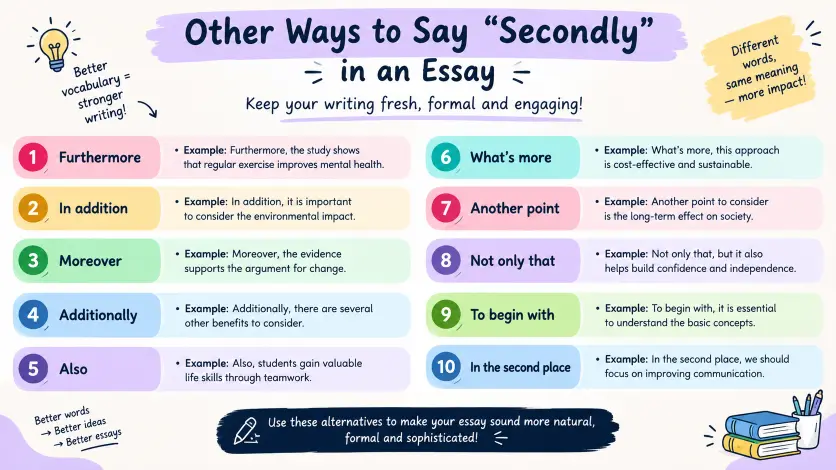
Choosing the right transition words can make the difference between an average essay and a polished, professional piece of writing. While “secondly” is grammatically correct and widely understood, using the same transition repeatedly can make your writing sound predictable or less engaging. Fortunately, there are many natural and formal alternatives to “secondly” that can help you introduce your next point smoothly and strengthen the flow of your argument.
In this guide, you’ll discover practical alternatives to secondly that work well in academic essays, assignments, reports, and formal writing. Each option is explained with clear examples so you can understand when and how to use it correctly. Whether you are a student preparing for an exam, an English learner improving academic writing, or a professional creating a structured document, these alternatives can help you express ideas more confidently. From “next” and “another important point” to more formal transitions such as “furthermore” and “in addition,” you’ll learn which expressions fit different contexts and levels of formality
Formal Alternatives to “Other Ways to Say Secondly in an Essay”
Formal academic writing benefits from precise transitions. These expressions work particularly well in essays, research papers, reports, and formal discussions.
- Second
- Furthermore
- Moreover
- In addition
Pro Tips Box
For academic essays, “second,” “furthermore,” and “in addition” are usually more natural than forcing “secondly” into every paragraph. Select the transition according to the logical relationship between ideas.
Casual Alternatives
When writing less formal content, you can use simpler transitions that sound natural and direct.
- Next
- Another point is
- Another thing to consider is
- Then
Pro Tips Box
Use simple transitions when the writing does not require a highly formal academic tone. “Next” is particularly useful when presenting ideas in a clear sequence.
Professional Alternatives
Professional communication often requires transitions that are organized without sounding overly academic.
- Another important consideration is
- A further point is
- Additionally
- The second point to consider is
Pro Tips Box
In reports, presentations, and workplace writing, choose transitions that clearly show how the next point relates to the previous one.
Informal Expressions
Informal expressions in English can be useful when explaining ideas conversationally or writing for a general audience.
- Another thing is
- Next, we should consider
- There is also
- On another note
Pro Tips Box
Avoid highly conversational expressions in formal academic essays unless the assignment specifically allows an informal style.
“Do not replace ‘secondly’ just for variety. Replace it when the new phrase communicates the relationship between your ideas more accurately.”
Common Mistakes When Using “Other Ways to Say Secondly in an Essay”
1. Using “secondly” without a first point
Incorrect:
Secondly, education improves career opportunities.
If there was no clearly stated first point, “secondly” may confuse the reader.
Better:
First, education improves personal development. Secondly, it improves career opportunities.
2. Using “secondly” for an unrelated idea
“Secondly” suggests sequence. It should normally introduce another point connected to the argument.
Example:
Firstly, exercise improves physical health. Secondly, it can support mental well-being.
3. Overusing “secondly”
Repeating the same transition in every paragraph can make an essay sound formulaic.
Example:
Firstly, technology is useful. Secondly, technology saves time. Secondly, technology improves communication.
Use different appropriate transitions instead.
4. Confusing “second” and “secondly”
“Second” can work naturally as an ordering transition.
Example:
First, the policy reduces costs. Second, it improves efficiency.
5. Using “moreover” as a direct replacement every time
“Moreover” generally adds supporting information rather than simply announcing the second item in a sequence.
Example:
The proposal is affordable. Moreover, it can be implemented quickly.
What Does “Other Ways to Say Secondly in an Essay” Mean?
The phrase “secondly” is an ordinal transition used to introduce the second point, argument, reason, or item in an organized sequence.
In an essay, it commonly follows “firstly” or “first” and signals that the writer is moving to another supporting idea.
Example:
First, public transport reduces traffic. Secondly, it can lower transportation costs.
Grammar Note
“Secondly” is an adverb and is commonly placed at the beginning of a sentence, usually followed by a comma.
Secondly, the proposal could reduce operating costs.
However, “second” is often more concise and natural in modern academic writing:
Second, the proposal could reduce operating costs.
“Effective transitions guide your reader; they should never distract your reader.”
When to Use “Other Ways to Say Secondly in an Essay”
Use a second-point transition when you want to:
- Introduce your second supporting argument
- Add another reason
- Continue a numbered sequence
- Develop a comparison
- Present another benefit
- Move from one supporting idea to another
- Organize an academic argument
- Structure a professional report
Spoken vs. Written
Written: “Furthermore,” “In addition,” and “Second” work well in essays and reports.
Spoken: “Next,” “Another point is,” and “Another thing to consider is” can sound more natural.
Formal vs. Informal
Formal: Furthermore, moreover, additionally, another important consideration is
Neutral: Second, next, in addition, another point is
Informal: Another thing is, then, there is also
Is It Professional or Polite to Say “Secondly”?
Polite? ✔️ Yes
Professional? ✔️ Yes, when used appropriately
Academic? ✔️ Yes
Natural? ✔️ Yes, although “second” can often sound more concise
Business Example
First, the proposed strategy could reduce expenses. Secondly, it could improve customer satisfaction.
For professional writing, alternatives such as “another important consideration is” or “in addition” may provide greater variety.
Pros and Cons of Using “Secondly”
Pros
- Simple and natural: Most readers understand it immediately.
- Friendly tone: It creates a straightforward progression of ideas.
- Common usage: It is familiar in essays and presentations.
- Easy to understand: It clearly signals the next point.
Cons
- Can become repetitive: Repeated use may make an essay sound formulaic.
- May sound mechanical: Frequent numbered transitions can reduce stylistic variety.
- Limited function: It primarily signals sequence rather than a specific logical relationship.
- Not always the best transition: Words such as “moreover” or “in addition” may better express an additive relationship.
Other Ways to Say “Other Ways to Say Secondly in an Essay” With Examples
These other ways to say secondly in an essay will help you sound more fluent, confident, and natural in different situations.
Use them according to tone, context, and audience. Some emphasize sequence, while others introduce additional evidence, arguments, or considerations.
1. Phrase: Second
Meaning: Introduces the second point in a sequence.
Explanation: “Second” is a concise alternative to “secondly” and is widely used in academic writing.
Example Sentence: Second, renewable energy can reduce dependence on fossil fuels.
Best Use: Academic essays
Worst Use: Casual storytelling
Tone: Clear, formal, direct
Context Variability: Casual: second; Professional: second; Spoken: second
2. Phrase: Next
Meaning: Introduces the idea that follows.
Explanation: “Next” is simple and works especially well when ideas follow a clear sequence.
Example Sentence: Next, we should consider the financial impact of the proposal.
Best Use: Presentations
Worst Use: Formal research
Tone: Simple, neutral, organized
Context Variability: Casual: next; Professional: next; Spoken: next
3. Phrase: Furthermore
Meaning: Adds another supporting point or piece of information.
Explanation: “Furthermore” emphasizes that the following idea strengthens the previous one.
Example Sentence: Furthermore, the study found significant improvements in productivity.
Best Use: Academic writing
Worst Use: Casual conversation
Tone: Formal, academic, authoritative
Context Variability: Casual: uncommon; Professional: furthermore; Spoken: formal speech
4. Phrase: Moreover
Meaning: Adds important supporting information.
Explanation: “Moreover” introduces an additional point that reinforces the preceding argument.
Example Sentence: Moreover, the proposed solution requires fewer resources.
Best Use: Formal essays
Worst Use: Casual messages
Tone: Formal, polished, persuasive
Context Variability: Casual: uncommon; Professional: moreover; Spoken: formal presentations
5. Phrase: In Addition
Meaning: Adds another relevant idea.
Explanation: “In addition” is a flexible transition for connecting supporting information.
Example Sentence: In addition, the program provides valuable training opportunities.
Best Use: Reports and essays
Worst Use: Very casual chat
Tone: Neutral, professional, clear
Context Variability: Casual: possible; Professional: excellent; Spoken: natural
6. Phrase: Additionally
Meaning: Introduces extra information.
Explanation: “Additionally” provides a concise way to add another point.
Example Sentence: Additionally, the revised system offers improved security.
Best Use: Professional writing
Worst Use: Casual conversation
Tone: Professional, concise, formal
Context Variability: Casual: less common; Professional: excellent; Spoken: possible
7. Phrase: Another Point Is
Meaning: Introduces another argument or idea.
Explanation: This phrase clearly signals that another supporting point is being presented.
Example Sentence: Another point is that the policy could benefit smaller businesses.
Best Use: General essays
Worst Use: Highly formal research
Tone: Clear, neutral, conversational
Context Variability: Casual: natural; Professional: suitable; Spoken: natural
8. Phrase: Another Important Point Is
Meaning: Introduces another significant idea.
Explanation: It emphasizes that the next point deserves particular attention.
Example Sentence: Another important point is the effect of rising costs on consumers.
Best Use: Argumentative essays
Worst Use: Short bullet lists
Tone: Professional, clear, emphatic
Context Variability: Casual: suitable; Professional: excellent; Spoken: natural
9. Phrase: Another Consideration Is
Meaning: Introduces another factor that should be considered.
Explanation: This transition is especially useful when discussing multiple factors in an argument.
Example Sentence: Another consideration is the long-term environmental impact.
Best Use: Analytical writing
Worst Use: Personal messages
Tone: Analytical, professional, thoughtful
Context Variability: Casual: possible; Professional: excellent; Spoken: natural
10. Phrase: Another Important Consideration Is
Meaning: Introduces another significant factor.
Explanation: It works well when developing a detailed analysis.
Example Sentence: Another important consideration is whether the plan is financially sustainable.
Best Use: Professional reports
Worst Use: Casual chat
Tone: Formal, analytical, precise
Context Variability: Casual: uncommon; Professional: excellent; Spoken: formal
11. Phrase: A Further Point Is
Meaning: Introduces another relevant argument.
Explanation: “A further point is” provides a formal way to extend an argument.
Example Sentence: A further point is that the policy may affect rural communities differently.
Best Use: Academic essays
Worst Use: Casual conversation
Tone: Formal, academic, measured
Context Variability: Casual: uncommon; Professional: excellent; Spoken: formal
12. Phrase: A Second Consideration Is
Meaning: Identifies another factor in an organized analysis.
Explanation: It explicitly indicates that the writer is addressing the second consideration.
Example Sentence: A second consideration is the availability of qualified staff.
Best Use: Analytical reports
Worst Use: Casual writing
Tone: Formal, structured, precise
Context Variability: Casual: uncommon; Professional: excellent; Spoken: formal
13. Phrase: The Second Point Is
Meaning: Directly identifies the second argument.
Explanation: This phrase is particularly clear when an essay contains several distinct points.
Example Sentence: The second point is that access to education remains unequal.
Best Use: Structured essays
Worst Use: Creative writing
Tone: Direct, clear, academic
Context Variability: Casual: possible; Professional: suitable; Spoken: natural
14. Phrase: The Next Point Is
Meaning: Introduces the point that follows.
Explanation: It is a straightforward alternative when ideas are presented sequentially.
Example Sentence: The next point is the importance of effective communication.
Best Use: Presentations
Worst Use: Formal literature
Tone: Clear, neutral, organized
Context Variability: Casual: natural; Professional: suitable; Spoken: excellent
15. Phrase: Equally Important
Meaning: Introduces an idea that deserves similar attention.
Explanation: This phrase emphasizes importance rather than simply numerical order.
Example Sentence: Equally important, employees need adequate training before the system is introduced.
Best Use: Persuasive writing
Worst Use: Strict numbering
Tone: Emphatic, professional, persuasive
Context Variability: Casual: possible; Professional: excellent; Spoken: natural
16. Phrase: Another Key Point Is
Meaning: Introduces another central idea.
Explanation: It highlights the importance of the upcoming argument.
Example Sentence: Another key point is the need for transparent communication.
Best Use: Argumentative essays
Worst Use: Informal texting
Tone: Clear, professional, emphatic
Context Variability: Casual: possible; Professional: excellent; Spoken: natural
17. Phrase: It Is Also Important to Note That
Meaning: Draws attention to additional information.
Explanation: This phrase is useful when the next point deserves special emphasis.
Example Sentence: It is also important to note that the results varied by age group.
Best Use: Academic analysis
Worst Use: Short essays
Tone: Formal, careful, explanatory
Context Variability: Casual: uncommon; Professional: excellent; Spoken: formal
18. Phrase: Another Factor Is
Meaning: Introduces another factor affecting an issue.
Explanation: It is particularly useful for analytical and cause-and-effect writing.
Example Sentence: Another factor is the increasing cost of raw materials.
Best Use: Analytical essays
Worst Use: Casual messages
Tone: Analytical, neutral, professional
Context Variability: Casual: possible; Professional: excellent; Spoken: natural
19. Phrase: There Is Also
Meaning: Introduces additional information.
Explanation: “There is also” is simple and flexible in less formal writing.
Example Sentence: There is also a significant difference in access between urban and rural areas.
Best Use: General writing
Worst Use: Formal thesis
Tone: Simple, natural, neutral
Context Variability: Casual: excellent; Professional: suitable; Spoken: excellent
20. Phrase: Another Aspect to Consider Is
Meaning: Introduces another dimension of an issue.
Explanation: This expression works well when examining a topic from multiple perspectives.
Example Sentence: Another aspect to consider is the effect on local employment.
Best Use: Critical analysis
Worst Use: Casual chat
Tone: Analytical, formal, thoughtful
Context Variability: Casual: uncommon; Professional: excellent; Spoken: formal
21. Phrase: A Related Point Is
Meaning: Introduces an idea connected to the previous point.
Explanation: It signals a logical connection rather than simply a numerical sequence.
Example Sentence: A related point is the need for better public awareness.
Best Use: Academic discussion
Worst Use: Unrelated topics
Tone: Academic, connected, precise
Context Variability: Casual: possible; Professional: excellent; Spoken: suitable
22. Phrase: In the Same Context
Meaning: Introduces another point within the same subject.
Explanation: It connects the next observation to the existing discussion.
Example Sentence: In the same context, employee satisfaction should also be considered.
Best Use: Analytical writing
Worst Use: Simple lists
Tone: Formal, analytical, connected
Context Variability: Casual: uncommon; Professional: suitable; Spoken: formal
23. Phrase: Alongside This
Meaning: Adds another related consideration.
Explanation: “Alongside this” is useful for presenting connected information.
Example Sentence: Alongside this, organizations must consider employee training.
Best Use: Professional writing
Worst Use: Numbered lists
Tone: Professional, natural, connected
Context Variability: Casual: possible; Professional: excellent; Spoken: natural
24. Phrase: Building on This
Meaning: Introduces an idea that develops the previous point.
Explanation: It shows that the new idea is based on or extends the previous argument.
Example Sentence: Building on this, policymakers should consider the long-term economic effects.
Best Use: Analytical essays
Worst Use: Unrelated ideas
Tone: Academic, logical, progressive
Context Variability: Casual: possible; Professional: excellent; Spoken: suitable
25. Phrase: Beyond This
Meaning: Introduces information that goes further than the previous point.
Explanation: It works when expanding the discussion to an additional issue.
Example Sentence: Beyond this, the proposal could improve long-term efficiency.
Best Use: Formal analysis
Worst Use: Basic lists
Tone: Formal, concise, analytical
Context Variability: Casual: possible; Professional: excellent; Spoken: formal
26. Phrase: In Addition to This
Meaning: Adds another related point.
Explanation: It explicitly connects new information with what was previously discussed.
Example Sentence: In addition to this, the company should improve its customer-support system.
Best Use: Professional reports
Worst Use: Repetitive writing
Tone: Professional, clear, additive
Context Variability: Casual: suitable; Professional: excellent; Spoken: natural
27. Phrase: It Is Worth Considering That
Meaning: Introduces an idea that deserves attention.
Explanation: This phrase is useful for presenting a less obvious but relevant consideration.
Example Sentence: It is worth considering that some students may lack reliable internet access.
Best Use: Critical essays
Worst Use: Simple sequences
Tone: Thoughtful, formal, analytical
Context Variability: Casual: possible; Professional: excellent; Spoken: formal
28. Phrase: Of Equal Importance
Meaning: Introduces something considered similarly important.
Explanation: It emphasizes importance rather than chronological order.
Example Sentence: Of equal importance is the need to protect consumer data.
Best Use: Formal arguments
Worst Use: Casual conversation
Tone: Formal, emphatic, academic
Context Variability: Casual: uncommon; Professional: excellent; Spoken: formal
29. Phrase: A Further Consideration Is
Meaning: Introduces another factor in an analysis.
Explanation: This formal expression is useful when evaluating several sides of an issue.
Example Sentence: A further consideration is the potential impact on small businesses.
Best Use: Research writing
Worst Use: Informal writing
Tone: Formal, analytical, precise
Context Variability: Casual: uncommon; Professional: excellent; Spoken: formal
30. Phrase: Moving to the Next Point
Meaning: Signals a transition to another idea.
Explanation: It is especially useful in presentations, speeches, and structured explanations.
Example Sentence: Moving to the next point, we should examine the effect on younger consumers.
Best Use: Presentations
Worst Use: Formal research
Tone: Direct, organized, conversational
Context Variability: Casual: natural; Professional: suitable; Spoken: excellent
“The best transition is not always the fanciest word; it is the one that accurately shows how your ideas connect.”
See Also
- See also: Other Ways to Say “On the Same Page” for useful alternatives when discussing agreement and shared understanding.
- See also: Professional English Guide for practical vocabulary and communication strategies for workplace writing and speaking.
How to Choose the Right Alternative
Not every transition means exactly the same thing. Before replacing “secondly,” identify the relationship between your ideas.
If you are simply numbering ideas
Use:
- Second
- Next
- The second point is
- The next point is
If you are adding supporting evidence
Use:
- Furthermore
- Moreover
- In addition
- Additionally
If you are introducing another factor
Use:
- Another factor is
- Another consideration is
- Another aspect to consider is
- A further consideration is
If you are emphasizing importance
Use:
- Equally important
- Of equal importance
- Another key point is
- Another important point is
If you are developing the previous idea
Use:
- Building on this
- Alongside this
- Beyond this
- A related point is
Professional Reaction Phrases and Academic Transitions
Although “secondly” is primarily an essay transition, developing a broader set of professional reaction phrases can improve your overall English communication.
For example:
- “That is an important consideration.”
- “I agree with that point.”
- “That raises another important issue.”
- “There is another factor to consider.”
- “I would also like to highlight this point.”
These expressions can help you move beyond repetitive transitions and communicate ideas with greater precision.
Mini Quiz and Self-Check
1. Which option is most suitable for adding supporting evidence?
A. Furthermore
B. Hey
C. Anyway
D. Bye
Answer: A. Furthermore
2. Which sentence uses “second” correctly?
A. Second, the policy may reduce costs.
B. Second the policy may reduce costs.
C. The second, policy may reduce costs.
D. Seconded, the policy may reduce costs.
Answer: A. Second, the policy may reduce costs.
3. You are writing a formal business report. Which phrase is appropriate?
A. Another important consideration is
B. Yo, another thing is
C. Guess what
D. Anyway, here’s another thing
Answer: A. Another important consideration is
4. Which transition best shows that an idea develops the previous idea?
A. Building on this
B. Goodbye
C. Suddenly
D. Once upon a time
Answer: A. Building on this
Comparison Table: Top Alternatives
| Phrase | Tone | Best Use |
| Second | Formal, direct | Academic essays |
| Furthermore | Formal, academic | Supporting arguments |
| Moreover | Formal, polished | Strong additional points |
| In addition | Neutral, professional | Essays and reports |
| Additionally | Professional, concise | Business writing |
| Next | Neutral, simple | Presentations |
| Another point is | Clear, natural | General essays |
| Another important consideration is | Formal, analytical | Reports |
| A further point is | Academic, formal | Argumentative writing |
| Building on this | Analytical, connected | Developing arguments |
FAQs
About Other Ways to Say Secondly in an Essay
What is another way to say “secondly” in an essay?
Common alternatives include second, next, furthermore, in addition, additionally, moreover, and another important point is. The best option depends on the relationship between your ideas.
Is “second” better than “secondly” in an essay?
Both are grammatically acceptable. “Second” is often concise and natural, while “secondly” explicitly functions as an adverbial transition.
Can I use “furthermore” instead of “secondly”?
Yes, when your second point adds supporting information to the previous point. However, “furthermore” does not necessarily indicate that something is literally the second item.
What are formal alternatives to “secondly”?
Useful formal alternatives include furthermore, moreover, additionally, in addition, a further point is, and another important consideration is.
How can I avoid repeating “firstly, secondly, thirdly” in an essay?
Mix sequence transitions with logical transitions. For example, use first, second, in addition, furthermore, another consideration is, and finally according to the relationship between your ideas.
Conclusion
Learning other ways to say secondly in an essay helps you create smoother, more varied, and more professional writing. Instead of automatically repeating “secondly,” consider whether you are numbering a point, adding evidence, introducing another factor, or developing an existing argument.
The key is to practice transitions in context. Choose phrases that match your audience, purpose, and level of formality. With regular practice, these alternatives can make your academic writing clearer and help you communicate ideas with greater confidence.









