Have you ever wanted to tell someone to keep their hands to themselves but struggled to find the right words? For you are setting personal boundaries, teaching children about appropriate behavior, or navigating an uncomfortable social situation, choosing the right expression can make a real difference. The phrase “keep your hands to yourself” is direct and widely understood, but it may sound strict or confrontational depending on the context. Fortunately, there are many alternative ways to communicate the same message politely, confidently, or firmly. Learning these expressions can help you improve your English vocabulary, communicate more naturally, and handle everyday conversations with greater confidence.
In this guide, you will discover useful alternatives to “keep your hands to yourself,” along with explanations of their meanings and appropriate usage. From polite requests such as “please respect my personal space” to firmer statements like “don’t touch me,” these expressions cover a range of situations and communication styles. Each alternative is selected for clarity, practical relevance, and usefulness in everyday English. Whether you are an English learner, a professional, or someone who wants to express boundaries respectfully, this list will help you choose the right words for the right situation.
Quick Categories: Alternatives to Clear
Formal alternatives to “clear”
- Unambiguous: Having only one possible meaning.
- Explicit: Stated directly and precisely.
- Evident: Easily recognized or understood.
- Apparent: Seeming obvious from the available information.
Pro Tip: Use “explicit” when information is directly stated and “unambiguous” when you want to emphasize that there is no room for misinterpretation.
Casual alternatives
- Easy to understand: Simple to follow.
- Straightforward: Simple and uncomplicated.
- Obvious: Easy to recognize.
- Easy to follow: Simple to understand step by step.
Pro Tip: In everyday conversations, natural expressions such as “easy to understand” often sound friendlier than formal vocabulary.
Professional alternatives
- Well-defined: Clearly established or described.
- Concise: Brief and easy to follow.
- Transparent: Open and easy to understand.
- Well-articulated: Expressed clearly and effectively.
Pro Tip: Choose “transparent” for openness, “concise” for brevity, and “well-defined” for requirements, roles, or objectives.
Informal expressions
- Crystal clear: Completely understandable.
- Crystal-clear explanation: An explanation that leaves little room for confusion.
- Plain and simple: Direct and uncomplicated.
- As clear as day: Extremely obvious.
Pro Tip: Informal expressions work well in conversations and friendly messages, but use more neutral alternatives in formal reports.
“Clear communication is not about using complicated words. It is about choosing words that leave no room for confusion.”
Common Mistakes When Using “Clear”
Even a familiar word can cause problems when its meaning does not fit the context. Here are five common mistakes to avoid.
1. Using “clear” when you mean concise. Incorrect: “Please make this report clear by removing unnecessary details.” Better: “Please make this report more concise by removing unnecessary details.”
2. Using “obvious” when you want to sound polite. Incorrect: “Obviously, you misunderstood the instructions.” Better: “It seems there may have been some confusion about the instructions.”
3. Confusing “transparent” with “easy to understand.” Incorrect: “The explanation is transparent” when you simply mean it is easy to follow. Better: “The explanation is straightforward.”
4. Using “explicit” when information is only implied. Incorrect: “The manager was explicit about the deadline” when the manager never stated it directly. Better: “The deadline was implied by the project schedule.”
5. Using “clear” without specifying what is clear. Incorrect: “Everything is clear” when several tasks remain uncertain. Better: “The project timeline is clear, but the budget still needs clarification.”
What Does “Clear” Mean?
Clear is an adjective that describes something that is easy to understand, free from confusion, obvious, transparent, or unobstructed.
Its exact meaning depends on the context:
- Communication: The explanation is clear.
- Evidence: The results are clear.
- Appearance: The water is clear.
- Space: The road is clear.
- Understanding: I am clear about my responsibilities.
Grammar explanation
“Clear” commonly appears after linking verbs such as be, seem, and become, or before a noun.
Examples:
- The instructions are clear.
- She gave a clear explanation.
- The situation became clear after the meeting.
It can also be used as a verb, as in “Please clear the desk,” or as an adverb in the expression “speak clearly.” These forms have different grammatical roles.
When to Use “Clear”
The word works in many contexts, but the best alternative depends on your intended meaning.
- Everyday conversations: Explaining directions, instructions, or ideas.
- Academic writing: Describing evidence, arguments, and conclusions.
- Professional communication: Discussing expectations, responsibilities, deadlines, and objectives.
- Customer service: Confirming information and resolving misunderstandings.
- Technical writing: Making procedures and documentation easy to follow.
Spoken vs. written English
Spoken English: “That makes sense,” “I get it,” and “It’s crystal clear” sound natural in many conversations.
Written English: “Unambiguous,” “well-defined,” and “explicit” can be useful when accuracy matters.
Formal vs. informal English
Formal writing generally favors precise, neutral language. Informal conversations allow more expressive phrases, such as “crystal clear” and “plain and simple.”
“The strongest synonym is the one that communicates your exact meaning, not simply the one that sounds sophisticated.”
Is It Professional or Polite to Say “Clear”?
Yes. “Clear” is generally both professional and polite when used appropriately.
- Polite? Yes.
- Professional? Yes, in most cases.
The tone depends on how you use the word. Saying “Your instructions are clear” is positive and neutral. However, “Is that clear?” may sound impatient or authoritative, depending on the relationship and delivery.
Business-style example:
“Thank you for outlining the project requirements. The objectives and expected deliverables are clear, and I will proceed accordingly.”
This version confirms understanding without sounding abrupt.
Pros and Cons of Using “Clear”
Pros
- Simple and natural: Easy to use in daily conversations.
- Friendly tone: Usually neutral and approachable.
- Common usage: Widely understood by English speakers.
- Easy to understand: Communicates meaning without unnecessary complexity.
Cons
- Too informal for some work contexts: Certain technical or legal situations require greater precision.
- Overused: Repetition can make writing monotonous.
- Limited emotional range: It does not always convey certainty, transparency, or simplicity precisely.
- Not suitable for every formal sentence: More specific vocabulary may better express the intended meaning.
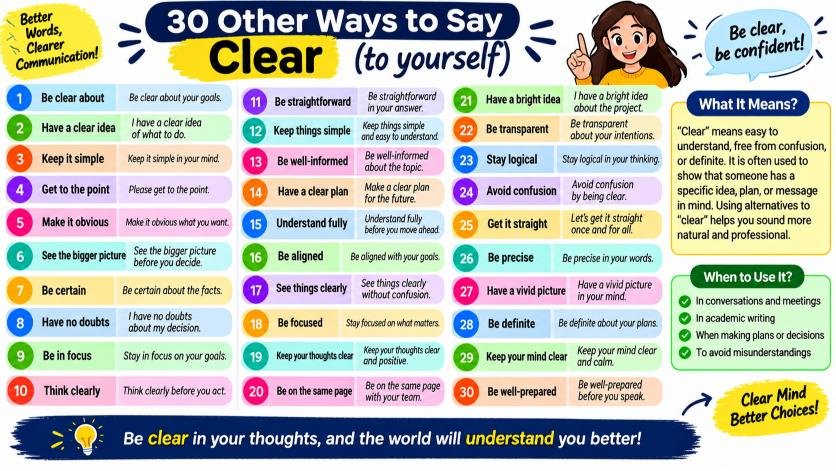
Other Ways to Say Clear (With Examples)
These alternatives will help you sound more fluent, confident, and natural in different situations.
Use them according to tone, context, and audience to communicate precisely, professionally, and naturally.
1. Understandable
Meaning: Easy for someone to comprehend.
Explanation: Use it when a message or explanation can be understood without much difficulty.
Example Sentence: The instructions were understandable, even for beginners.
Best Use: Everyday explanations
Worst Use: Technical precision
Tone: Neutral, friendly, accessible
Context Variability: Casual: “Your point is understandable.” Professional: “The guidelines are understandable.” Spoken: “That explanation is understandable.”
2. Obvious
Meaning: Easy to notice, recognize, or understand.
Explanation: Use it when something is readily apparent, but consider your tone because the word can sound dismissive.
Example Sentence: It became obvious that we needed a different approach.
Best Use: Evident facts
Worst Use: Sensitive feedback
Tone: Direct, confident, emphatic
Context Variability: Casual: “It’s obvious now.” Professional: “The need for revision is obvious.” Spoken: “It was obvious from the beginning.”
3. Evident
Meaning: Clearly visible or supported by available information.
Explanation: This formal alternative works well when facts or results make something easy to recognize.
Example Sentence: The benefits of the new process are evident in the latest results.
Best Use: Evidence-based writing
Worst Use: Casual chatting
Tone: Formal, objective, analytical
Context Variability: Casual: “The difference is evident.” Professional: “Progress is evident in the data.” Spoken: “It was evident that the team had improved.”
4. Straightforward
Meaning: Simple and uncomplicated.
Explanation: Use it when a process, explanation, or task is easy to follow.
Example Sentence: The application process is straightforward and takes only a few minutes.
Best Use: Simple instructions
Worst Use: Complex ambiguity
Tone: Neutral, practical, approachable
Context Variability: Casual: “The answer is straightforward.” Professional: “The procedure is straightforward.” Spoken: “It’s a straightforward task.”
5. Unambiguous
Meaning: Having only one possible interpretation.
Explanation: This precise alternative is particularly useful when instructions or statements must not be misunderstood.
Example Sentence: The contract includes unambiguous payment terms.
Best Use: Legal documents
Worst Use: Casual conversation
Tone: Formal, precise, authoritative
Context Variability: Casual: “Make the message unambiguous.” Professional: “The requirements must be unambiguous.” Spoken: “We need an unambiguous answer.”
6. Explicit
Meaning: Expressed directly and in detail.
Explanation: Use it when information is stated openly rather than left for someone to infer.
Example Sentence: The manager gave explicit instructions about the submission deadline.
Best Use: Direct instructions
Worst Use: Implied meaning
Tone: Formal, direct, precise
Context Variability: Casual: “Be explicit about what you need.” Professional: “The policy provides explicit guidance.” Spoken: “She was explicit about the deadline.”
7. Apparent
Meaning: Seeming clear or noticeable from the available evidence.
Explanation: Use it when something appears to be true or readily recognizable, while remembering that appearances can be misleading.
Example Sentence: It became apparent that the original plan needed revision.
Best Use: Initial observations
Worst Use: Proven certainty
Tone: Neutral, analytical, measured
Context Variability: Casual: “The problem was apparent.” Professional: “The risks became apparent during testing.” Spoken: “It was apparent that he disagreed.”
8. Crystal clear
Meaning: Completely clear and easy to understand.
Explanation: This emphatic expression highlights that there is virtually no confusion.
Example Sentence: After the demonstration, the new procedure was crystal clear.
Best Use: Strong emphasis
Worst Use: Formal legal prose
Tone: Confident, emphatic, conversational
Context Variability: Casual: “That’s crystal clear.” Professional: “The expectations are crystal clear.” Spoken: “Your explanation made everything crystal clear.”
9. Plain
Meaning: Simple, direct, and easy to understand.
Explanation: Use it to describe language that avoids unnecessary complexity.
Example Sentence: Please explain the policy in plain English.
Best Use: Accessible language
Worst Use: Complex technical detail
Tone: Neutral, simple, practical
Context Variability: Casual: “Put it in plain words.” Professional: “Use plain language in the report.” Spoken: “Let me give you a plain explanation.”
10. Transparent
Meaning: Open, accessible, and easy to examine or understand.
Explanation: Use it when describing honest communication, visible processes, or accessible decision-making.
Example Sentence: The company maintains a transparent hiring process.
Best Use: Open communication
Worst Use: Mere simplicity
Tone: Professional, open, trustworthy
Context Variability: Casual: “Let’s keep things transparent.” Professional: “Our pricing structure is transparent.” Spoken: “We want a transparent discussion.”
11. Well-defined
Meaning: Clearly described, established, or limited.
Explanation: This phrase works especially well for responsibilities, goals, boundaries, and requirements.
Example Sentence: Every team member has a well-defined role.
Best Use: Project planning
Worst Use: Unsettled concepts
Tone: Professional, precise, organized
Context Variability: Casual: “We need well-defined rules.” Professional: “The project has well-defined objectives.” Spoken: “Everyone needs a well-defined role.”
12. Concise
Meaning: Brief but informative.
Explanation: Use it when someone communicates the essential information without unnecessary words; it does not automatically mean the message is understandable.
Example Sentence: Please keep your executive summary concise.
Best Use: Business writing
Worst Use: Detailed instruction
Tone: Professional, efficient, direct
Context Variability: Casual: “Keep your answer concise.” Professional: “The report should be concise.” Spoken: “Could you give me a concise summary?”
13. Well-articulated
Meaning: Expressed clearly and effectively.
Explanation: Use it to praise an explanation, argument, opinion, or presentation.
Example Sentence: She presented a well-articulated argument during the meeting.
Best Use: Presentations and arguments
Worst Use: Vague responses
Tone: Professional, appreciative, thoughtful
Context Variability: Casual: “That was a well-articulated point.” Professional: “Your proposal is well-articulated.” Spoken: “He gave a well-articulated response.”
14. Intelligible
Meaning: Capable of being understood.
Explanation: This relatively formal word often describes speech, writing, sounds, or information that can be understood.
Example Sentence: The recording was intelligible despite the background noise.
Best Use: Speech and audio
Worst Use: Friendly small talk
Tone: Formal, technical, neutral
Context Variability: Casual: “Make your words intelligible.” Professional: “The recording remains intelligible.” Spoken: “Her explanation was perfectly intelligible.”
15. Comprehensible
Meaning: Able to be understood mentally.
Explanation: Use it when assessing whether information, an argument, or a complex subject is understandable.
Example Sentence: The textbook makes difficult concepts comprehensible to new learners.
Best Use: Educational material
Worst Use: Casual greetings
Tone: Academic, neutral, informative
Context Variability: Casual: “The instructions are comprehensible.” Professional: “The report is comprehensible to non-specialists.” Spoken: “His reasoning was comprehensible.”
16. Lucid
Meaning: Clear, logical, and easy to understand.
Explanation: Use it to describe an explanation or style of writing that presents ideas exceptionally well.
Example Sentence: The professor delivered a lucid explanation of the theory.
Best Use: Explanations and essays
Worst Use: Casual requests
Tone: Refined, intellectual, positive
Context Variability: Casual: “That was a lucid explanation.” Professional: “The report offers a lucid analysis.” Spoken: “She gave a lucid account of events.”
17. Coherent
Meaning: Logical and consistent, with ideas that fit together.
Explanation: Use it when a message or argument forms a connected, understandable whole.
Example Sentence: He presented a coherent strategy for improving customer service.
Best Use: Logical arguments
Worst Use: Isolated details
Tone: Analytical, professional, measured
Context Variability: Casual: “Your explanation is coherent.” Professional: “The proposal presents a coherent strategy.” Spoken: “She gave a coherent account of the incident.”
18. Definitive
Meaning: Conclusive or authoritative.
Explanation: Use it when a statement or result settles a question, rather than simply making something easy to understand.
Example Sentence: The investigation provided a definitive answer to the question.
Best Use: Final conclusions
Worst Use: Preliminary guesses
Tone: Authoritative, confident, formal
Context Variability: Casual: “We need a definitive answer.” Professional: “The report offers definitive findings.” Spoken: “The test gave us a definitive result.”
19. Specific
Meaning: Clearly identified or described in detail.
Explanation: Use it when a general statement needs precise information about a person, task, amount, or requirement.
Example Sentence: Could you provide specific examples to support your argument?
Best Use: Detailed requests
Worst Use: Broad overviews
Tone: Direct, practical, professional
Context Variability: Casual: “Be specific about what happened.” Professional: “Please provide specific requirements.” Spoken: “Can you be more specific?”
20. Precise
Meaning: Accurate and exact.
Explanation: Use it when wording, measurements, or information must be exact rather than merely understandable.
Example Sentence: The report provides precise figures for quarterly spending.
Best Use: Technical details
Worst Use: General impressions
Tone: Technical, professional, exact
Context Variability: Casual: “Give me a precise answer.” Professional: “The instructions must be precise.” Spoken: “Could you be more precise?”
21. Definite
Meaning: Certain, clearly established, or not doubtful.
Explanation: Use it to describe confirmed plans, decisions, or information.
Example Sentence: We have a definite date for the product launch.
Best Use: Confirmed plans
Worst Use: Uncertain situations
Tone: Direct, confident, neutral
Context Variability: Casual: “That’s a definite yes.” Professional: “We need a definite timeline.” Spoken: “Do we have a definite answer?”
22. Plain and simple
Meaning: Easy to understand without unnecessary complications.
Explanation: This conversational expression emphasizes a direct explanation or uncomplicated fact.
Example Sentence: The rule is plain and simple: everyone must register before entering.
Best Use: Everyday emphasis
Worst Use: Formal reports
Tone: Casual, emphatic, direct
Context Variability: Casual: “It’s plain and simple.” Professional: “The requirement is simple.” Spoken: “Plain and simple, we need more time.”
23. Easy to follow
Meaning: Simple to understand or follow step by step.
Explanation: Use it for instructions, presentations, guides, and explanations with a logical sequence.
Example Sentence: The tutorial provides easy-to-follow steps for setting up the software.
Best Use: Guides and tutorials
Worst Use: Abstract theories
Tone: Friendly, accessible, practical
Context Variability: Casual: “Your directions are easy to follow.” Professional: “The manual offers easy-to-follow procedures.” Spoken: “The presentation was easy to follow.”
24. Self-explanatory
Meaning: Easy to understand without additional explanation.
Explanation: Use it when the meaning is apparent from the item itself, although the phrase can sometimes sound dismissive.
Example Sentence: The diagram is self-explanatory and requires no additional notes.
Best Use: Simple diagrams
Worst Use: Confusing material
Tone: Neutral, confident, practical
Context Variability: Casual: “The label is self-explanatory.” Professional: “The chart is largely self-explanatory.” Spoken: “The process should be self-explanatory.”
25. Unmistakable
Meaning: So clear or distinctive that it cannot reasonably be mistaken for something else.
Explanation: Use it to emphasize a recognizable sign, message, or difference.
Example Sentence: Her enthusiasm was unmistakable during the presentation.
Best Use: Strong evidence
Worst Use: Ambiguous signals
Tone: Emphatic, confident, expressive
Context Variability: Casual: “The message was unmistakable.” Professional: “The results show an unmistakable improvement.” Spoken: “His reaction was unmistakable.”
26. Plainspoken
Meaning: Using direct, uncomplicated language.
Explanation: Use it to describe a person or communication style that avoids unnecessary formality and complexity.
Example Sentence: The director gave a plainspoken explanation of the company’s challenges.
Best Use: Direct communication
Worst Use: Highly technical writing
Tone: Honest, direct, approachable
Context Variability: Casual: “I appreciate your plainspoken advice.” Professional: “The report uses a plainspoken style.” Spoken: “She gave us a plainspoken answer.”
27. Crystal-clear explanation
Meaning: An explanation that is exceptionally easy to understand.
Explanation: This noun phrase emphasizes the quality of an explanation rather than clarity in general.
Example Sentence: The instructor gave a crystal-clear explanation of the grammar rule.
Best Use: Teaching and training
Worst Use: Highly formal documents
Tone: Positive, emphatic, conversational
Context Variability: Casual: “Thanks for the crystal-clear explanation.” Professional: “The training included a crystal-clear explanation of the procedure.” Spoken: “That was a crystal-clear explanation.”
28. As clear as day
Meaning: Extremely obvious or easy to recognize.
Explanation: This idiom is useful in informal conversations when something is unmistakable.
Example Sentence: It was as clear as day that the team needed additional support.
Best Use: Informal emphasis
Worst Use: Academic writing
Tone: Conversational, emphatic, expressive
Context Variability: Casual: “The answer is as clear as day.” Professional: “The results are evident.” Spoken: “It was as clear as day.”
29. Beyond doubt
Meaning: Certain enough that there is no reasonable doubt.
Explanation: Use this expression when the available evidence supports a strong conclusion, not merely when something is understandable.
Example Sentence: The records established beyond doubt that the payment had been received.
Best Use: Strong conclusions
Worst Use: Unverified claims
Tone: Formal, emphatic, authoritative
Context Variability: Casual: “That is beyond doubt.” Professional: “The audit established the discrepancy beyond doubt.” Spoken: “Her commitment is beyond doubt.”
30. Crystal-clear instructions
Meaning: Instructions that are completely easy to understand.
Explanation: This phrase emphasizes the clarity and accessibility of directions or requirements.
Example Sentence: The onboarding guide provides crystal-clear instructions for new employees.
Best Use: Onboarding and training
Worst Use: Unclear procedures
Tone: Positive, practical, emphatic
Context Variability: Casual: “Give me crystal-clear instructions.” Professional: “The guide contains crystal-clear instructions.” Spoken: “The instructions were crystal clear.”
Mini Quiz: Test Your Understanding
Choose the best answer for each question.
1. Which word means having only one possible interpretation?
Concise
Unambiguous
Transparent
Apparent
2. You want to praise a short business report. Which word fits best?
Concise
Obvious
Beyond doubt
As clear as day
3. Which phrase is most natural in a casual conversation?
The findings are definitive
The clause is unambiguous
It’s crystal clear
The procedure is well-defined
4. A company openly explains its pricing and decision-making. Which word fits best?
Lucid
Transparent
Definite
Intelligible
0 of 4 answered
Reset quiz
Comparison Table: Top Alternatives
Here is a quick comparison of ten useful options for different situations.
| Phrase | Tone | Best Use |
| Understandable | Neutral | Everyday explanations |
| Straightforward | Friendly, practical | Instructions and processes |
| Unambiguous | Formal, precise | Policies and contracts |
| Explicit | Direct, formal | Requirements and directions |
| Evident | Analytical | Evidence and results |
| Transparent | Professional | Processes and communication |
| Concise | Efficient | Emails and reports |
| Well-articulated | Appreciative | Presentations and arguments |
| Crystal clear | Emphatic, casual | Conversations |
| Well-defined | Professional | Roles and objectives |
See Also
- See also: Other Ways to Say “I Understand” for natural responses in conversations and professional settings.
- See also: Professional English: How to Write Clear and Effective Business Emails.
FAQs
1. What are the best alternatives to clear?
The best options include understandable, straightforward, evident, explicit, and unambiguous. Choose according to whether you mean easy to understand, obvious, or impossible to misinterpret.
2. What is a more formal word for clear?
“Unambiguous,” “explicit,” “evident,” and “well-defined” are useful formal alternatives. Each has a slightly different meaning, so select the one that matches your context.
3. How can I say this clearly in a professional email?
You can use “well-defined,” “straightforward,” “explicit,” or “concise.” For example, “The project objectives are well-defined” sounds professional and precise.
4. What is an informal way to say clear?
“Crystal clear,” “plain and simple,” and “as clear as day” are common informal expressions in English. They are suitable for friendly conversations but may be too conversational for formal reports.
5. How do I choose the right synonym for clear?
Consider your audience, purpose, and intended meaning. Use “concise” for brevity, “transparent” for openness, “explicit” for directly stated information, and “unambiguous” when avoiding multiple interpretations.
Conclusion
Learning other ways to say things clearly helps you express ideas with greater precision, improve your vocabulary, and communicate more naturally. Although these alternatives share similarities, words such as “concise,” “transparent,” “explicit,” and “straightforward” serve different purposes. Understanding these distinctions helps you avoid repetition and select language that suits the situation.
Practice one or two alternatives each day by using them in emails, conversations, and short writing exercises. Pay attention to tone, audience, and context before replacing a familiar word with a more advanced expression. The goal is not to use the most complicated vocabulary, but to make every message accurate, natural, and easy to understand