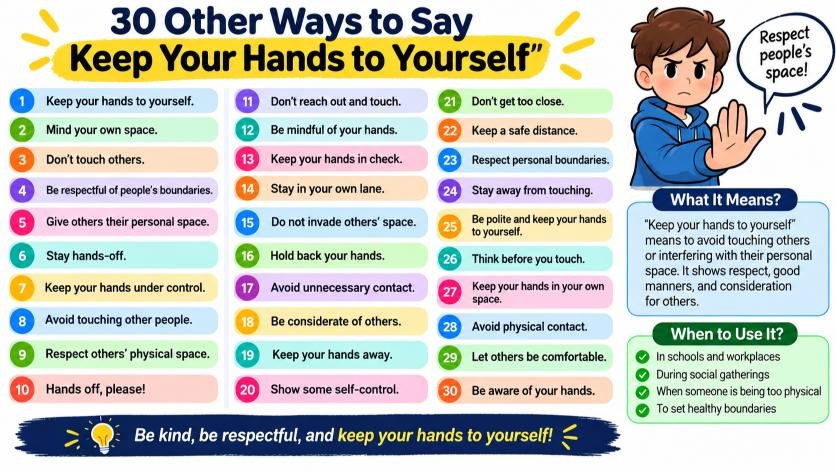
Have you ever wanted to tell someone to keep their hands to themselves but struggled to find the right words? For you are setting personal boundaries, teaching children about appropriate behavior, or navigating an uncomfortable social situation, choosing the right expression can make a real difference. The phrase “keep your hands to yourself” is direct and widely understood, but it may sound strict or confrontational depending on the context. Fortunately, there are many alternative ways to communicate the same message politely, confidently, or firmly. Learning these expressions can help you improve your English vocabulary, communicate more naturally, and handle everyday conversations with greater confidence.
In this guide, you will discover useful alternatives to “keep your hands to yourself,” along with explanations of their meanings and appropriate usage. From polite requests such as “please respect my personal space” to firmer statements like “don’t touch me,” these expressions cover a range of situations and communication styles. Each alternative is selected for clarity, practical relevance, and usefulness in everyday English. Whether you are an English learner, a professional, or someone who wants to express boundaries respectfully, this list will help you choose the right words for the right situation.
Quick Categories: Alternatives to “Mainly”
Formal alternatives to “mainly”
- Primarily
- Chiefly
- Predominantly
- Principally
Pro Tip: Use primarily or principally in reports, academic essays, and formal explanations when identifying the central purpose or factor.
Casual alternatives
- Mostly
- For the most part
- Generally
- Largely
Pro Tip: Use mostly in everyday conversations because it is simple, natural, and easy to understand.
Professional alternatives
- Primarily
- Predominantly
- In large part
- To a great extent
Pro Tip: In business writing, choose a phrase that accurately describes the degree to which something is true instead of relying on vague wording.
Informal expressions
- Mostly
- More than anything
- Above all
- For the most part
Pro Tip: More than anything often expresses a strong preference or priority, so it is not interchangeable with mainly in every sentence.
“Strong vocabulary is not about using complicated words. It is about choosing the word that communicates your meaning most accurately.”
What Does “Mainly” Mean?
Mainly is an adverb meaning primarily, mostly, or chiefly. It indicates that something is the principal part, purpose, reason, or characteristic of a situation, even when other elements are also present.
Grammar explanation
Mainly is an adverb. It commonly modifies verbs, adjectives, or other parts of a sentence to show emphasis or predominance.
Examples:
- The course mainly focuses on business communication.
- The team is mainly responsible for customer support.
- The audience was mainly composed of university students.
Mainly can appear before the main verb, after the verb be, or near the phrase it modifies. Its position depends on sentence structure and emphasis.
When to Use “Mainly”
Use mainly when you want to identify the dominant element without suggesting that it is the only element.
- Everyday conversation: Explain your interests, routines, or preferences.
- Academic writing: Describe the primary focus of research or an argument.
- Professional communication: Identify key responsibilities, business priorities, or project objectives.
- Reports and presentations: Summarize the largest contributing factors.
- Explanations and descriptions: Clarify what something consists of or what it is intended to do.
Spoken vs. written English
| Context | Recommended wording | Example |
| Spoken | Mostly | I mostly work from home. |
| Casual writing | For the most part | The event was successful for the most part. |
| Academic writing | Primarily | The study primarily examines language acquisition. |
| Business writing | Predominantly | Our clients are predominantly small businesses. |
Formal vs. informal usage
Mainly is appropriate in both formal and informal English. However, you can select more specific alternatives to match your audience, sentence structure, and intended emphasis.
Is It Professional or Polite to Say “Mainly”?
Polite? Yes. Professional? Yes.
The word mainly is neutral, clear, and suitable for professional communication. It is not inherently informal or impolite. Alternatives such as primarily and predominantly can sometimes sound more precise in reports or formal presentations.
Business-style example:
“Our department primarily focuses on improving customer satisfaction and streamlining internal processes.”
This sentence communicates the team’s central priorities clearly without sounding overly casual.
Pros and Cons of Using “Mainly”
Pros
- Simple and natural: Easy for readers and listeners to understand.
- Friendly tone: Works comfortably in everyday conversations.
- Common usage: Suitable for many types of communication.
- Easy to understand: Expresses the main point without unnecessary complexity.
Cons
- May lack precision: Some technical contexts require a more specific description.
- Can become repetitive: Repeated use may reduce vocabulary variety.
- Limited emphasis: It does not always communicate strong preference or priority.
- May be vague: Without context, readers may not know what proportion or factor is dominant.
“Use synonyms to improve precision, not simply to avoid repeating a word.”
Other Ways to Say “Mainly” With Examples
These 30 alternatives will help you sound more fluent, confident, and natural in different situations.
Choose each expression according to tone, context, and audience. Some emphasize the largest part of something, while others highlight a central purpose, priority, or preference.
1. Phrase: Primarily
Meaning: Mainly or first and foremost.
Explanation: This is one of the closest alternatives to mainly and works well in formal contexts.
Example Sentence: Our department primarily handles customer inquiries.
Best Use: Business communication
Worst Use: Deliberately casual banter
Tone: Formal, clear, precise
Context Variability:
- Casual: I primarily shop online.
- Professional: The team primarily manages client accounts.
- Spoken: We primarily work with small businesses.
2. Phrase: Mostly
Meaning: For the greatest part or in most cases.
Explanation: This is a natural, widely used alternative suitable for everyday English.
Example Sentence: The participants were mostly university students.
Best Use: Everyday conversation
Worst Use: Highly technical definitions
Tone: Natural, neutral, friendly
Context Variability:
- Casual: I mostly cook at home.
- Professional: Our customers are mostly local businesses.
- Spoken: I mostly agree with your suggestion.
3. Phrase: Chiefly
Meaning: More than anything else; principally.
Explanation: Chiefly emphasizes the most important reason, feature, or element.
Example Sentence: The program was designed chiefly for new employees.
Best Use: Formal explanations
Worst Use: Relaxed everyday chat
Tone: Formal, focused, authoritative
Context Variability:
- Casual: The trip was chiefly about relaxation.
- Professional: The project chiefly concerns product quality.
- Spoken: This meeting is chiefly about planning.
4. Phrase: Largely
Meaning: To a great extent or for the most part.
Explanation: Largely indicates that something is true to a substantial degree.
Example Sentence: The project’s success was largely due to teamwork.
Best Use: Reports and analysis
Worst Use: Exact numerical statements
Tone: Professional, measured, analytical
Context Variability:
- Casual: The room is largely empty.
- Professional: Growth was largely driven by referrals.
- Spoken: The outcome was largely unexpected.
5. Phrase: For the Most Part
Meaning: In most respects or generally.
Explanation: This expression acknowledges that a statement is mostly true while allowing for exceptions.
Example Sentence: For the most part, the training sessions were helpful.
Best Use: Balanced opinions
Worst Use: Extremely concise headings
Tone: Conversational, balanced, neutral
Context Variability:
- Casual: I’m happy with the results for the most part.
- Professional: The transition went smoothly for the most part.
- Spoken: For the most part, everyone agreed.
6. Phrase: Predominantly
Meaning: Mainly or consisting mostly of one type.
Explanation: Predominantly is useful when describing the dominant characteristic of a group, population, or category.
Example Sentence: The survey included predominantly female respondents.
Best Use: Research and reports
Worst Use: Simple casual exchanges
Tone: Academic, formal, precise
Context Variability:
- Casual: The playlist is predominantly pop music.
- Professional: Our workforce is predominantly remote.
- Spoken: The audience was predominantly made up of students.
7. Phrase: Principally
Meaning: Mainly or chiefly.
Explanation: Principally highlights the central purpose, factor, or responsibility.
Example Sentence: The policy principally addresses workplace safety.
Best Use: Formal documents
Worst Use: Informal texting
Tone: Formal, authoritative, precise
Context Variability:
- Casual: The visit was principally for family reasons.
- Professional: The proposal principally concerns cost reduction.
- Spoken: The discussion principally focused on deadlines.
8. Phrase: Generally
Meaning: In most cases or as a broad rule.
Explanation: Generally is useful for broad observations, although it does not always mean that one element forms the largest part.
Example Sentence: Employees generally prefer clear instructions.
Best Use: Broad observations
Worst Use: Exact proportions
Tone: Neutral, measured, approachable
Context Variability:
- Casual: I generally wake up early.
- Professional: Customers generally expect timely responses.
- Spoken: We generally meet on Mondays.
9. Phrase: Essentially
Meaning: In the most important or fundamental sense.
Explanation: Essentially focuses on the core nature of something rather than its proportions.
Example Sentence: The two proposals are essentially the same.
Best Use: Clarifying key ideas
Worst Use: Statistical descriptions
Tone: Analytical, concise, thoughtful
Context Variability:
- Casual: It’s essentially a larger version of the original.
- Professional: The role is essentially project coordination.
- Spoken: Essentially, we need more time.
10. Phrase: In Large Part
Meaning: To a considerable degree.
Explanation: This expression often identifies a major contributing factor without suggesting it is the sole cause.
Example Sentence: The improvement was due in large part to better communication.
Best Use: Explaining causes
Worst Use: Very casual small talk
Tone: Formal, explanatory, balanced
Context Variability:
- Casual: The party’s success was in large part thanks to the hosts.
- Professional: The results depended in large part on employee training.
- Spoken: Our progress came in large part from collaboration.
11. Phrase: For the Most
Meaning: This is an incomplete expression when intended to mean mainly.
Explanation: Use the complete expression for the most part instead.
Example Sentence: For the most part, the plan worked well.
Best Use: Complete expressions
Worst Use: Standalone phrasing
Tone: Incomplete, unclear, unidiomatic
Context Variability:
- Casual: Say, “It was good for the most part.”
- Professional: Say, “The results were positive for the most part.”
- Spoken: Say, “For the most part, I agree.”
12. Phrase: Above All
Meaning: More importantly than anything else.
Explanation: Above all emphasizes the highest priority rather than simply the largest proportion.
Example Sentence: Above all, we must protect customer data.
Best Use: Highlighting priorities
Worst Use: Describing percentages
Tone: Emphatic, purposeful, confident
Context Variability:
- Casual: Above all, have fun.
- Professional: Above all, we value transparency.
- Spoken: Above all, safety comes first.
13. Phrase: To a Great Extent
Meaning: To a considerable degree.
Explanation: This phrase describes the degree to which something is true or influential.
Example Sentence: The final outcome depended to a great extent on preparation.
Best Use: Formal analysis
Worst Use: Brief casual replies
Tone: Formal, analytical, measured
Context Variability:
- Casual: The weather affected our plans to a great extent.
- Professional: Performance depends to a great extent on planning.
- Spoken: The change helped to a great extent.
14. Phrase: For the Most Part of
Meaning: This is generally an incorrect construction when used as a direct synonym for mainly.
Explanation: Use for the most part or a construction such as for most of the day, depending on the intended meaning.
Example Sentence: For the most part, the employees were satisfied.
Best Use: Corrected phrasing
Worst Use: Incorrect constructions
Tone: Context-dependent, neutral, grammatical
Context Variability:
- Casual: For most of the day, I was busy.
- Professional: For most of the quarter, sales remained stable.
- Spoken: For the most part, it went well.
15. Phrase: Predominantly Focused On
Meaning: Concentrated mainly on a particular subject.
Explanation: This phrase explicitly identifies the dominant focus of an activity or project.
Example Sentence: The course is predominantly focused on practical communication skills.
Best Use: Course descriptions
Worst Use: Unrelated emphasis
Tone: Academic, descriptive, professional
Context Variability:
- Casual: The channel is predominantly focused on cooking.
- Professional: The initiative is predominantly focused on retention.
- Spoken: The workshop is predominantly focused on teamwork.
16. Phrase: In the Main
Meaning: Generally or for the most part.
Explanation: This relatively formal expression summarizes what is generally true.
Example Sentence: In the main, the recommendations were well received.
Best Use: Formal summaries
Worst Use: Casual conversation
Tone: Formal, restrained, traditional
Context Variability:
- Casual: In the main, everything went fine.
- Professional: In the main, the findings support our strategy.
- Spoken: In the main, I agree with the report.
17. Phrase: For the Most Part, Primarily
Meaning: A combination of expressions indicating a general pattern or main emphasis.
Explanation: This combination is often redundant, so choose one expression unless the sentence clearly needs both meanings.
Example Sentence: The team primarily works with regional clients.
Best Use: Simplified wording
Worst Use: Redundant sentences
Tone: Wordy, explanatory, neutral
Context Variability:
- Casual: Mostly, I stay home.
- Professional: The team primarily serves enterprise clients.
- Spoken: For the most part, I agree.
18. Phrase: More Than Anything
Meaning: More strongly or importantly than other things.
Explanation: More than anything often expresses a person’s strongest desire or preference, rather than a general proportion.
Example Sentence: More than anything, I want the team to succeed.
Best Use: Personal priorities
Worst Use: Statistical reports
Tone: Personal, emphatic, sincere
Context Variability:
- Casual: More than anything, I want a day off.
- Professional: More than anything, we need a reliable solution.
- Spoken: I want clarity more than anything.
19. Phrase: At Heart
Meaning: In someone’s or something’s essential nature.
Explanation: At heart describes a fundamental characteristic, not simply what happens most frequently.
Example Sentence: She is, at heart, a dedicated teacher.
Best Use: Character descriptions
Worst Use: Numerical comparisons
Tone: Reflective, warm, descriptive
Context Variability:
- Casual: He’s at heart a creative person.
- Professional: The organization is, at heart, service-oriented.
- Spoken: At heart, we’re trying to help.
20. Phrase: Fundamentally
Meaning: At the most basic or essential level.
Explanation: Fundamentally identifies the underlying nature of an idea, issue, or difference.
Example Sentence: The two systems are fundamentally different.
Best Use: Conceptual explanations
Worst Use: Minor details
Tone: Analytical, precise, serious
Context Variability:
- Casual: We’re fundamentally looking for the same thing.
- Professional: The strategy is fundamentally customer-centered.
- Spoken: Fundamentally, the problem is communication.
21. Phrase: In Essence
Meaning: In the most basic or important sense.
Explanation: In essence introduces a simplified summary of a larger idea.
Example Sentence: In essence, the proposal aims to reduce operating costs.
Best Use: Summarizing ideas
Worst Use: Exact data reporting
Tone: Clear, analytical, concise
Context Variability:
- Casual: In essence, it’s the same idea.
- Professional: In essence, the policy prioritizes accountability.
- Spoken: In essence, we need a better plan.
22. Phrase: To a Large Degree
Meaning: To a substantial extent.
Explanation: This phrase describes how strongly a factor influences a result.
Example Sentence: Productivity improved to a large degree after the changes.
Best Use: Evaluating outcomes
Worst Use: Informal short answers
Tone: Analytical, measured, formal
Context Variability:
- Casual: The delay was caused to a large degree by traffic.
- Professional: Results depend to a large degree on execution.
- Spoken: It helped to a large degree.
23. Phrase: In Most Cases
Meaning: Usually or under most circumstances.
Explanation: This expression describes a general pattern rather than identifying the largest part of a single thing.
Example Sentence: In most cases, applications are reviewed within five days.
Best Use: Guidelines and advice
Worst Use: Describing composition
Tone: Neutral, practical, informative
Context Variability:
- Casual: In most cases, I walk to work.
- Professional: In most cases, approval is required.
- Spoken: In most cases, that solution works.
24. Phrase: Usually
Meaning: On most occasions or as a regular habit.
Explanation: Usually emphasizes frequency, so it is appropriate when mainly refers to what someone generally does.
Example Sentence: I usually work on client projects in the morning.
Best Use: Habits and routines
Worst Use: Describing the makeup of a group
Tone: Natural, neutral, conversational
Context Variability:
- Casual: I usually drink tea.
- Professional: We usually respond within one business day.
- Spoken: I usually take the train.
25. Phrase: For the Most Part, Generally
Meaning: Two expressions conveying a broad or mostly true statement.
Explanation: Using both is usually unnecessary; select one for clearer writing.
Example Sentence: Generally, the feedback has been positive.
Best Use: Concise editing
Worst Use: Repetitive writing
Tone: Neutral, wordy if combined, explanatory
Context Variability:
- Casual: Generally, I like the idea.
- Professional: Generally, performance has improved.
- Spoken: For the most part, it works.
26. Phrase: Particularly
Meaning: Especially or to a notable degree.
Explanation: Particularly highlights a specific item or feature, not necessarily the largest overall portion.
Example Sentence: The training is particularly useful for new managers.
Best Use: Highlighting specifics
Worst Use: Replacing every use of mainly
Tone: Emphatic, specific, professional
Context Variability:
- Casual: I particularly like the blue one.
- Professional: This feature is particularly valuable to clients.
- Spoken: I’m particularly interested in that option.
27. Phrase: Especially
Meaning: More than usual or to a greater degree than others.
Explanation: Especially highlights a particularly important example or group within a broader category.
Example Sentence: The advice is especially useful for beginner writers.
Best Use: Emphasizing examples
Worst Use: Describing the main proportion
Tone: Clear, emphatic, accessible
Context Variability:
- Casual: I love fruit, especially mangoes.
- Professional: This training is especially relevant to new hires.
- Spoken: It’s especially important today.
28. Phrase: In Particular
Meaning: Specifically or especially.
Explanation: In particular singles out a specific person, item, or point rather than describing a dominant proportion.
Example Sentence: We need to improve communication, in particular between departments.
Best Use: Specific emphasis
Worst Use: General proportions
Tone: Precise, focused, neutral
Context Variability:
- Casual: I like the desserts, the cheesecake in particular.
- Professional: We value feedback, in particular from clients.
- Spoken: I liked the ending in particular.
29. Phrase: At Its Core
Meaning: At the central or essential part of something.
Explanation: This phrase identifies the fundamental idea or purpose underlying a subject.
Example Sentence: At its core, the initiative is about improving access to education.
Best Use: Explaining purpose
Worst Use: Reporting frequencies
Tone: Reflective, explanatory, thoughtful
Context Variability:
- Casual: At its core, it’s a friendship story.
- Professional: At its core, the strategy is about trust.
- Spoken: At its core, this is a teamwork issue.
30. Phrase: In the First Place
Meaning: Originally, or as the primary reason something happened.
Explanation: This expression can explain an original reason, but it is not a universal synonym for mainly.
Example Sentence: We introduced the policy in the first place to improve workplace safety.
Best Use: Explaining original reasons
Worst Use: Describing group composition
Tone: Explanatory, conversational, contextual
Context Variability:
- Casual: I went there in the first place to relax.
- Professional: The policy was created in the first place to protect customer data.
- Spoken: That’s why we started in the first place.
Common Mistakes When Using “Mainly”
Avoid these five errors to make your English clearer and more accurate.
1. Using “mainly” when you mean “always.” Mainly allows exceptions.
Incorrect: I mainly arrive at work at 9 a.m. every single day without exception.
Better: I always arrive at work at 9 a.m.
2. Confusing “mainly” with “especially.” Mainly identifies the dominant part; especially highlights a particular item.
Example: The course mainly covers grammar, especially verb tenses.
3. Using “mainly” and “mostly” repeatedly. Both are often interchangeable, but repetition makes writing monotonous.
Example: The project mainly involves research and mostly focuses on surveys.
Better: The project primarily involves research and focuses on surveys.
4. Using formal alternatives in every conversation. Words such as predominantly may sound unnecessarily technical in casual speech.
Example: “I predominantly eat at home” can become “I mostly eat at home.”
5. Treating every alternative as an exact synonym. Above all, particularly, and usually have distinct meanings.
Example: “Above all, we need safety” emphasizes priority, while “We mainly need safety equipment” identifies the principal requirement.
“A synonym is useful only when it preserves the meaning of your original sentence.”
Pull Quotes and Highlights
“Primarily” is an excellent choice for professional reports and formal explanations.
“Mostly” is often the easiest replacement for “mainly” in everyday conversation.
“Predominantly” works well when describing the dominant feature of a group or category.
Choose your alternative according to meaning, not simply to make your vocabulary sound sophisticated.
Mini Quiz: Test Your Understanding
1. Which alternative is best suited to a formal research report?
Mostly
Primarily
More than anything
2. Which sentence correctly describes a general habit?
I usually walk to work.
I particularly walk to work.
I am at heart walk to work.
3. Which phrase emphasizes the highest priority?
In most cases
Above all
Predominantly
4. Which expression is closest to mainly in everyday English?
Mostly
At its core
In the first place
Score: 0 of 4
Try again
Comparison Table: Top 10 Alternatives
| Phrase | Tone | Best Use |
| Primarily | Formal, precise | Business reports |
| Mostly | Casual, natural | Daily conversation |
| Chiefly | Formal, focused | Written explanations |
| Largely | Analytical, neutral | Discussing causes |
| For the most part | Conversational, balanced | General observations |
| Predominantly | Academic, formal | Describing groups |
| Principally | Formal, authoritative | Policies and reports |
| Generally | Neutral, broad | General statements |
| Essentially | Analytical, concise | Explaining core ideas |
| In large part | Formal, explanatory | Discussing contributing factors |
FAQs
1. What is the closest synonym for mainly?
Mostly and primarily are among the closest synonyms. Mostly is especially natural in everyday conversation, while primarily often suits formal and professional writing.
2. What are formal alternatives to mainly?
Use primarily, chiefly, principally, or predominantly. Choose the word that best matches the sentence rather than assuming every option is interchangeable.
3. How can I replace mainly academic writing?
Use primarily to describe a study’s focus, predominantly to describe a dominant characteristic, or largely to discuss contributing factors.
4. Is it mainly professional English?
Yes. Mainly is a neutral adverb suitable for emails, meetings, presentations, and reports. Alternatives can add variety or precision, but they are not automatically more professional.
5. Can I use mostly and mainly interchangeably?
Often, yes. For example, “The audience was mainly students” and “The audience was mostly students” convey similar meanings. However, the best choice depends on sentence structure and context.
See Also
- See also: Other Ways to Say “For Example” in Writing to improve variety in essays and explanations.
- See also: Professional English: How to Write Clear and Effective Business Emails to strengthen workplace communication.
Your turn: Which alternative to mainly do you use most often? Share your favorite phrase and an example sentence in the comments.
Conclusion
Learning other ways to say mainly helps you communicate with greater clarity, precision, and confidence. Words such as mostly, primarily, chiefly, and largely can express similar ideas while offering different levels of formality and emphasis. Understanding these distinctions allows you to choose vocabulary that suits everyday conversations, academic assignments, and professional documents.
To build fluency, practise replacing repeated words in your daily writing. Write three sentences using mainly, then rewrite them with suitable alternatives. Check whether the meaning remains accurate and whether the tone matches your audience. Consistent practice will help you develop a more flexible vocabulary and communicate naturally in English.