Do you find yourself using the word “mainly” too often in your writing or everyday conversations? Although it is a useful English adverb, repeating the same word can make your sentences sound less varied and engaging. Learning alternative expressions can help you communicate your ideas more clearly, improve your vocabulary, and make your English sound more natural. For you are writing an academic assignment, preparing a professional email, or having a casual conversation, choosing the right synonym for “mainly” can make a noticeable difference. Words such as “primarily,” “mostly,” “chiefly,” and “largely” can often express similar meanings, depending on the context.
In this guide, you will discover practical alternatives to “mainly,” along with clear definitions and example sentences to help you understand how each expression works. The list is designed for English learners, students, professionals, and anyone looking to strengthen their writing and speaking skills. Each alternative is presented with attention to meaning, context, and common usage, helping you avoid awkward substitutions and choose words more confidently. By the end, you will have a useful collection of expressions to make your English more precise, natural, and effective.
Quick Categories: Choose the Right Expression
Formal alternatives to “haha”
- That’s amusing. A polite way to acknowledge something funny.
- That’s quite funny. A complete, natural response suitable for polite conversations.
- I appreciate the humor. A restrained expression of appreciation for a joke.
Pro tip: In formal emails, describe the joke as amusing or respond to its content rather than relying on laughter abbreviations.
Casual alternatives
- LOL. A widely recognized abbreviation for laughing out loud.
- I’m cracking up. Shows that something is making you laugh a lot.
- That’s hilarious. Expresses strong amusement.
- You got me laughing. Credits someone for making you laugh.
Pro tip: Use these expressions with friends and familiar colleagues when the conversation is relaxed.
Professional alternatives
- That’s a good one. A friendly response to a clever joke.
- Well played. Acknowledges a witty comment or clever move.
- Good one! A brief, positive reaction to humor.
- That made me smile. Communicates warmth without exaggerated laughter.
Pro tip: Keep professional reactions brief, respectful, and appropriate to the relationship. Not every workplace conversation needs a humorous reply.
Informal expressions
- LMAO. A slang abbreviation expressing strong amusement.
- I’m dead. An exaggerated reaction to something extremely funny.
- Can’t stop laughing. Suggests sustained amusement.
- I’m wheezing. Informally describes laughing so hard that breathing feels difficult.
Pro tip: These informal expressions are best reserved for friends, social media, and relaxed group chats. Some can sound exaggerated if the joke is only mildly amusing.
“Match your reaction to the joke. A clever one-liner may deserve ‘Well played,’ while a hilarious meme might deserve ‘I’m dead.’”
Common Mistakes When Using Funny Text Reactions
Even familiar expressions can sound unnatural when they are used in the wrong context. Here are five mistakes to avoid.
1. Using internet slang in a formal email. Incorrect: “LMAO, your proposal is interesting.” Better: “That’s an interesting point, and I appreciate the humor.”
2. Using an exaggerated reaction for a minor joke. Incorrect: “I’m literally dying” in response to a mildly amusing comment. Better: “That’s funny.”
3. Assuming LOL always means genuine laughter. Incorrect: “LOL, I understand your complaint” when a serious response is needed. Better: “I understand your concern, and I’ll look into it.”
4. Repeating the same expression in every message. Incorrect: “Haha, haha, haha” after every comment. Better: Vary your responses with “Good one,” “That’s hilarious,” or “You got me laughing.”
5. Ignoring the possibility of misunderstanding. Incorrect: “I’m dead” in a sensitive conversation where the reader may misunderstand the exaggeration. Better: “That was really funny” or “You made me laugh.”
What Does “Haha” Mean in Text?
“Haha” is a written representation of laughter. People use it in text messages, social media comments, online discussions, and chats to show amusement or signal that a message is intended humorously.
Grammatically, “haha” functions as an informal interjection or a written sound imitation. It is not a conventional verb or noun in most everyday sentences, although it can be used independently as a complete reaction.
Example: “Haha, I didn’t expect that twist!”
The number and arrangement of letters can affect the perceived tone. “Ha” may suggest a brief laugh or sarcasm, “haha” often sounds friendly, and “hahaha” can suggest stronger amusement. However, meaning depends on context and the people communicating.
When to Use Funny Alternatives to “Haha”
Different expressions work better in different situations.
- Text messages: Use “LOL,” “That’s hilarious,” or “I’m cracking up.”
- Funny memes: Try “I’m dead,” “I’m wheezing,” or “I can’t.”
- Friendly teasing: Use “You got me laughing” or “Good one!”
- Social media comments: Try “I’m crying,” “LMAO,” or “This is too funny.”
- Workplace chats: Use “That’s a good one,” “Well played,” or “That made me smile.”
- Formal communication: Prefer “That’s amusing” or acknowledge the humor in a complete sentence.
Spoken vs. written usage
Written reactions such as LOL and LMAO are common in digital conversations, but people do not always say these abbreviations aloud. In spoken English, phrases such as “That’s hilarious,” “You made me laugh,” and “That’s a good one” generally sound more natural.
Formal vs. informal usage
Formal language usually favors restrained, clear expressions. Informal language allows abbreviations, playful exaggeration, and internet slang. Choose according to the audience, relationship, and communication channel.
Is It Professional or Polite to Say “Haha”?
Polite? Yes. “Haha” can sound friendly and approachable when used in a suitable conversation.
Professional? No, not in most formal contexts. However, it can be acceptable in informal workplace chats, especially when colleagues already communicate casually.
A business-style example:
Instead of writing, “Haha, that’s so funny!” in a formal email, try:
“That’s a clever observation. I appreciate the humor, and I look forward to discussing the next steps.”
The revised version acknowledges the joke while keeping the focus on professional communication.
Pros and Cons of Using “Haha”
Pros
- Simple and natural: Easy to type and understand.
- Friendly tone: Can make a message feel warmer.
- Common usage: Widely recognized in digital communication.
- Easy to understand: Usually signals amusement without requiring explanation.
Cons
- Too informal for work: May not suit formal emails or official documents.
- Overused: Repetition can make messages feel predictable.
- Limited emotional range: Does not always communicate how funny something really is.
- Not suitable for formal writing: Can weaken the tone of academic or business documents.
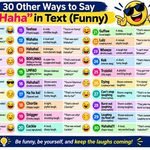
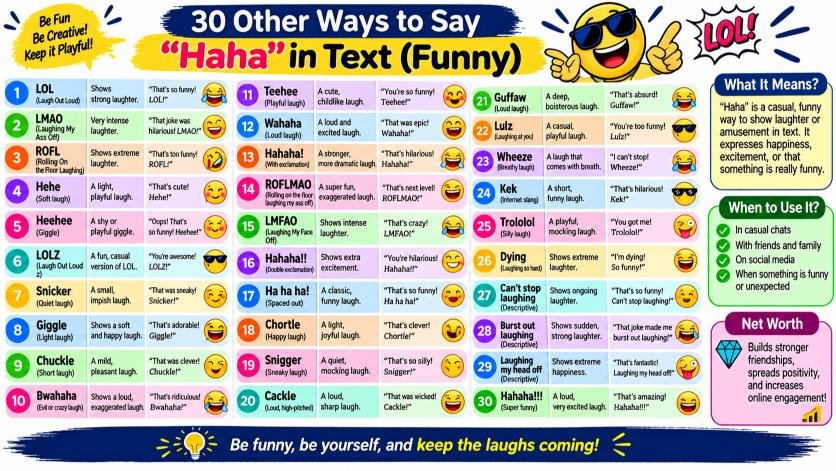
Other Ways to Say Haha in Text Funny: 30 Examples
These alternatives will help you sound more fluent, confident, and natural in different situations.
Use them according to tone, context, and audience to express excitement, admiration, or approval.
1. LOL
Meaning: An abbreviation for “laughing out loud.”
Explanation: It is a familiar way to react to something amusing in a text conversation.
Example Sentence: “LOL, I can’t believe you actually said that!”
Best Use: Casual texting
Worst Use: Formal reports
Tone: Friendly, relaxed, playful
Context Variability:
- Casual: “LOL, that was unexpected.”
- Professional: “LOL, that was a clever point.” (Informal teams only.)
- Spoken: “That was hilarious!”
2. LMAO
Meaning: An abbreviation for “laughing my ass off.”
Explanation: This slang expression conveys stronger amusement than a simple “haha” and includes mild profanity.
Example Sentence: “LMAO, that video caught me completely off guard.”
Best Use: Close friends
Worst Use: Business emails
Tone: Bold, humorous, informal
Context Variability:
- Casual: “LMAO, your reaction was priceless.”
- Professional: “That was genuinely funny.” (Safer alternative.)
- Spoken: “I’m laughing so hard!”
3. I’m Cracking Up
Meaning: You are laughing a lot because something is funny.
Explanation: This natural expression communicates strong amusement without using internet abbreviations.
Example Sentence: “I’m cracking up at the last part of that story.”
Best Use: Funny stories
Worst Use: Serious discussions
Tone: Animated, friendly, enthusiastic
Context Variability:
- Casual: “I’m cracking up at this meme.”
- Professional: “That story genuinely made me laugh.”
- Spoken: “I’m cracking up right now!”
4. That’s Hilarious
Meaning: Something is extremely funny.
Explanation: It is a clear and versatile reaction that works in both spoken and written English.
Example Sentence: “That’s hilarious! I wasn’t expecting that ending.”
Best Use: Funny moments
Worst Use: Sensitive situations
Tone: Positive, expressive, natural
Context Variability:
- Casual: “That’s hilarious, send me more!”
- Professional: “That’s a hilarious observation.”
- Spoken: “That’s absolutely hilarious!”
5. I’m Dead
Meaning: Something is so funny that you are figuratively overwhelmed with laughter.
Explanation: This internet expression exaggerates your reaction for humorous effect.
Example Sentence: “I’m dead. Why would he wear that to the party?”
Best Use: Funny memes
Worst Use: Sensitive conversations
Tone: Exaggerated, playful, informal
Context Variability:
- Casual: “I’m dead at this comment.”
- Professional: “That was unexpectedly funny.”
- Spoken: “That absolutely cracked me up!”
6. I’m Wheezing
Meaning: You are laughing so hard that it feels difficult to breathe normally.
Explanation: This informal expression often appears in reactions to absurd jokes, memes, and funny videos.
Example Sentence: “I’m wheezing at the way the cat fell off the sofa.”
Best Use: Hilarious videos
Worst Use: Formal correspondence
Tone: Playful, exaggerated, expressive
Context Variability:
- Casual: “I’m wheezing at this clip.”
- Professional: “That was a very funny moment.”
- Spoken: “I’m laughing so hard!”
7. That’s a Good One
Meaning: A joke or comment is clever or amusing.
Explanation: This phrase acknowledges humor without sounding overly dramatic.
Example Sentence: “That’s a good one! I didn’t see that punchline coming.”
Best Use: Clever jokes
Worst Use: Serious feedback
Tone: Warm, appreciative, conversational
Context Variability:
- Casual: “That’s a good one, honestly.”
- Professional: “That’s a good one. Nicely done.”
- Spoken: “Good one!”
8. Well Played
Meaning: Someone has made a clever joke or executed something skillfully.
Explanation: It shows appreciation for wit, timing, or a smart response.
Example Sentence: “Well played! That comeback was brilliant.”
Best Use: Clever comebacks
Worst Use: Emotional disclosures
Tone: Respectful, witty, approving
Context Variability:
- Casual: “Well played, you got me.”
- Professional: “Well played. That was a clever response.”
- Spoken: “Nicely done!”
9. You Got Me Laughing
Meaning: Someone has made you laugh.
Explanation: This expression directly credits the other person for making the conversation enjoyable.
Example Sentence: “You got me laughing with that unexpected comparison.”
Best Use: Friendly banter
Worst Use: Formal notices
Tone: Genuine, friendly, appreciative
Context Variability:
- Casual: “You got me laughing again.”
- Professional: “That comment made me smile.”
- Spoken: “You really made me laugh!”
10. I Can’t Stop Laughing
Meaning: You find something so funny that you continue laughing.
Explanation: It emphasizes sustained amusement and works well when a joke has made a strong impression.
Example Sentence: “I can’t stop laughing at the ending of that video.”
Best Use: Funny stories
Worst Use: Serious meetings
Tone: Enthusiastic, animated, informal
Context Variability:
- Casual: “I can’t stop laughing at this.”
- Professional: “That was genuinely amusing.”
- Spoken: “I can’t stop laughing!”
“The strongest reaction is not always the funniest one. Natural English depends on sincerity, timing, and context.”
11. I’m Crying
Meaning: Something is so funny that you figuratively have tears from laughing.
Explanation: It is an exaggerated online reaction, often used with memes and absurd humor.
Example Sentence: “I’m crying at the way he tried to explain that mistake.”
Best Use: Funny memes
Worst Use: Serious news
Tone: Dramatic, playful, informal
Context Variability:
- Casual: “I’m crying. This is too funny.”
- Professional: “That was an amusing story.”
- Spoken: “That’s making me laugh so much!”
12. This Is Too Funny
Meaning: Something is extremely amusing.
Explanation: This straightforward expression emphasizes how strongly you find a situation humorous.
Example Sentence: “This is too funny. I need to show my brother.”
Best Use: Group chats
Worst Use: Formal complaints
Tone: Cheerful, emphatic, conversational
Context Variability:
- Casual: “This is too funny!”
- Professional: “That’s a particularly funny observation.”
- Spoken: “This is so funny!”
13. I’m Losing It
Meaning: You are struggling to contain your laughter or excitement.
Explanation: The phrase is informal and often exaggerates a reaction to something ridiculous.
Example Sentence: “I’m losing it over that ridiculous dance move.”
Best Use: Ridiculous moments
Worst Use: Serious situations
Tone: Animated, humorous, informal
Context Variability:
- Casual: “I’m losing it at this video.”
- Professional: “That was unexpectedly entertaining.”
- Spoken: “I can’t believe how funny that is!”
14. I Can’t Even
Meaning: You are so amused or overwhelmed that you struggle to respond.
Explanation: This incomplete informal expression relies on context to communicate a strong reaction.
Example Sentence: “I can’t even. That outfit is unbelievable.”
Best Use: Playful reactions
Worst Use: Formal writing
Tone: Dramatic, casual, expressive
Context Variability:
- Casual: “I can’t even with this meme.”
- Professional: “That was quite an unexpected moment.”
- Spoken: “I don’t even know what to say!”
15. Stop, That’s So Funny
Meaning: Something is so amusing that you playfully ask the other person to stop.
Explanation: The phrase expresses enthusiasm rather than a serious request to end the joke.
Example Sentence: “Stop, that’s so funny! How did you think of that?”
Best Use: Friendly teasing
Worst Use: Serious disagreements
Tone: Excited, affectionate, playful
Context Variability:
- Casual: “Stop, I’m laughing too hard.”
- Professional: “That’s a clever joke.”
- Spoken: “Stop, that’s hilarious!”
16. You Made My Day
Meaning: Someone has made you feel especially happy.
Explanation: This expression emphasizes the positive emotional effect of a funny or thoughtful interaction, rather than laughter alone.
Example Sentence: “That message was so funny. You made my day.”
Best Use: Warm appreciation
Worst Use: Minor jokes
Tone: Grateful, warm, sincere
Context Variability:
- Casual: “You made my day with that meme.”
- Professional: “Your comment genuinely brightened my day.”
- Spoken: “That really made my day!”
17. That’s Gold
Meaning: Something is exceptionally funny, clever, or entertaining.
Explanation: This informal expression praises a joke, comment, or moment as especially good.
Example Sentence: “That reply is gold. You should turn it into a meme.”
Best Use: Clever humor
Worst Use: Formal reports
Tone: Enthusiastic, approving, informal
Context Variability:
- Casual: “That’s gold. I’m saving this.”
- Professional: “That’s an excellent observation.”
- Spoken: “That’s brilliant!”
18. I’m Actually Laughing Out Loud
Meaning: You are genuinely laughing rather than simply typing a reaction.
Explanation: This phrase adds emphasis by making your amusement explicit.
Example Sentence: “I’m actually laughing out loud at your impression.”
Best Use: Genuine reactions
Worst Use: Formal documents
Tone: Sincere, amused, conversational
Context Variability:
- Casual: “I’m actually laughing out loud right now.”
- Professional: “That genuinely made me laugh.”
- Spoken: “I’m really laughing!”
19. That Caught Me Off Guard
Meaning: Something surprised you unexpectedly.
Explanation: This phrase works when a joke is funny partly because you did not anticipate it.
Example Sentence: “That punchline caught me off guard. I wasn’t expecting it.”
Best Use: Unexpected jokes
Worst Use: Predictable humor
Tone: Natural, reflective, conversational
Context Variability:
- Casual: “That caught me off guard!”
- Professional: “That was an unexpected and amusing twist.”
- Spoken: “I didn’t see that coming!”
20. You Win
Meaning: You admit that someone’s joke or comeback was particularly effective.
Explanation: This playful expression suggests that the other person has won a humorous exchange.
Example Sentence: “You win. That comeback was way too good.”
Best Use: Friendly banter
Worst Use: Serious negotiations
Tone: Playful, conceding, friendly
Context Variability:
- Casual: “You win. I have no comeback.”
- Professional: “That’s a clever response.”
- Spoken: “All right, you got me!”
21. Good One!
Meaning: A short way to praise a joke or witty remark.
Explanation: This expression is concise and sounds natural in both spoken conversations and casual messages.
Example Sentence: “Good one! You really thought that through.”
Best Use: Quick replies
Worst Use: Serious disclosures
Tone: Positive, lighthearted, appreciative
Context Variability:
- Casual: “Good one! You got me.”
- Professional: “Good one. Nicely put.”
- Spoken: “That’s a good one!”
22. That Was Priceless
Meaning: Something was so funny or memorable that it was especially enjoyable.
Explanation: This phrase often describes an amusing reaction, expression, or unexpected moment.
Example Sentence: “Your expression when the magician revealed the trick was priceless.”
Best Use: Funny reactions
Worst Use: Formal evaluations
Tone: Warm, amused, expressive
Context Variability:
- Casual: “That reaction was priceless.”
- Professional: “That was a memorable moment.”
- Spoken: “Your reaction was priceless!”
23. I Wasn’t Ready for That
Meaning: Something surprised you with unexpected humor.
Explanation: This expression is especially useful when a punchline or image is funnier than anticipated.
Example Sentence: “I wasn’t ready for that final scene. It was hilarious.”
Best Use: Surprise humor
Worst Use: Serious discussions
Tone: Surprised, amused, informal
Context Variability:
- Casual: “I wasn’t ready for that meme.”
- Professional: “That was an unexpected twist.”
- Spoken: “I did not see that coming!”
24. That Sent Me
Meaning: Something made you laugh intensely or left you overwhelmed with amusement.
Explanation: This informal internet expression describes a strong reaction to a joke, video, or comment.
Example Sentence: “The last line in that message absolutely sent me.”
Best Use: Online humor
Worst Use: Formal emails
Tone: Exaggerated, playful, contemporary
Context Variability:
- Casual: “That sent me. I’m still laughing.”
- Professional: “That was particularly funny.”
- Spoken: “That really cracked me up!”
25. I’m Done
Meaning: You are so amused that you jokingly cannot handle any more.
Explanation: In humorous conversations, this phrase signals that a joke has pushed your reaction to its limit.
Example Sentence: “I’m done. Why would anyone put googly eyes on a printer?”
Best Use: Absurd jokes
Worst Use: Workplace conflict
Tone: Dramatic, playful, informal
Context Variability:
- Casual: “I’m done. This group chat is ridiculous.”
- Professional: “That was unexpectedly amusing.”
- Spoken: “I can’t handle how funny that is!”
26. That Was Smooth
Meaning: Someone delivered a clever remark or handled a situation skillfully.
Explanation: This phrase often expresses admiration for a witty comeback or a well-timed joke.
Example Sentence: “That was smooth. You answered the question without missing a beat.”
Best Use: Clever comebacks
Worst Use: Serious criticism
Tone: Confident, approving, conversational
Context Variability:
- Casual: “That was smooth. I’ll give you that.”
- Professional: “That was a well-handled response.”
- Spoken: “Nicely handled!”
27. I See What You Did There
Meaning: You have recognized a joke, pun, or clever play on words.
Explanation: This expression acknowledges the thought behind a humorous remark, sometimes with playful approval.
Example Sentence: “I see what you did there with that coffee pun.”
Best Use: Wordplay jokes
Worst Use: Urgent requests
Tone: Witty, knowing, friendly
Context Variability:
- Casual: “I see what you did there!”
- Professional: “Nice wordplay.”
- Spoken: “Ah, clever!”
28. That’s Actually Hilarious
Meaning: Something is genuinely very funny, perhaps more than expected.
Explanation: The word “actually” emphasizes that the humor has pleasantly surprised you.
Example Sentence: “That’s actually hilarious. I thought the story would end differently.”
Best Use: Unexpected humor
Worst Use: Sensitive moments
Tone: Genuine, surprised, enthusiastic
Context Variability:
- Casual: “That’s actually hilarious.”
- Professional: “That is genuinely amusing.”
- Spoken: “That’s really funny!”
29. That Made Me Smile
Meaning: Something gave you a feeling of happiness or amusement.
Explanation: This gentle expression is suitable when you want to acknowledge humor without claiming that you laughed out loud.
Example Sentence: “Your funny story made me smile during a busy afternoon.”
Best Use: Polite reactions
Worst Use: Extreme comedy
Tone: Warm, gentle, sincere
Context Variability:
- Casual: “That made me smile, not going to lie.”
- Professional: “That was a pleasant and amusing moment.”
- Spoken: “That put a smile on my face.”
30. I’m Genuinely Amused
Meaning: You find something entertaining or funny.
Explanation: This more restrained expression communicates amusement without relying on slang or exaggerated reactions.
Example Sentence: “I’m genuinely amused by how creatively you solved that problem.”
Best Use: Polite conversations
Worst Use: Close-friend banter
Tone: Restrained, thoughtful, polite
Context Variability:
- Casual: “That genuinely made me laugh.”
- Professional: “I’m genuinely amused by that observation.”
- Spoken: “That’s quite amusing!”
Scroll-Stopping Highlights
“LOL is convenient, but a complete sentence can make your reaction feel more genuine.”
“Use informal expressions with friends and restrained reactions in professional conversations.”
“The best alternatives to haha express not only laughter, but also surprise, appreciation, and connection.”
Mini Quiz: Test Your Understanding
Choose the most appropriate answer for each situation.
1. Which reaction is most suitable for a formal business email?
LMAO
I’m dead
That’s amusing.
I’m wheezing.
2. Your friend sends you an extremely funny meme. Which reaction sounds most natural?
Please accept my amusement.
I’m wheezing.
I acknowledge the humor.
Your message has been received.
3. Someone makes a clever pun. Which response best acknowledges the wordplay?
I see what you did there.
I cannot comment.
Please revise your sentence.
That is unacceptable.
4. You want to respond politely to a colleague’s lighthearted comment. Which is the safest choice?
LMAO, bro.
I’m dead.
That made me smile.
I’m literally dying.
Check answers
Comparison Table: Top 10 Alternatives
| Phrase | Tone | Best Use |
| LOL | Casual | Everyday texts |
| LMAO | Very informal | Close friends |
| I’m cracking up | Expressive | Funny stories |
| That’s hilarious | Enthusiastic | General reactions |
| I’m dead | Exaggerated | Memes and jokes |
| I’m wheezing | Playful | Funny videos |
| That’s a good one | Friendly | Clever jokes |
| Well played | Witty | Smart comebacks |
| That made me smile | Polite | Workplace chats |
| That’s amusing | Restrained | Formal conversations |
FAQs:
1. What are the funniest alternatives to haha in a text?
“I’m dead,” “I’m wheezing,” “LMAO,” “I’m crying,” and “That sent me” are popular choices for exaggerated amusement. Use them when the conversation is informal.
2. What can I text instead of haha to sound more natural?
Try “That’s hilarious,” “You got me laughing,” or “That’s a good one.” These expressions communicate genuine amusement and make your replies less repetitive.
3. What are some professional alternatives to haha?
Use “That’s amusing,” “That’s a good one,” “Well played,” or “That made me smile.” For formal emails, a complete sentence is generally more appropriate than internet slang.
4. Is LOL more appropriate than haha?
Both are widely understood in casual digital communication. LOL is an abbreviation, while haha imitates laughter in writing. The more appropriate choice depends on your audience and the tone of the conversation.
5. How can I make my text reactions funnier without sounding rude?
Match your reaction to the joke, avoid humor that targets someone’s insecurities, and use exaggeration only when the relationship supports it. Friendly phrases such as “I’m cracking up” are often safer than sarcasm.
“Fluency means knowing what to say, when to say it, and when a simpler response works best.”
See Also: Related English Guides
- See also: Other Ways to Say That’s Funny for more natural reactions to jokes and amusing situations.
- See also: Professional English Phrases for Workplace Communication to improve your tone in emails, meetings, and business chats.
Editorial note: These are suggested internal article titles. Link them to the corresponding published pages on your website.
Conclusion
Learning other ways to say haha in text funny helps you express amusement more precisely, avoid repetitive messages, and communicate with greater confidence. From casual reactions such as “LMAO” and “I’m dead” to polite expressions such as “That’s amusing,” each phrase offers a different way to respond to humor.
Practice using one or two new expressions each day. Pay attention to the relationship, platform, and tone before choosing a reaction. With regular practice, you can build a more flexible vocabulary, improve your informal expressions in English, and select professional reaction phrases that make your communication sound natural and appropriate.