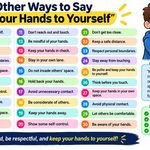
Have you ever wanted to tell someone to keep their hands to themselves but struggled to find the right words? For you are setting personal boundaries, teaching children about appropriate behavior, or navigating an uncomfortable social situation, choosing the right expression can make a real difference. The phrase “keep your hands to yourself” is direct and widely understood, but it may sound strict or confrontational depending on the context. Fortunately, there are many alternative ways to communicate the same message politely, confidently, or firmly. Learning these expressions can help you improve your English vocabulary, communicate more naturally, and handle everyday conversations with greater confidence.
In this guide, you will discover useful alternatives to “keep your hands to yourself,” along with explanations of their meanings and appropriate usage. From polite requests such as “please respect my personal space” to firmer statements like “don’t touch me,” these expressions cover a range of situations and communication styles. Each alternative is selected for clarity, practical relevance, and usefulness in everyday English. Whether you are an English learner, a professional, or someone who wants to express boundaries respectfully, this list will help you choose the right words for the right situation
Quick Categories: Choose the Right Expression
Formal alternatives to “Knock It Out of the Park”
- Achieve outstanding results: Emphasizes measurable success.
- Demonstrate exceptional performance: Suitable for evaluations and formal feedback.
- Exceed expectations: Highlights results beyond what was anticipated.
- Deliver an exemplary performance: Expresses strong professional approval.
Pro tip: Use precise, objective expressions in formal reports, academic writing, and performance reviews instead of idioms.
Casual alternatives
- Do an amazing job: Friendly and enthusiastic.
- Absolutely nail it: Expresses confident approval.
- Hit it out of the park: A close alternative that retains the baseball metaphor.
- Crush it: Communicates impressive success in relaxed conversation.
Pro tip: Use energetic expressions with friends and familiar colleagues, but consider your workplace culture before using slang.
Professional alternatives
- Deliver exceptional results: Focuses on quality and outcomes.
- Make a strong impression: Highlights a positive effect on an audience.
- Perform exceptionally well: Suitable for reviews and business discussions.
- Go above and beyond: Praises extra effort and initiative.
Pro tip: For business emails, connect praise to a specific achievement so your feedback sounds sincere and credible.
Informal expressions
- Ace it: Succeed at something, especially a test or task.
- Hit the mark: Meet the intended goal or standard.
- Be on fire: Perform exceptionally well over a period.
- Smash it: Achieve something impressively.
Pro tip: Informal expressions work well in conversations and messages. For formal documents, choose neutral wording such as “performed exceptionally well.”
“The best alternative is the one that matches your meaning, audience, and level of formality.”
Common Mistakes to Avoid
Here are five frequent errors English learners should watch for when using “knock it out of the park.”
1. Using the idiom in overly formal writing. Incorrect: “The organization knocked it out of the park in its official regulatory statement.” Better: “The organization achieved outstanding results in its regulatory review.”
2. Using the expression for ordinary performance. Incorrect: “She knocked it out of the park by arriving five minutes early.” Better: “She arrived five minutes early.” Why: The idiom usually suggests exceptional success, not simply completing a routine action.
3. Confusing effort with results. Incorrect: “He knocked it out of the park because he worked late.” Better: “He went above and beyond by working late.” Why: Working hard does not automatically mean achieving an outstanding result.
4. Using the wrong verb form. Incorrect: “She knock it out of the park yesterday.” Better: “She knocked it out of the park yesterday.” Why: Use the past-tense form when describing a completed achievement.
5. Mixing incompatible expressions. Incorrect: “He exceeded expectations out of the park.” Better: “He exceeded expectations.” Why: Each expression should stand on its own unless the sentence is deliberately constructed another way.
What Does “Knock It Out of the Park” Mean?
“Knock it out of the park” is an English idiom meaning to achieve exceptional success, perform extremely well, or impress people with an accomplishment.
The expression comes from baseball, where hitting a ball out of the playing field can produce a home run. In everyday English, it is used figuratively to describe outstanding results.
Grammar explanation: The phrase is commonly used with the pronoun it, which refers to a task, performance, presentation, or other activity. The verb changes according to tense.
- Present: “You knock it out of the park every time.”
- Past: “She knocked it out of the park yesterday.”
- Future: “I know you will knock it out of the park.”
Example: “Your presentation was excellent. You really knocked it out of the park.”
When to Use “Knock It Out of the Park”
This expression works best when you want to emphasize exceptional performance rather than ordinary success.
Common situations include:
- Presentations: Praising an engaging or persuasive presentation.
- Work projects: Recognizing a successful launch or excellent results.
- Examinations: Celebrating an outstanding performance on a test.
- Creative work: Complimenting a design, article, performance, or campaign.
- Sports and competitions: Describing a remarkable performance.
- Personal achievements: Congratulating someone on reaching an important goal.
Spoken vs. Written English
- Spoken English: Natural in conversations, celebrations, and informal workplace discussions.
- Written English: Appropriate for friendly emails, internal messages, and informal social posts; less suitable for highly formal documents.
Formal vs. Informal English
- Formal: “The team exceeded its performance targets.”
- Neutral: “The team performed exceptionally well.”
- Informal: “The team absolutely crushed it.”
Choose a phrase according to the relationship between the speaker and listener, the communication channel, and the seriousness of the situation.
Is It Professional or Polite to Say “Knock It Out of the Park”?
Politeness: Yes. The expression is generally positive and complimentary, so it is usually polite when directed sincerely at someone.
Professionalism: Not always. It is common in relaxed workplaces, team chats, and spoken praise, but more formal alternatives may be preferable in executive reports, client proposals, official correspondence, and performance documentation.
Business-style example:
“Your team exceeded expectations and delivered exceptional results during the product launch.”
Polite? Yes.
Professional? Not in every situation. The idiom is friendly and acceptable in many workplaces, but it is less formal than direct, results-focused language.
Pros and Cons of Using “Knock It Out of the Park”
Pros
- Simple and natural: Easy for many English speakers to understand.
- Friendly tone: Communicates enthusiasm and appreciation.
- Common usage: Familiar in everyday American English.
- Easy to understand: Conveys strong approval in a short phrase.
Cons
- Too informal for work: May not suit formal business writing.
- Overused: Repetition can make praise sound generic.
- Limited emotional range: Does not explain exactly what made the performance successful.
- Not suitable for formal writing: Objective language is often better for reports and official documents.
30 Other Ways to Say “Knock It Out of the Park” With Examples
These alternatives will help you sound more fluent, confident, and natural in different situations.
Use them according to tone, context, and audience to express excitement, admiration, or approval.
1. Excel
Meaning: To perform exceptionally well in a particular area.
Explanation: This versatile verb works in academic, professional, and personal contexts.
Example Sentence: “She continues to excel in her leadership role.”
Best Use: Formal praise
Worst Use: Casual banter
Tone: Positive, confident, professional
Context Variability: Casual: “He excels at cooking.” Professional: “She excels in project management.” Spoken: “You really excel at this.”
2. Do an Outstanding Job
Meaning: To complete a task exceptionally well.
Explanation: This direct expression emphasizes the quality of someone’s work.
Example Sentence: “Your team did an outstanding job preparing the annual report.”
Best Use: Workplace feedback
Worst Use: Casual teasing
Tone: Appreciative, clear, professional
Context Variability: Casual: “You did an outstanding job.” Professional: “The department did an outstanding job meeting its targets.” Spoken: “You did a fantastic job today.”
3. Exceed Expectations
Meaning: To perform better than anticipated.
Explanation: This phrase is particularly useful when achievements surpass established standards or goals.
Example Sentence: “The new campaign exceeded expectations and attracted more customers than projected.”
Best Use: Performance reviews
Worst Use: Routine tasks
Tone: Objective, professional, approving
Context Variability: Casual: “That meal exceeded my expectations.” Professional: “The project exceeded expectations.” Spoken: “You really exceeded my expectations.”
4. Deliver Exceptional Results
Meaning: To produce remarkably successful outcomes.
Explanation: This phrase focuses on measurable achievements rather than enthusiasm alone.
Example Sentence: “The marketing team delivered exceptional results during the final quarter.”
Best Use: Business reports
Worst Use: Friendly banter
Tone: Formal, confident, results-focused
Context Variability: Casual: “They delivered exceptional results.” Professional: “Our team delivered exceptional results within budget.” Spoken: “Your work delivered excellent results.”
5. Hit It Out of the Park
Meaning: To achieve something extremely successfully.
Explanation: This is the closest alternative because it retains the original baseball metaphor.
Example Sentence: “You hit it out of the park with that presentation.”
Best Use: Enthusiastic praise
Worst Use: Formal reports
Tone: Energetic, friendly, celebratory
Context Variability: Casual: “You hit it out of the park.” Professional: “The team hit it out of the park with the launch.” Spoken: “You really hit it out of the park today.”
6. Absolutely Nail It
Meaning: To perform a task perfectly or very successfully.
Explanation: This informal expression is useful when someone handles a challenge particularly well.
Example Sentence: “You absolutely nailed the client presentation.”
Best Use: Team conversations
Worst Use: Formal correspondence
Tone: Enthusiastic, informal, approving
Context Variability: Casual: “You nailed it.” Professional: “You handled the presentation exceptionally well.” Spoken: “You absolutely nailed that answer.”
7. Do an Amazing Job
Meaning: To perform a task extremely well.
Explanation: This simple expression is easy to understand and appropriate for everyday compliments.
Example Sentence: “You did an amazing job organizing the event.”
Best Use: Everyday praise
Worst Use: Technical reports
Tone: Warm, enthusiastic, friendly
Context Variability: Casual: “You did an amazing job.” Professional: “You did an excellent job coordinating the event.” Spoken: “You did such an amazing job.”
8. Crush It
Meaning: To achieve impressive success.
Explanation: This energetic informal expression is common in conversations about work, sports, and personal goals.
Example Sentence: “You crushed it during the sales presentation.”
Best Use: Informal encouragement
Worst Use: Formal documents
Tone: Bold, upbeat, informal
Context Variability: Casual: “You crushed it.” Professional: “You achieved excellent sales results.” Spoken: “Go out there and crush it.”
9. Demonstrate Exceptional Performance
Meaning: To show an unusually high level of ability or effectiveness.
Explanation: This formal expression works well in evaluations and official assessments.
Example Sentence: “The employee demonstrated exceptional performance throughout the project.”
Best Use: Formal evaluations
Worst Use: Casual chats
Tone: Formal, objective, respectful
Context Variability: Casual: “She performed brilliantly.” Professional: “He demonstrated exceptional performance.” Spoken: “You performed exceptionally well.”
10. Make a Strong Impression
Meaning: To cause others to form a positive and lasting opinion.
Explanation: Use this expression when someone’s work, behavior, or presentation impresses an audience.
Example Sentence: “The candidate made a strong impression during the interview.”
Best Use: Interviews, presentations
Worst Use: Private achievements
Tone: Positive, polished, professional
Context Variability: Casual: “You made a great impression.” Professional: “She made a strong impression on the panel.” Spoken: “You really impressed everyone.”
11. Perform Exceptionally Well
Meaning: To perform at a particularly high level.
Explanation: This neutral phrase is suitable for both spoken English and formal writing.
Example Sentence: “The entire team performed exceptionally well under pressure.”
Best Use: Performance assessments
Worst Use: Playful banter
Tone: Neutral, professional, complimentary
Context Variability: Casual: “You performed really well.” Professional: “The department performed exceptionally well.” Spoken: “You did exceptionally well today.”
12. Go Above and Beyond
Meaning: To do more than a task or role requires.
Explanation: This expression emphasizes extra effort, initiative, or commitment rather than results alone.
Example Sentence: “She went above and beyond to help the customer resolve the issue.”
Best Use: Employee recognition
Worst Use: Results-only reporting
Tone: Appreciative, encouraging, professional
Context Variability: Casual: “You went above and beyond.” Professional: “The employee consistently went above and beyond expectations.” Spoken: “You really went the extra mile.”
13. Ace It
Meaning: To succeed at something extremely well.
Explanation: This informal expression is particularly common for exams, interviews, and challenging tasks.
Example Sentence: “You prepared thoroughly, so I know you will ace the interview.”
Best Use: Tests, interviews
Worst Use: Formal reports
Tone: Confident, casual, encouraging
Context Variability: Casual: “I aced the test.” Professional: “She performed very well in the interview.” Spoken: “You are going to ace it.”
14. Hit the Mark
Meaning: To achieve the intended goal or meet the desired standard.
Explanation: This expression is useful when an outcome matches expectations or requirements.
Example Sentence: “The revised proposal hit the mark with the client.”
Best Use: Meeting objectives
Worst Use: Major achievements
Tone: Clear, positive, measured
Context Variability: Casual: “That joke hit the mark.” Professional: “The campaign hit the mark with its target audience.” Spoken: “Your explanation really hit the mark.”
15. Be on Fire
Meaning: To perform exceptionally well, often repeatedly or over a short period.
Explanation: This informal idiom highlights a streak of success rather than a single accomplishment.
Example Sentence: “You have won three matches in a row. You are on fire!”
Best Use: Sports, casual praise
Worst Use: Formal reviews
Tone: Excited, playful, energetic
Context Variability: Casual: “You are on fire today.” Professional: “The team has maintained an impressive winning streak.” Spoken: “You have been on fire all week.”
16. Smash It
Meaning: To accomplish something with impressive success.
Explanation: This informal expression is common in British English and other varieties of English.
Example Sentence: “Good luck with your presentation. You are going to smash it.”
Best Use: Friendly encouragement
Worst Use: Formal writing
Tone: Energetic, informal, confident
Context Variability: Casual: “You smashed it.” Professional: “You delivered an excellent presentation.” Spoken: “Go and smash it today.”
17. Achieve Outstanding Results
Meaning: To accomplish results that are significantly better than average.
Explanation: This phrase emphasizes achievement and works well in formal communication.
Example Sentence: “The research team achieved outstanding results in the latest trial.”
Best Use: Reports, evaluations
Worst Use: Lighthearted conversation
Tone: Formal, objective, appreciative
Context Variability: Casual: “They achieved great results.” Professional: “The department achieved outstanding results.” Spoken: “Your efforts produced excellent results.”
18. Deliver an Exemplary Performance
Meaning: To perform at a level worthy of admiration or imitation.
Explanation: This formal expression is appropriate for public speaking, evaluations, and professional recognition.
Example Sentence: “The presenter delivered an exemplary performance at the conference.”
Best Use: Formal recognition
Worst Use: Everyday banter
Tone: Refined, formal, respectful
Context Variability: Casual: “She did a brilliant job.” Professional: “He delivered an exemplary performance.” Spoken: “That was an outstanding presentation.”
19. Impress Everyone
Meaning: To earn admiration from the people who observe a performance.
Explanation: Use this expression when the audience’s positive reaction is the main point.
Example Sentence: “Her innovative solution impressed everyone in the meeting.”
Best Use: Audience reactions
Worst Use: Objective reporting
Tone: Positive, enthusiastic, accessible
Context Variability: Casual: “You impressed everyone.” Professional: “Her proposal impressed the review committee.” Spoken: “You really impressed everyone today.”
20. Rise to the Occasion
Meaning: To respond successfully to a challenging situation.
Explanation: This phrase emphasizes meeting a difficult moment with skill, courage, or determination.
Example Sentence: “When the deadline changed, the entire team rose to the occasion.”
Best Use: Challenging situations
Worst Use: Routine activities
Tone: Encouraging, respectful, inspiring
Context Variability: Casual: “You rose to the occasion.” Professional: “The team rose to the occasion under pressure.” Spoken: “I knew you would rise to the occasion.”
21. Set a New Standard
Meaning: To achieve a level of quality that becomes a benchmark for others.
Explanation: Use this phrase when an accomplishment establishes a new benchmark.
Example Sentence: “The redesigned service set a new standard for customer support.”
Best Use: Industry achievements
Worst Use: Ordinary tasks
Tone: Authoritative, positive, ambitious
Context Variability: Casual: “That meal set a new standard.” Professional: “The initiative set a new standard for efficiency.” Spoken: “You have set a new standard for the team.”
22. Pull Off Something Impressive
Meaning: To achieve something difficult or unexpected successfully.
Explanation: This phrase is particularly effective when the achievement involves a challenge or obstacle.
Example Sentence: “The organizers pulled off an impressive event despite the last-minute changes.”
Best Use: Unexpected success
Worst Use: Formal evaluations
Tone: Conversational, admiring, upbeat
Context Variability: Casual: “You pulled it off.” Professional: “The team successfully delivered the event.” Spoken: “I cannot believe you pulled that off.”
23. Shine
Meaning: To perform particularly well or stand out positively.
Explanation: This concise expression works well for highlighting talent, strengths, and confidence.
Example Sentence: “She really shone during the leadership discussion.”
Best Use: Talent recognition
Worst Use: Detailed reports
Tone: Warm, positive, encouraging
Context Variability: Casual: “You really shone today.” Professional: “She shone during the client presentation.” Spoken: “You always shine under pressure.”
24. Make a Home Run
Meaning: To achieve a major success.
Explanation: This baseball-inspired expression can be understood, but “hit a home run” is the more natural standard phrasing in English.
Example Sentence: “The company hit a home run with its new product.”
Best Use: Major successes
Worst Use: Formal documentation
Tone: Enthusiastic, conversational, celebratory
Context Variability: Casual: “That was a home run.” Professional: “The launch was a major success.” Spoken: “You hit a home run with that idea.”
25. Nail the Execution
Meaning: To carry out a plan or task extremely effectively.
Explanation: This expression focuses on how well an idea or plan was implemented.
Example Sentence: “The team nailed the execution of the product launch.”
Best Use: Project delivery
Worst Use: Formal academic prose
Tone: Confident, practical, informal
Context Variability: Casual: “You nailed the execution.” Professional: “The team executed the plan flawlessly.” Spoken: “You really nailed the delivery.”
26. Outperform Expectations
Meaning: To achieve a level of performance higher than expected.
Explanation: This results-focused phrase is useful in business, education, and performance analysis.
Example Sentence: “The new service outperformed expectations during its first month.”
Best Use: Business results
Worst Use: Casual compliments
Tone: Analytical, professional, positive
Context Variability: Casual: “The results were better than expected.” Professional: “The service outperformed expectations.” Spoken: “You did even better than we expected.”
27. Deliver a Winning Performance
Meaning: To perform successfully in a way that produces a favorable outcome.
Explanation: This phrase is especially suitable for competitions, presentations, and high-stakes events.
Example Sentence: “The sales team delivered a winning performance at the annual conference.”
Best Use: Competitive settings
Worst Use: Routine paperwork
Tone: Energetic, polished, approving
Context Variability: Casual: “That was a winning performance.” Professional: “The team delivered a winning performance.” Spoken: “You gave a winning presentation.”
28. Set the Bar High
Meaning: To establish a high standard of quality or performance.
Explanation: Use this expression when someone creates a benchmark that others may find difficult to match.
Example Sentence: “Your work on this project has set the bar high for future teams.”
Best Use: Quality benchmarks
Worst Use: Modest achievements
Tone: Respectful, confident, aspirational
Context Variability: Casual: “You set the bar high.” Professional: “This achievement sets a high standard for future projects.” Spoken: “You have really raised the bar.”
29. Turn in a Stellar Performance
Meaning: To deliver an outstanding performance.
Explanation: “Stellar” adds emphasis and is appropriate for polished praise in writing or speech.
Example Sentence: “The speaker turned in a stellar performance at the international conference.”
Best Use: Public recognition
Worst Use: Routine updates
Tone: Enthusiastic, polished, complimentary
Context Variability: Casual: “You gave a stellar performance.” Professional: “She delivered a stellar presentation.” Spoken: “That was a stellar performance.”
30. Surpass All Expectations
Meaning: To perform better than anyone reasonably anticipated.
Explanation: This expression communicates exceptional achievement and is especially effective when results are surprising.
Example Sentence: “The project surpassed all expectations in quality, speed, and customer satisfaction.”
Best Use: Exceptional achievements
Worst Use: Ordinary results
Tone: Formal, emphatic, appreciative
Context Variability: Casual: “It was better than I imagined.” Professional: “The project surpassed all expectations.” Spoken: “You surpassed all our expectations.”
“For professional communication, ‘exceeded expectations’ is often a stronger choice than an idiom because it focuses on the achievement itself.”
Mini Quiz: Test Your Understanding
Choose the most suitable expression for each situation.
1. You are writing a formal employee performance review. Which phrase fits best?
Crush it
Demonstrate exceptional performance
Be on fire
2. Your friend has just completed a difficult exam successfully. What sounds natural?
You absolutely nailed it!
You demonstrated exceptional performance in the examination.
You set a new standard of compliance.
3. A project delivered better results than the original target. Which phrase is most precise?
Rise to the occasion
Exceed expectations
Shine
4. Your colleague worked extra hours to help a customer. What best praises the extra effort?
Go above and beyond
Hit the mark
Ace it
0 of 4 answered
Reset quiz
Comparison Table: Top 10 Alternatives
| Phrase | Tone | Best Use |
| Excel | Professional | Skills and achievements |
| Do an outstanding job | Neutral, positive | Workplace praise |
| Exceed expectations | Formal | Performance reviews |
| Deliver exceptional results | Professional | Business reports |
| Hit it out of the park | Informal | Enthusiastic praise |
| Absolutely nail it | Casual | Presentations and tasks |
| Make a strong impression | Polished | Interviews and meetings |
| Go above and beyond | Appreciative | Extra effort |
| Rise to the occasion | Encouraging | Difficult situations |
| Surpass all expectations | Formal, emphatic | Exceptional results |
Related Reading
- See also: Other Ways to Say “Great Job” for more natural ways to praise someone’s work.
- See also: Professional English Phrases for Meetings and Emails to improve workplace communication.
Keep learning: Which expression do you use most often? Share your favorite alternative and practice using it in a sentence.
FAQs
1. What are the best alternatives to “knock it out of the park”?
The best alternatives include “exceed expectations,” “excel,” “do an outstanding job,” “deliver exceptional results,” and “absolutely nail it.” Choose according to your audience and the level of formality.
2. What is a professional way to say “knock it out of the park”?
Use “deliver exceptional results,” “perform exceptionally well,” or “exceed expectations.” These phrases communicate strong approval without relying on informal idioms.
3. Is “knock it out of the park” formal or informal?
It is generally an informal idiom. It is widely understood in everyday English and many workplaces, but formal reports and official documents often benefit from more precise alternatives.
4. Can I use “knock it out of the park” in a business email?
Yes, especially when writing to familiar colleagues in a relaxed workplace. For clients, senior executives, or formal correspondence, “Your team exceeded expectations” may be more appropriate.
5. What is the difference between “knock it out of the park” and “exceed expectations”?
“Knock it out of the park” expresses enthusiastic admiration for exceptional performance. “Exceed expectations” emphasizes achieving more than anticipated and generally sounds more objective and professional.
Conclusion
Learning other ways to say “knock it out of the park” helps you communicate praise more precisely, confidently, and naturally. From casual expressions such as “crush it” and “ace it” to professional alternatives such as “deliver exceptional results” and “exceed expectations,” each phrase offers a different way to recognize success.
Practice these expressions in daily conversations, workplace emails, presentations, and feedback. Pay attention to your audience, the situation, and the tone you want to convey. With regular practice, you will develop a broader vocabulary and become more confident choosing the right expression for every occasion.