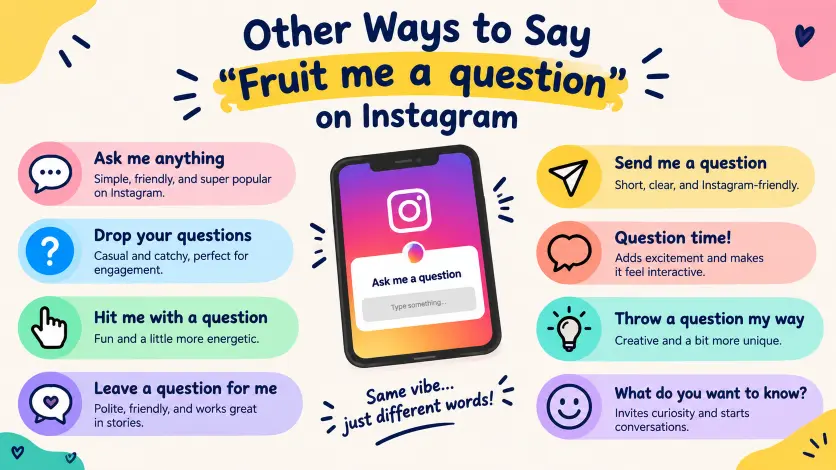
Looking for better ways to say “Ask me a question” on Instagram? Whether you are creating an Instagram Story, hosting a Q&A, promoting your personal brand, or simply encouraging followers to interact, using the same phrase repeatedly can feel predictable. A fresh, natural invitation can make your content sound more engaging and encourage people to respond. From casual expressions like “Got a question? Send it my way!” to professional options such as “Feel free to ask me anything,” the right wording depends on your audience, personality, and purpose.
In this guide, you’ll discover 30 practical alternatives to “Ask me a question” on Instagram, organized to help you choose the right expression for different situations. These phrases are useful for creators, influencers, businesses, students, professionals, and English learners who want to communicate naturally online. Each alternative focuses on clear, everyday English and shows how small wording changes can make an Instagram invitation feel more friendly, conversational, and engaging.
Formal Alternatives to “Fruit”
- Fresh produce
- Agricultural produce
- Orchard produce
- Seasonal produce
Pro Tip
Use these expressions when discussing food in reports, presentations, agriculture, retail, or formal writing. “Produce” is especially useful when the exact type of fruit is already clear.
Casual Alternatives
- Fresh fruit
- Nature’s treats
- Fresh picks
- Sweet produce
Pro Tip
Casual expressions work well in everyday conversations, food blogs, social posts, and friendly discussions. Choose natural wording rather than forcing a synonym.
Professional Alternatives
- Fresh produce
- Seasonal produce
- Fresh food products
- Agricultural produce
Pro Tip
In professional communication, select terms that describe the category accurately. “Fresh produce” usually sounds more natural than trying to replace “fruit” with an unusual synonym.
Informal Expressions
- Fresh picks
- Nature’s treats
- Sweet treats
- Fresh goodies
Pro Tip
Informal expressions in English are best suited to friendly conversations, captions, food reviews, and relaxed marketing. Avoid them in technical reports unless the tone allows creativity.
“Specific vocabulary makes ordinary descriptions more vivid and useful.”
Common Mistakes When Using “Fruit”
1. Using “produce” for every situation
Mistake: “I ate some produce for breakfast.”
Better: “I ate some fruit for breakfast.”
“Produce” can include vegetables as well as fruit, so it may be too broad when you mean fruit specifically.
2. Treating “fruit” as always countable
Mistake: “I bought three fruits” when discussing fruit generally.
Better: “I bought three pieces of fruit.”
“Fruit” is commonly uncountable when referring to food generally, although “fruits” is possible when referring to different varieties or types.
3. Using “berries” as a general synonym
Mistake: “I love eating berries” when you mean apples, bananas, and oranges too.
Better: “I love eating fruit.”
“Berries” describes a specific group of fruits, not fruit as a whole.
4. Using “citrus” for all fruit
Mistake: “Bananas are citrus.”
Better: “Oranges and lemons are citrus fruits.”
“Citrus” refers to a particular botanical and culinary group.
5. Using informal expressions in formal writing
Mistake: “The company sells nature’s treats.”
Better: “The company sells fresh produce.”
Creative expressions may sound inappropriate in academic, business, or technical contexts.
What Does “Fruit” Mean?
“Fruit” generally refers to the edible reproductive part of a flowering plant, especially when it is commonly eaten as food. In everyday English, it usually includes foods such as apples, oranges, bananas, grapes, mangoes, and strawberries.
Grammatically, fruit is often used as an uncountable noun when discussing fruit as a category.
Example: “Eating fresh fruit can be part of a balanced diet.”
When referring to several varieties or types, fruits can also be used.
Example: “Tropical fruits are popular in many countries.”
When to Use “Fruit”
You can use “fruit” in many everyday and professional contexts:
- When discussing food and nutrition
- When talking about grocery shopping
- When describing a healthy diet
- When discussing farming and agriculture
- When writing recipes
- When talking about different varieties
- When describing desserts and drinks
- When discussing seasonal foods
Spoken vs. Written
Spoken English: “I bought some fruit from the market.”
Written English: “The report examines consumer demand for fresh fruit.”
Formal vs. Informal
Formal: “The retailer specializes in seasonal produce.”
Informal: “I picked up some fresh fruit.”
“Context determines whether a vocabulary choice sounds natural, professional, or unnecessarily complicated.”
Is It Professional or Polite to Say “Fruit”?
Polite? ✔️ Yes
Professional? ❌ No, in most cases
The word “fruit” is perfectly polite and standard English, but it is not inherently a professional expression. In business, agriculture, retail, or nutrition writing, more specific terms such as fresh produce, seasonal produce, or agricultural produce may provide greater precision.
Business-style example:
“Our company sources fresh produce from regional farms.”
Pros and Cons of Using “Fruit”
Pros
- Simple and natural: Easy for almost every English speaker to understand.
- Friendly tone: Works naturally in everyday conversations.
- Common usage: Appropriate in many ordinary situations.
- Easy to understand: Rarely creates confusion when the context is clear.
Cons
- Too informal for some work contexts: More precise terminology may be preferable.
- Overused: Repeating the same noun can make writing less varied.
- Limited emotional range: It does not communicate much about quality, freshness, or variety.
- Not suitable for all formal writing: Technical contexts may require more precise terminology.
“Do not replace a simple word just to sound advanced. Replace it when the new expression communicates your meaning more accurately.”
Other Ways to Say “Fruit” With Examples
These alternatives to fruit can help you sound more fluent, confident, and natural in different situations.
Use them according to tone, context, and audience to express excitement, admiration, or approval when discussing food and produce.
1. Phrase: Fresh Produce
- Meaning: Recently harvested food products, especially fruits and vegetables.
- Explanation: This is one of the most natural professional alternatives to “fruit” when the context includes food retail or agriculture.
- Example Sentence: “The supermarket receives fresh produce every morning.”
- Best Use: Retail communication
- Worst Use: Specific fruit
- Tone: Professional, natural, practical
- Context Variability: Casual: “I bought fresh produce.” Professional: “We source fresh produce locally.” Spoken: “The market has great fresh produce.”
2. Phrase: Fresh Fruit
- Meaning: Fruit that is fresh rather than processed, canned, or dried.
- Explanation: This phrase adds information about freshness while remaining completely natural.
- Example Sentence: “The hotel provides fresh fruit at breakfast.”
- Best Use: Everyday descriptions
- Worst Use: Technical writing
- Tone: Natural, clear, friendly
- Context Variability: Casual: “I want some fresh fruit.” Professional: “Fresh fruit is available to guests.” Spoken: “They serve fresh fruit.”
3. Phrase: Produce
- Meaning: Food grown or produced by agriculture, especially fruits and vegetables.
- Explanation: “Produce” is broader than “fruit” and should be used when the wider category is intended.
- Example Sentence: “The store sells locally grown produce.”
- Best Use: Grocery contexts
- Worst Use: Fruit-specific meaning
- Tone: Professional, neutral, practical
- Context Variability: Casual: “The produce looks good.” Professional: “Our produce is locally sourced.” Spoken: “Where’s the produce section?”
4. Phrase: Seasonal Produce
- Meaning: Agricultural food available naturally during a particular season.
- Explanation: This phrase emphasizes availability according to the time of year.
- Example Sentence: “The restaurant changes its menu to feature seasonal produce.”
- Best Use: Food writing
- Worst Use: Generic fruit
- Tone: Professional, descriptive, refined
- Context Variability: Casual: “I love seasonal produce.” Professional: “We prioritize seasonal produce.” Spoken: “They use seasonal produce.”
5. Phrase: Orchard Produce
- Meaning: Agricultural products harvested from orchards.
- Explanation: This expression is useful when discussing apples, pears, peaches, and similar orchard-grown foods.
- Example Sentence: “The farm specializes in high-quality orchard produce.”
- Best Use: Agriculture
- Worst Use: Tropical fruit
- Tone: Formal, agricultural, specific
- Context Variability: Casual: “The orchard has great produce.” Professional: “Orchard produce is shipped nationwide.” Spoken: “This farm sells orchard produce.”
6. Phrase: Agricultural Produce
- Meaning: Food and other products obtained through farming.
- Explanation: This is a formal expression that can include fruits, vegetables, grains, and other crops.
- Example Sentence: “The region exports a large volume of agricultural produce.”
- Best Use: Formal writing
- Worst Use: Casual chat
- Tone: Formal, technical, professional
- Context Variability: Casual: “They grow lots of produce.” Professional: “Agricultural produce is a major export.” Spoken: “The area produces agricultural goods.”
7. Phrase: Farm-Fresh Produce
- Meaning: Produce that is presented as recently harvested or directly associated with a farm.
- Explanation: It emphasizes freshness and a connection to agricultural production.
- Example Sentence: “Customers appreciate the farm-fresh produce sold at the weekend market.”
- Best Use: Marketing
- Worst Use: Scientific reports
- Tone: Friendly, descriptive, promotional
- Context Variability: Casual: “I bought farm-fresh produce.” Professional: “We market farm-fresh produce.” Spoken: “They sell farm-fresh produce.”
8. Phrase: Fresh Picks
- Meaning: Freshly selected or recently available food items.
- Explanation: “Fresh picks” is a creative, informal expression often used in marketing.
- Example Sentence: “Check out this week’s fresh picks from local farms.”
- Best Use: Marketing copy
- Worst Use: Academic writing
- Tone: Casual, upbeat, promotional
- Context Variability: Casual: “These are my fresh picks.” Professional: “Explore our weekly fresh picks.” Spoken: “These are today’s fresh picks.”
9. Phrase: Nature’s Treats
- Meaning: A creative expression for naturally grown foods enjoyed as something pleasant.
- Explanation: This phrase is figurative rather than a direct dictionary synonym.
- Example Sentence: “The picnic table was filled with nature’s treats.”
- Best Use: Creative writing
- Worst Use: Business reports
- Tone: Warm, creative, positive
- Context Variability: Casual: “I love nature’s treats.” Professional: “The campaign celebrates nature’s treats.” Spoken: “These feel like nature’s treats.”
10. Phrase: Sweet Produce
- Meaning: Produce known for a naturally sweet flavor.
- Explanation: This expression highlights taste rather than simply identifying the food category.
- Example Sentence: “The market offers a wide range of sweet produce.”
- Best Use: Food descriptions
- Worst Use: Savory fruit
- Tone: Descriptive, casual, friendly
- Context Variability: Casual: “I prefer sweet produce.” Professional: “The display features sweet produce.” Spoken: “They have plenty of sweet produce.”
11. Phrase: Fresh Goodies
- Meaning: A friendly informal expression for appealing fresh foods.
- Explanation: It is suitable for relaxed communication but is not a direct technical synonym.
- Example Sentence: “We came home with a basket of fresh goodies.”
- Best Use: Friendly conversation
- Worst Use: Formal reports
- Tone: Informal, cheerful, friendly
- Context Variability: Casual: “Look at these fresh goodies.” Professional: “The campaign promotes fresh goodies.” Spoken: “We bought some fresh goodies.”
12. Phrase: Healthy Produce
- Meaning: Fresh agricultural foods associated with healthy eating.
- Explanation: This expression emphasizes the nutritional or wellness context.
- Example Sentence: “The program encourages families to buy healthy produce.”
- Best Use: Health contexts
- Worst Use: Exact variety
- Tone: Neutral, positive, practical
- Context Variability: Casual: “I try to eat healthy produce.” Professional: “The initiative promotes healthy produce.” Spoken: “They sell healthy produce.”
13. Phrase: Natural Produce
- Meaning: Produce described as naturally grown or minimally processed.
- Explanation: Use this phrase carefully because “natural” can have different meanings depending on context.
- Example Sentence: “The shop specializes in natural produce.”
- Best Use: Food marketing
- Worst Use: Scientific precision
- Tone: Neutral, descriptive, promotional
- Context Variability: Casual: “I prefer natural produce.” Professional: “Our brand focuses on natural produce.” Spoken: “They offer natural produce.”
14. Phrase: Fresh Food
- Meaning: Food that is fresh rather than preserved or heavily processed.
- Explanation: This is broader than “fruit” and should be used when the wider food category is intended.
- Example Sentence: “The market is known for fresh food.”
- Best Use: General contexts
- Worst Use: Fruit-specific meaning
- Tone: Simple, neutral, natural
- Context Variability: Casual: “I prefer fresh food.” Professional: “The restaurant emphasizes fresh food.” Spoken: “They serve fresh food.”
15. Phrase: Edible Produce
- Meaning: Agricultural products suitable for eating.
- Explanation: This is a more technical phrase and is useful when discussing food production.
- Example Sentence: “The facility inspects all edible produce before distribution.”
- Best Use: Technical contexts
- Worst Use: Casual conversation
- Tone: Technical, formal, precise
- Context Variability: Casual: “The produce is ready to eat.” Professional: “Edible produce undergoes inspection.” Spoken: “The produce is edible.”
16. Phrase: Market Produce
- Meaning: Produce sold through a market.
- Explanation: The phrase focuses on the commercial setting rather than the specific type of food.
- Example Sentence: “Local market produce is often sold directly to consumers.”
- Best Use: Retail contexts
- Worst Use: Personal diet
- Tone: Neutral, commercial, practical
- Context Variability: Casual: “The market produce looks fresh.” Professional: “Market produce supports local vendors.” Spoken: “I like buying market produce.”
17. Phrase: Local Produce
- Meaning: Food grown or produced within a nearby geographical area.
- Explanation: This expression is useful when emphasizing regional sourcing.
- Example Sentence: “The restaurant supports local produce suppliers.”
- Best Use: Local sourcing
- Worst Use: Distant imports
- Tone: Professional, natural, positive
- Context Variability: Casual: “I love local produce.” Professional: “We prioritize local produce.” Spoken: “They use local produce.”
18. Phrase: Organic Produce
- Meaning: Produce marketed or certified as meeting applicable organic production standards.
- Explanation: This phrase should be used specifically when organic status is relevant.
- Example Sentence: “The store has a dedicated section for organic produce.”
- Best Use: Retail contexts
- Worst Use: Generic fruit
- Tone: Professional, specific, neutral
- Context Variability: Casual: “I usually buy organic produce.” Professional: “The retailer specializes in organic produce.” Spoken: “Do they sell organic produce?”
19. Phrase: Tropical Fruit
- Meaning: Fruit associated with tropical or warm climates.
- Explanation: This is a specific category rather than a universal replacement for “fruit.”
- Example Sentence: “The smoothie contains several types of tropical fruit.”
- Best Use: Specific categories
- Worst Use: Apples and pears
- Tone: Descriptive, specific, natural
- Context Variability: Casual: “I love tropical fruit.” Professional: “The company imports tropical fruit.” Spoken: “They have great tropical fruit.”
20. Phrase: Citrus
- Meaning: A group of fruits such as oranges, lemons, limes, and grapefruits.
- Explanation: “Citrus” should only be used when referring to citrus varieties.
- Example Sentence: “The recipe combines several types of citrus.”
- Best Use: Specific fruit
- Worst Use: General category
- Tone: Natural, culinary, specific
- Context Variability: Casual: “I love citrus.” Professional: “The product contains citrus extracts.” Spoken: “This drink has a citrus flavor.”
21. Phrase: Berries
- Meaning: A category of small, soft fruits such as strawberries, blueberries, and raspberries.
- Explanation: Use “berries” when referring specifically to this group.
- Example Sentence: “The breakfast bowl is topped with fresh berries.”
- Best Use: Specific category
- Worst Use: All fruit
- Tone: Natural, specific, friendly
- Context Variability: Casual: “I bought some berries.” Professional: “Fresh berries are in high demand.” Spoken: “Would you like some berries?”
22. Phrase: Orchard Fruits
- Meaning: Fruits commonly grown on trees in orchards.
- Explanation: This phrase provides greater specificity than the general word “fruit.”
- Example Sentence: “The region is famous for its orchard fruits.”
- Best Use: Agriculture
- Worst Use: Berries
- Tone: Formal, descriptive, specific
- Context Variability: Casual: “I like orchard fruits.” Professional: “Orchard fruits account for much of the harvest.” Spoken: “These are common orchard fruits.”
23. Phrase: Tree Fruits
- Meaning: Fruits that grow on trees.
- Explanation: This practical category can include apples, peaches, pears, cherries, and similar fruits.
- Example Sentence: “The farm grows several varieties of tree fruits.”
- Best Use: Agriculture
- Worst Use: Bananas generally
- Tone: Neutral, descriptive, educational
- Context Variability: Casual: “I enjoy tree fruits.” Professional: “Tree fruits require careful cultivation.” Spoken: “These are tree fruits.”
24. Phrase: Seasonal Fruits
- Meaning: Fruits that are naturally or commercially available during a particular season.
- Explanation: This phrase is useful for menus, shopping, nutrition, and agriculture.
- Example Sentence: “The chef uses seasonal fruits in the dessert menu.”
- Best Use: Food writing
- Worst Use: Year-round products
- Tone: Natural, descriptive, professional
- Context Variability: Casual: “I love seasonal fruits.” Professional: “The menu features seasonal fruits.” Spoken: “What seasonal fruits are available?”
25. Phrase: Fresh Harvest
- Meaning: Recently harvested agricultural food.
- Explanation: This phrase emphasizes when produce was gathered rather than its exact category.
- Example Sentence: “The market celebrates the season’s fresh harvest.”
- Best Use: Marketing
- Worst Use: Exact identification
- Tone: Warm, promotional, descriptive
- Context Variability: Casual: “Look at this fresh harvest.” Professional: “The campaign highlights the fresh harvest.” Spoken: “This is from the fresh harvest.”
26. Phrase: Garden Produce
- Meaning: Food grown in a garden.
- Explanation: It is useful when describing small-scale or homegrown agricultural products.
- Example Sentence: “The family shares garden produce with their neighbors.”
- Best Use: Home gardening
- Worst Use: Commercial imports
- Tone: Friendly, natural, descriptive
- Context Variability: Casual: “We have plenty of garden produce.” Professional: “The project distributes garden produce.” Spoken: “This came from our garden.”
27. Phrase: Homegrown Produce
- Meaning: Produce grown locally or by the person or organization discussing it.
- Explanation: This phrase emphasizes personal or local cultivation.
- Example Sentence: “They serve homegrown produce at the community event.”
- Best Use: Local contexts
- Worst Use: Imported products
- Tone: Friendly, warm, natural
- Context Variability: Casual: “We have homegrown produce.” Professional: “The café promotes homegrown produce.” Spoken: “Most of this is homegrown.”
28. Phrase: Nutritious Produce
- Meaning: Produce considered valuable as part of a nutritious diet.
- Explanation: This phrase highlights nutritional value rather than simply identifying fruit.
- Example Sentence: “The program encourages children to eat more nutritious produce.”
- Best Use: Health writing
- Worst Use: Exact fruit name
- Tone: Professional, positive, informative
- Context Variability: Casual: “I want more nutritious produce.” Professional: “The campaign promotes nutritious produce.” Spoken: “We should buy more nutritious produce.”
29. Phrase: Fresh Food Products
- Meaning: Food products that are sold in a fresh state.
- Explanation: This is a broad business-oriented expression that can include fruit.
- Example Sentence: “The company distributes fresh food products to regional retailers.”
- Best Use: Business writing
- Worst Use: Casual chat
- Tone: Corporate, formal, precise
- Context Variability: Casual: “They sell fresh food.” Professional: “We distribute fresh food products.” Spoken: “The company handles fresh food products.”
30. Phrase: Nature’s Bounty
- Meaning: A figurative expression for abundant natural food resources.
- Explanation: It is a creative phrase that can describe fruit when emphasizing abundance and natural beauty.
- Example Sentence: “The display celebrates nature’s bounty with colorful produce.”
- Best Use: Creative writing
- Worst Use: Technical reports
- Tone: Poetic, warm, expressive
- Context Variability: Casual: “Nature’s bounty is amazing.” Professional: “The campaign celebrates nature’s bounty.” Spoken: “This display really shows nature’s bounty.”
Scroll-Stopping Highlights
“Use ‘fresh produce’ when you want a natural professional alternative to ‘fruit.’”
“Do not use ‘citrus’ or ‘berries’ as general synonyms because they describe specific fruit categories.”
“The most fluent speakers choose vocabulary based on context, not complexity.”
“Professional English becomes clearer when your word choice adds useful information.”
Mini Quiz: Test Your Understanding
1. Which phrase is most suitable for a supermarket report?
A. Nature’s treats
B. Fresh produce
C. Fresh goodies
D. Sweet treats
Answer: B. Fresh produce
2. Which expression specifically describes oranges, lemons, and limes?
A. Orchard produce
B. Citrus
C. Garden produce
D. Tree fruits
Answer: B. Citrus
3. Which phrase sounds most informal?
A. Agricultural produce
B. Fresh food products
C. Fresh goodies
D. Seasonal produce
Answer: C. Fresh goodies
4. Which sentence is most appropriate for a professional presentation?
A. “We sell nature’s treats.”
B. “We sell fresh produce.”
C. “We sell fresh goodies.”
D. “We sell sweet treats.”
Answer: B. “We sell fresh produce.”
Comparison Table: Top Alternatives
| Phrase | Tone | Best Use |
| Fresh produce | Professional, natural | Retail and business |
| Fresh fruit | Neutral, natural | Everyday English |
| Produce | Neutral, practical | Grocery contexts |
| Seasonal produce | Professional, descriptive | Food and agriculture |
| Local produce | Professional, positive | Local sourcing |
| Farm-fresh produce | Promotional, friendly | Marketing |
| Agricultural produce | Formal, technical | Reports |
| Tropical fruit | Specific, descriptive | Fruit categories |
| Citrus | Specific, natural | Culinary contexts |
| Berries | Specific, friendly | Specific fruit category |
FAQs
1. What are the best alternatives to “fruit”?
Some useful alternatives include fresh produce, fresh fruit, seasonal produce, local produce, orchard produce, and agricultural produce. The best choice depends on your context.
2. Is “produce” another word for “fruit”?
“Produce” can include fruit, but it usually refers to fruits and vegetables collectively. Use “fresh produce” when the wider category is intended.
3. What is a professional way to say “fruit”?
Fresh produce, seasonal produce, and agricultural produce can work well in professional contexts, depending on the intended meaning.
4. Can I use “berries” instead of “fruit”?
Only when you specifically mean berries. “Berries” refers to a particular category and is not a general replacement for all fruit.
5. How can learning alternatives to “fruit” improve my English?
Learning alternatives helps you avoid repetition, describe food more precisely, and select vocabulary appropriate for casual conversations, professional writing, and formal communication.
Conclusion
Learning different ways to say “fruit” can make your English more flexible and precise. Simple options such as fresh fruit work well in everyday conversations, while fresh produce, seasonal produce, and agricultural produce are more useful in professional or formal contexts. Specific terms such as citrus, berries, and tropical fruit allow you to communicate exactly what you mean.
The key is not to replace “fruit” every time you use it. Instead, pay attention to your audience, purpose, and context. Practice choosing one suitable alternative each day, and your vocabulary will gradually become more natural. Strong professional reaction phrases and precise food vocabulary can also help you communicate with greater confidence in English.









