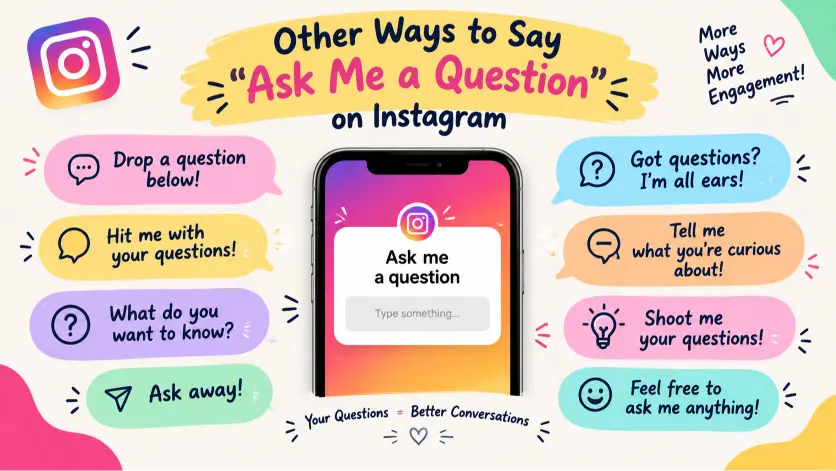
Looking for better ways to say “Ask me a question” on Instagram? For you are creating an Instagram Story, hosting a Q&A, promoting your personal brand, or simply encouraging followers to interact, using the same phrase repeatedly can feel predictable. A fresh, natural invitation can make your content sound more engaging and encourage people to respond. From casual expressions like “Got a question? Send it my way!” to professional options such as “Feel free to ask me anything,” the right wording depends on your audience, personality, and purpose.
In this guide, you’ll discover 30 practical alternatives to “Ask me a question” on Instagram, organized to help you choose the right expression for different situations. These phrases are useful for creators, influencers, businesses, students, professionals, and English learners who want to communicate naturally online. Each alternative focuses on clear, everyday English and shows how small wording changes can make an Instagram invitation feel more friendly, conversational, and engaging
Quick Categories
Formal alternatives to “Ask Me a Question on Instagram”
- Please submit your questions
- Feel free to send me your questions
- I welcome your questions
- Please share any questions you may have
Pro Tip: Use these expressions for educational content, expert discussions, webinars, or professional social media accounts.
Casual alternatives
- Ask me anything
- Send me a question
- Drop me a question
- What do you want to know?
Pro Tip: Casual expressions work particularly well in Instagram Stories, Q&A stickers, captions, and conversations with friends or followers.
Professional alternatives
- Send your questions my way
- I’d love to answer your questions
- Share your questions with me
- Let me know what you’d like to know
Pro Tip: Choose professional wording when communicating with clients, students, colleagues, or a business audience.
Informal expressions
- Got a question? Ask away
- Curious about something? Ask me
- Questions? Send them over
- Want to know more? Just ask
Pro Tip: Informal expressions are useful when your Instagram audience already knows your personality and communication style.
“The same invitation can sound friendly, professional, or playful simply by changing a few words.”
Common Mistakes
1. Using “ask me a question” repeatedly
Mistake: Ask me a question on Instagram. Ask me a question in the comments. Ask me a question in my Story.
Better: Ask me anything in the comments or send your questions through my Story.
2. Using overly formal language with a casual audience
Mistake: Please submit any inquiries you may have.
Better: Got a question? Ask me anything.
3. Forgetting the correct preposition
Mistake: Ask me a question at Instagram.
Correct: Ask me a question on Instagram.
4. Making the invitation too vague
Mistake: Questions.
Better: Have a question? Send it my way.
5. Using professional wording in a highly personal post
Mistake: I welcome your questions regarding my weekend plans.
Better: Want to know what I’m up to? Ask me anything.
What Does “Ask Me a Question on Instagram” Mean?
“Ask me a question on Instagram” means inviting someone to send or post a question through Instagram.
Grammatically, “ask” is the main verb, “me” is the indirect object, and “a question” is the direct object. The phrase “on Instagram” identifies the platform where the interaction should happen.
Example:
“Ask me a question on Instagram, and I’ll answer it tonight.”
The phrase is grammatically correct and easy to understand, but there are many other ways to say ask me a question on Instagram depending on your audience and communication goal.
When to Use “Ask Me a Question on Instagram”
You can use the phrase in several contexts:
- Instagram Stories: Invite followers to submit questions.
- Q&A sessions: Encourage audience participation.
- Instagram Lives: Ask viewers to send questions during a live discussion.
- Educational posts: Invite students to clarify a topic.
- Personal posts: Encourage followers to learn more about you.
- Business accounts: Invite customers to ask about products or services.
- Creator content: Build engagement and conversation.
Spoken vs Written
Spoken:
“Feel free to ask me anything.”
Written:
“Send me your questions through the Instagram Q&A.”
Formal vs Informal
Formal:
“Please submit your questions.”
Informal:
“Got a question? Ask away!”
Is It Professional or Polite to Say “Ask Me a Question on Instagram”?
The phrase is polite, but it is not necessarily the most professional expression for every situation.
Polite? ✔️ Yes
Professional? ❌ No, in most cases
For professional communication, alternatives such as “Please submit your questions,” “I’d be happy to answer your questions,” or “Feel free to share your questions” can sound more polished.
Business-style example:
“Feel free to submit your questions through our Instagram Story, and our team will respond.”
Pros and Cons of Using “Ask Me a Question on Instagram”
Pros
- Simple and natural
- Friendly tone
- Common usage
- Easy to understand
Cons
- Too informal for some work situations
- Can become overused
- Limited emotional range
- Not suitable for formal writing
“Clear wording gets attention. Appropriate wording keeps people engaged.”
Other Ways to Say “Ask Me a Question on Instagram” With Examples
These alternatives will help you sound more fluent, confident, and natural in different situations.
Use them according to tone, context, and audience to express excitement, admiration, or approval.
1. Phrase: Ask Me Anything
- Meaning: Invite someone to ask any question they want.
- Explanation: This is one of the most common and natural Q&A expressions online.
- Example Sentence: “Ask me anything about learning English.”
- Best Use: Instagram Q&As
- Worst Use: Formal correspondence
- Tone: Friendly, open, casual
- Context Variability: Casual / professional social media / spoken
2. Phrase: Send Me a Question
- Meaning: Invite someone to send you a question.
- Explanation: It is direct, simple, and easy for English learners to use.
- Example Sentence: “Send me a question through my Instagram Story.”
- Best Use: Social media
- Worst Use: Formal reports
- Tone: Simple, friendly, direct
- Context Variability: Casual / professional social media / written
3. Phrase: Drop Me a Question
- Meaning: Ask someone to send you a question.
- Explanation: “Drop me” gives the invitation a relaxed conversational feel.
- Example Sentence: “Drop me a question before tonight’s Q&A.”
- Best Use: Instagram Stories
- Worst Use: Formal emails
- Tone: Casual, relaxed, friendly
- Context Variability: Casual / spoken / social media
4. Phrase: Feel Free to Ask Me Anything
- Meaning: Tell people they are welcome to ask questions.
- Explanation: This expression sounds welcoming without putting pressure on the audience.
- Example Sentence: “Feel free to ask me anything about my new course.”
- Best Use: Audience engagement
- Worst Use: Legal documents
- Tone: Polite, welcoming, professional
- Context Variability: Professional / casual / spoken
5. Phrase: Send Your Questions My Way
- Meaning: Invite people to send their questions to you.
- Explanation: This is a friendly way to encourage direct interaction.
- Example Sentence: “If you’re curious about the process, send your questions my way.”
- Best Use: Creator content
- Worst Use: Formal reports
- Tone: Friendly, confident, conversational
- Context Variability: Casual / professional social media / spoken
6. Phrase: I’d Love to Answer Your Questions
- Meaning: Express enthusiasm about responding to questions.
- Explanation: This phrase combines an invitation with a positive emotional response.
- Example Sentence: “I’d love to answer your questions about studying abroad.”
- Best Use: Audience engagement
- Worst Use: Formal notices
- Tone: Warm, enthusiastic, professional
- Context Variability: Professional / casual / written
7. Phrase: Share Your Questions With Me
- Meaning: Invite people to tell you what they want to know.
- Explanation: It is neutral enough for both personal and professional content.
- Example Sentence: “Share your questions with me in today’s Instagram Q&A.”
- Best Use: Educational content
- Worst Use: Very casual chats
- Tone: Neutral, friendly, polished
- Context Variability: Professional / social media / spoken
8. Phrase: Let Me Know What You’d Like to Know
- Meaning: Ask people to identify the information they want.
- Explanation: This sounds natural when you want targeted questions.
- Example Sentence: “Let me know what you’d like to know about the program.”
- Best Use: Educational posts
- Worst Use: Quick casual chats
- Tone: Helpful, professional, welcoming
- Context Variability: Professional / casual / written
9. Phrase: What Do You Want to Know?
- Meaning: Directly ask the audience what information they want.
- Explanation: This is short and effective for informal social media.
- Example Sentence: “What do you want to know about my daily routine?”
- Best Use: Instagram Stories
- Worst Use: Formal business posts
- Tone: Casual, direct, engaging
- Context Variability: Casual / spoken / social media
10. Phrase: Got a Question? Ask Away
- Meaning: Encourage someone to start asking questions.
- Explanation: “Ask away” means that the person is welcome to ask questions freely.
- Example Sentence: “Got a question about the lesson? Ask away!”
- Best Use: Informal Q&A
- Worst Use: Formal correspondence
- Tone: Friendly, informal, encouraging
- Context Variability: Casual / spoken / social media
“Ask away” is short, natural, and especially useful when you want your audience to feel comfortable asking questions.
11. Phrase: Have a Question? Send It Over
- Meaning: Invite someone to send you a question.
- Explanation: It creates a relaxed and approachable invitation.
- Example Sentence: “Have a question? Send it over, and I’ll answer it.”
- Best Use: Instagram Stories
- Worst Use: Formal applications
- Tone: Casual, friendly, relaxed
- Context Variability: Casual / spoken / social media
12. Phrase: Curious About Something? Ask Me
- Meaning: Invite questions about something that interests the audience.
- Explanation: It works well when you expect people to have specific curiosities.
- Example Sentence: “Curious about my writing process? Ask me!”
- Best Use: Creator posts
- Worst Use: Formal notices
- Tone: Friendly, engaging, informal
- Context Variability: Casual / spoken / social media
13. Phrase: I Welcome Your Questions
- Meaning: Clearly state that questions are encouraged.
- Explanation: This is more polished and professional than many casual alternatives.
- Example Sentence: “I welcome your questions about the new training program.”
- Best Use: Professional content
- Worst Use: Casual memes
- Tone: Formal, welcoming, confident
- Context Variability: Professional / written / spoken
14. Phrase: Please Submit Your Questions
- Meaning: Ask people to provide their questions.
- Explanation: This is suitable when questions need to be collected systematically.
- Example Sentence: “Please submit your questions before the live session begins.”
- Best Use: Professional events
- Worst Use: Personal Stories
- Tone: Formal, clear, professional
- Context Variability: Professional / written / spoken
15. Phrase: Please Share Any Questions You Have
- Meaning: Encourage people to communicate their questions.
- Explanation: This is polite and appropriate for educational or business audiences.
- Example Sentence: “Please share any questions you have about the workshop.”
- Best Use: Educational content
- Worst Use: Very casual posts
- Tone: Polite, professional, inviting
- Context Variability: Professional / educational / written
16. Phrase: What Would You Like to Ask?
- Meaning: Ask someone what question they would like to raise.
- Explanation: It focuses attention directly on the person’s interests.
- Example Sentence: “What would you like to ask about the new project?”
- Best Use: Q&A sessions
- Worst Use: Formal reports
- Tone: Polite, conversational, neutral
- Context Variability: Spoken / professional / casual
17. Phrase: Let’s Have a Q&A
- Meaning: Suggest a question-and-answer session.
- Explanation: This works particularly well for Instagram Lives and Stories.
- Example Sentence: “Let’s have a Q&A about English learning tonight.”
- Best Use: Live sessions
- Worst Use: Formal letters
- Tone: Friendly, engaging, collaborative
- Context Variability: Casual / social media / spoken
18. Phrase: Send in Your Questions
- Meaning: Ask people to submit questions.
- Explanation: “Send in” is commonly used when collecting audience responses.
- Example Sentence: “Send in your questions before our Instagram Live.”
- Best Use: Live events
- Worst Use: Academic papers
- Tone: Friendly, clear, encouraging
- Context Variability: Social media / spoken / professional
19. Phrase: Share What You’re Curious About
- Meaning: Encourage people to talk about what they want to know.
- Explanation: This makes the invitation feel more personal and conversational.
- Example Sentence: “Share what you’re curious about, and I’ll cover it in my next post.”
- Best Use: Educational content
- Worst Use: Formal business writing
- Tone: Warm, conversational, engaging
- Context Variability: Casual / educational / social media
20. Phrase: Tell Me What You Want to Know
- Meaning: Ask the audience to identify their questions.
- Explanation: It is direct and works well when you want specific responses.
- Example Sentence: “Tell me what you want to know about working remotely.”
- Best Use: Audience research
- Worst Use: Formal letters
- Tone: Direct, friendly, confident
- Context Variability: Casual / professional social media / spoken
21. Phrase: I’m Happy to Answer Your Questions
- Meaning: State that you are willing to provide answers.
- Explanation: This is a polite option for professional and educational communication.
- Example Sentence: “I’m happy to answer your questions about the application process.”
- Best Use: Professional communication
- Worst Use: Formal contracts
- Tone: Polite, helpful, professional
- Context Variability: Professional / spoken / written
22. Phrase: Feel Free to Send Your Questions
- Meaning: Tell people they can comfortably send questions.
- Explanation: It creates an open and welcoming tone.
- Example Sentence: “Feel free to send your questions through Instagram.”
- Best Use: Customer engagement
- Worst Use: Legal documents
- Tone: Polite, friendly, professional
- Context Variability: Professional / casual / written
23. Phrase: Have Questions? Let Me Know
- Meaning: Invite people to tell you if they have questions.
- Explanation: This concise expression works in many social media contexts.
- Example Sentence: “Have questions about the course? Let me know.”
- Best Use: Educational posts
- Worst Use: Formal reports
- Tone: Friendly, concise, approachable
- Context Variability: Casual / professional / social media
24. Phrase: Want to Know More? Just Ask
- Meaning: Encourage people to request additional information.
- Explanation: It makes the invitation sound easy and approachable.
- Example Sentence: “Want to know more about my new project? Just ask.”
- Best Use: Personal content
- Worst Use: Formal correspondence
- Tone: Casual, warm, encouraging
- Context Variability: Casual / spoken / social media
25. Phrase: Send Over Your Questions
- Meaning: Ask people to send their questions.
- Explanation: This is a relaxed expression that works well in online communication.
- Example Sentence: “Send over your questions before tomorrow’s Q&A.”
- Best Use: Online events
- Worst Use: Formal letters
- Tone: Casual, friendly, direct
- Context Variability: Casual / professional social media / spoken
26. Phrase: I’m Here to Answer Your Questions
- Meaning: Tell the audience that you are available to respond.
- Explanation: It creates a supportive and approachable impression.
- Example Sentence: “I’m here to answer your questions about the new service.”
- Best Use: Customer support
- Worst Use: Formal reports
- Tone: Helpful, reassuring, professional
- Context Variability: Professional / spoken / social media
27. Phrase: Ask Away on Instagram
- Meaning: Invite people to ask questions freely on Instagram.
- Explanation: This is a concise way to encourage interaction.
- Example Sentence: “I’m online tonight, so ask away on Instagram.”
- Best Use: Instagram Stories
- Worst Use: Business reports
- Tone: Casual, energetic, inviting
- Context Variability: Casual / spoken / social media
28. Phrase: Send Me Your Questions on Instagram
- Meaning: Directly invite questions through Instagram.
- Explanation: This keeps the original meaning while sounding slightly more natural and direct.
- Example Sentence: “Send me your questions on Instagram, and I’ll answer them tomorrow.”
- Best Use: Q&A sessions
- Worst Use: Formal writing
- Tone: Friendly, direct, natural
- Context Variability: Casual / professional social media / written
29. Phrase: Let’s Hear Your Questions
- Meaning: Invite the audience to share their questions.
- Explanation: It creates a sense of participation and group conversation.
- Example Sentence: “Let’s hear your questions about the new course.”
- Best Use: Live discussions
- Worst Use: Formal documents
- Tone: Engaging, confident, conversational
- Context Variability: Spoken / social media / professional
30. Phrase: Your Questions Are Welcome
- Meaning: Clearly communicate that people are encouraged to ask questions.
- Explanation: This is one of the more polished alternatives for professional audiences.
- Example Sentence: “Your questions are welcome during our Instagram Live.”
- Best Use: Professional Q&A
- Worst Use: Casual jokes
- Tone: Polite, formal, welcoming
- Context Variability: Professional / written / spoken
“Professional English is not always more complicated English. Often, it is simply clearer and more appropriate.”
See Also
- See also: Other Ways to Say “Ask Me Anything” for additional conversational and social media alternatives.
- See also: Professional English Phrases for Better Workplace Communication for polished expressions suitable for colleagues, clients, and professional audiences.
Mini Quiz / Self-Check
1. You are creating an informal Instagram Story for your followers. Which phrase sounds most natural?
A. Please submit your inquiries.
B. Ask me anything.
C. Your questions are hereby requested.
D. Please provide your questions formally.
Answer: B. Ask me anything.
2. You are hosting a professional online workshop. Which option is most appropriate?
A. Ask away!
B. What do you wanna know?
C. Please share any questions you have.
D. Hit me with questions.
Answer: C. Please share any questions you have.
3. You want to sound warm and professional while inviting questions.
A. I’d love to answer your questions.
B. Questions.
C. Ask me stuff.
D. What’s up?
Answer: A. I’d love to answer your questions.
4. Which phrase is most casual?
A. I welcome your questions.
B. Please submit your questions.
C. Your questions are welcome.
D. Got a question? Ask away.
Answer: D. Got a question? Ask away.
Comparison Table: Top Alternatives
| Phrase | Tone | Best Use |
| Ask me anything | Casual, friendly | Instagram Q&As |
| Send me a question | Simple, direct | Stories |
| Feel free to ask me anything | Polite, welcoming | General engagement |
| I’d love to answer your questions | Warm, professional | Educational content |
| Send your questions my way | Friendly, confident | Creator content |
| Please submit your questions | Formal, professional | Events |
| Share your questions with me | Neutral, polished | Professional social media |
| Ask away | Informal, encouraging | Casual Q&As |
| Have questions? Let me know | Friendly, concise | Educational posts |
| Your questions are welcome | Formal, welcoming | Professional Q&As |
Professional Reaction Phrases for Instagram
If your goal is to encourage engagement without sounding overly casual, professional reaction phrases can help you create a stronger connection with your audience.
Try:
- I’d be happy to answer your questions.
- Feel free to share your questions.
- I welcome your questions and feedback.
- Let me know what you’d like to know.
- I’d love to hear your thoughts.
These expressions are particularly useful for teachers, consultants, business owners, coaches, and creators.
Informal Expressions in English for Social Media
Social media often favors shorter, more conversational language. Expressions such as “Ask me anything,” “Ask away,” “Send it over,” and “Just ask” can make your content feel more approachable.
However, informal does not always mean better. Choose wording based on your audience, purpose, and relationship with the reader.
“Choose the phrase that matches your audience, not simply the phrase that sounds most impressive.”
CTA
Have a favorite expression from this list? Share it in the comments and tell us which phrase you would use on Instagram.
FAQs
1. What are the best other ways to say “ask me a question on Instagram”?
Some natural options are “Ask me anything,” “Send me a question,” “Feel free to ask me anything,” and “I’d love to answer your questions.”
2. How can I politely ask people to send questions on Instagram?
Try “Feel free to send your questions,” “Please share any questions you have,” or “I’d be happy to answer your questions.”
3. Is “ask me anything” professional?
“Ask me anything” is natural and friendly, but it is generally more suitable for social media, Q&A sessions, and informal communication than formal business writing.
4. What is a casual way to ask followers questions on Instagram?
You can say “Got a question? Ask away,” “Curious about something? Ask me,” or “Want to know more? Just ask.”
5. What is a professional alternative to “ask me a question on Instagram”?
For professional communication, use expressions such as “Please submit your questions,” “I welcome your questions,” or “Please share any questions you have.”
Conclusion
Learning different ways to say “ask me a question on Instagram” gives you more flexibility when communicating with followers, students, customers, colleagues, and professional audiences. Instead of repeating one expression, you can select wording that matches the level of formality and the relationship you have with your audience.
Practice using one casual, one neutral, and one professional alternative each day. Over time, these expressions will become easier to use naturally. The goal is not to memorize every phrase, but to develop tone awareness so you can communicate clearly, confidently, and appropriately in English.









