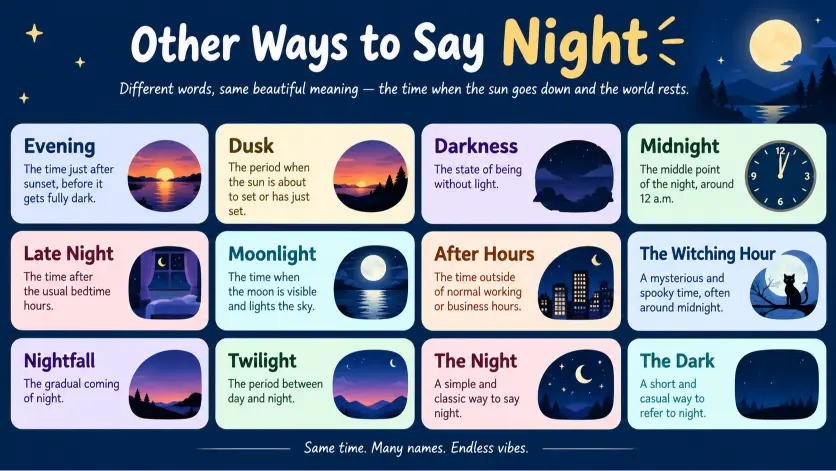
Have you ever felt that using the word “night” again and again makes your English sound repetitive? 🌙 Whether you are writing an email, having a casual conversation, creating content, or improving your vocabulary, knowing different ways to talk about nighttime can make your English more natural and expressive. From simple alternatives like “evening” and “nighttime” to descriptive expressions such as “after dark” and “the late hours,” the right phrase depends on the context, tone, and exact time you mean.
In this guide, you’ll discover 30+ practical ways to say “night” in English, with clear explanations and examples to help you use each expression correctly. These alternatives are selected based on common English usage and differences in formal, informal, conversational, and descriptive contexts. For you’re an English learner, student, professional, or content writer, these examples can help you expand your vocabulary, avoid repetition, and communicate with greater confidence. Keep reading to find the expression that fits your situation best
Formal Alternatives to “Night”
- The evening
- The nighttime hours
- After dark
- The late hours
These expressions work well in formal writing, reports, announcements, and polished descriptions.
Pro Tip
Use the evening for a generally polite and neutral tone. Use after dark when darkness itself is important to the meaning.
Casual Alternatives
- Tonight
- This evening
- Later tonight
- At bedtime
These expressions are common in everyday conversations, texts, and informal messages.
Pro Tip
Use tonight when referring specifically to the current or upcoming night.
Professional Alternatives
- During the evening
- During nighttime hours
- After business hours
- Overnight
These phrases are useful in workplace communication, schedules, reports, customer service, and professional announcements.
Pro Tip
In professional writing, choose the expression that communicates the exact time period rather than simply replacing night with a synonym.
Informal Expressions
- Late at night
- In the wee hours
- Long after dark
- Before bed
These expressions are more conversational and are best suited to personal communication and informal storytelling.
Pro Tip
Avoid expressions such as the wee hours in formal reports unless the conversational tone is intentional.
“Context determines whether a nighttime expression sounds natural, professional, or overly casual.”
Common Mistakes When Using “Night”
1. Using “night” when “evening” is more accurate
Incorrect: I have a meeting at 5 p.m. tonight.
Better: I have a meeting at 5 p.m. this evening.
At 5 p.m., evening may be more natural depending on the season and context.
2. Confusing “tonight” with “night”
Incorrect: I will call you night.
Correct: I will call you tonight.
Tonight means during the current or upcoming night.
3. Using “at night” for a specific night
Less natural: I saw her at night yesterday.
Better: I saw her last night.
Use last night, tonight, or tomorrow night when referring to a particular night.
4. Using “overnight” to mean every night
Incorrect: The store is open overnight from 6 p.m. every day.
Better: The store is open during the evening and overnight hours.
Overnight generally refers to a period extending through the night.
5. Using formal expressions in casual conversations
Awkward: I will meet you during the nighttime hours.
Natural: I’ll meet you tonight.
Professional expressions can sound unnecessarily formal in everyday conversation.
What Does “Night” Mean?
Night refers to the period when it is dark outside, generally occurring between evening and morning.
In English grammar, night is a countable noun in expressions such as a night, last night, and three nights. It also appears in common fixed expressions such as at night, tonight, and all night.
Example:
The streets become quieter at night.
The exact beginning and ending of night can vary depending on context, location, season, and cultural usage.
When to Use “Night”
You can use night in many everyday and professional contexts:
- Talking about darkness
- Describing sleeping time
- Discussing evening plans
- Talking about nighttime activities
- Describing travel or events
- Discussing schedules
- Writing stories or creative descriptions
- Referring to a specific evening or nighttime period
Spoken vs. Written
In spoken English, expressions such as tonight, last night, and late at night are extremely natural.
In written English, alternatives such as during the evening, after dark, and during nighttime hours may provide more precision.
Formal vs. Informal
Formal:
The facility remains operational during nighttime hours.
Informal:
The facility is open at night.
Is It Professional or Polite to Say “Night”?
Polite? ✔ Yes
The word night is completely polite and normal in everyday English.
Professional? ❌ No, in most cases
The word itself is not unprofessional, but a more specific expression may be preferable in formal workplace communication.
Business-style example:
The maintenance team will complete the work during the nighttime hours.
This sounds more precise in a professional announcement than simply saying:
The maintenance team will work at night.
Pros and Cons of Using “Night”
Pros
- Simple and natural: Everyone understands it.
- Friendly tone: It sounds normal in conversation.
- Common usage: Native speakers use it frequently.
- Easy to understand: It requires little interpretation.
Cons
- Too informal for some work contexts: More precise wording may be preferable.
- Overused: Repeating it can make writing less varied.
- Limited emotional range: It does not always communicate atmosphere or mood.
- Not suitable for formal writing: Specific expressions may be more appropriate depending on the context.
Other Ways to Say “Night” With Examples
These alternatives will help you sound more fluent, confident, and natural in different situations.
Use them according to tone, context, and audience to express excitement, admiration, or approval when discussing nighttime activities and experiences.
1. Phrase: Evening
- Meaning: The period between afternoon and nighttime.
- Explanation: It usually describes the earlier part of the night.
- Example Sentence: We are hosting a networking event this evening.
- Best Use: Social plans
- Worst Use: Deep midnight
- Tone: Neutral, natural, polite
- Context Variability: Casual: See you this evening. Professional: The meeting is scheduled for this evening. Spoken: What are you doing this evening?
2. Phrase: Tonight
- Meaning: The current or upcoming night.
- Explanation: It is used when referring specifically to the night of today.
- Example Sentence: Are you available tonight?
- Best Use: Daily conversation
- Worst Use: General time
- Tone: Casual, natural, direct
- Context Variability: Casual: Let’s go out tonight. Professional: The system will be updated tonight. Spoken: Are you working tonight?
3. Phrase: This Evening
- Meaning: The evening of today.
- Explanation: It is a slightly more polished alternative to tonight when referring to earlier evening hours.
- Example Sentence: I will send the final report this evening.
- Best Use: Polite communication
- Worst Use: Midnight
- Tone: Polite, neutral, professional
- Context Variability: Casual: I’ll call you this evening. Professional: The presentation will take place this evening. Spoken: Are you free this evening?
4. Phrase: Last Night
- Meaning: The night immediately before today.
- Explanation: It specifically refers to the previous night.
- Example Sentence: I finished the report last night.
- Best Use: Recent past
- Worst Use: General time
- Tone: Natural, conversational, direct
- Context Variability: Casual: I watched a movie last night. Professional: The issue was identified last night. Spoken: Did you sleep well last night?
5. Phrase: Tomorrow Night
- Meaning: The night following today.
- Explanation: It specifies a future nighttime period.
- Example Sentence: The conference dinner is tomorrow night.
- Best Use: Future plans
- Worst Use: Past events
- Tone: Natural, clear, conversational
- Context Variability: Casual: See you tomorrow night. Professional: The event begins tomorrow night. Spoken: Are you free tomorrow night?
6. Phrase: After Dark
- Meaning: The period after daylight has ended.
- Explanation: It emphasizes darkness rather than a specific clock time.
- Example Sentence: The park is closed after dark.
- Best Use: Safety notices
- Worst Use: Early evening
- Tone: Neutral, descriptive, formal
- Context Variability: Casual: I don’t usually walk there after dark. Professional: Visitors are advised to leave after dark. Spoken: It’s quiet after dark.
7. Phrase: Nighttime
- Meaning: The period of darkness between evening and morning.
- Explanation: It is useful when discussing nighttime as a general period.
- Example Sentence: The animals are most active during nighttime.
- Best Use: General description
- Worst Use: Specific appointment
- Tone: Neutral, descriptive, professional
- Context Variability: Casual: I prefer nighttime walks. Professional: Nighttime operations require additional staff. Spoken: The city looks different at nighttime.
8. Phrase: The Late Hours
- Meaning: A period late in the evening or night.
- Explanation: It emphasizes that something happens relatively late.
- Example Sentence: She continued working into the late hours.
- Best Use: Late activity
- Worst Use: Early evening
- Tone: Formal, descriptive, serious
- Context Variability: Casual: We talked into the late hours. Professional: The team worked into the late hours. Spoken: He often works during the late hours.
9. Phrase: Late at Night
- Meaning: A time well into the night.
- Explanation: It is useful when the exact time is not important.
- Example Sentence: I usually get my best ideas late at night.
- Best Use: Personal routines
- Worst Use: Formal schedule
- Tone: Casual, natural, descriptive
- Context Variability: Casual: I study late at night. Professional: The issue occurred late at night. Spoken: Why are you awake so late at night?
10. Phrase: Overnight
- Meaning: During the night or from one day into the next.
- Explanation: It often describes processes, travel, stays, or changes continuing through the night.
- Example Sentence: The package will arrive overnight.
- Best Use: Services
- Worst Use: Dinner plans
- Tone: Professional, practical, neutral
- Context Variability: Casual: We stayed overnight. Professional: The system will undergo overnight maintenance. Spoken: The delivery arrived overnight.
11. Phrase: During the Evening
- Meaning: At some point during evening hours.
- Explanation: It provides a neutral and relatively formal time reference.
- Example Sentence: The guests will arrive during the evening.
- Best Use: Formal writing
- Worst Use: Friendly texting
- Tone: Formal, neutral, precise
- Context Variability: Casual: I’ll come during the evening. Professional: The inspection will take place during the evening. Spoken: We met during the evening.
12. Phrase: During the Night
- Meaning: At some point throughout nighttime.
- Explanation: It is particularly useful for events that occur while people are sleeping.
- Example Sentence: The temperature dropped significantly during the night.
- Best Use: Reports
- Worst Use: Casual invitations
- Tone: Neutral, formal, descriptive
- Context Variability: Casual: It rained during the night. Professional: The equipment was monitored during the night. Spoken: I woke up during the night.
13. Phrase: At Nighttime
- Meaning: During the nighttime period.
- Explanation: It is a straightforward alternative to at night.
- Example Sentence: The building looks beautiful at nighttime.
- Best Use: Descriptions
- Worst Use: Formal schedules
- Tone: Descriptive, natural, neutral
- Context Variability: Casual: The city is beautiful at nighttime. Professional: Security increases at nighttime. Spoken: Do you work at nighttime?
14. Phrase: Before Bed
- Meaning: The period immediately before going to sleep.
- Explanation: It focuses on bedtime rather than the entire night.
- Example Sentence: I usually read before bed.
- Best Use: Daily routines
- Worst Use: Workplace schedules
- Tone: Casual, friendly, natural
- Context Variability: Casual: I drink tea before bed. Professional: Avoid using the device immediately before bed. Spoken: Do you read before bed?
15. Phrase: Bedtime
- Meaning: The usual time when someone goes to bed.
- Explanation: It refers specifically to sleeping time.
- Example Sentence: The children have a strict bedtime.
- Best Use: Sleep routines
- Worst Use: Business meetings
- Tone: Casual, familiar, friendly
- Context Variability: Casual: It’s almost bedtime. Professional: A consistent bedtime can support healthy routines. Spoken: What time is your bedtime?
16. Phrase: Sleeping Hours
- Meaning: The period normally spent sleeping.
- Explanation: It focuses on sleep rather than darkness.
- Example Sentence: Please avoid making noise during sleeping hours.
- Best Use: Rules
- Worst Use: Social plans
- Tone: Formal, practical, clear
- Context Variability: Casual: I protect my sleeping hours. Professional: Noise should be minimized during sleeping hours. Spoken: Try to maintain regular sleeping hours.
17. Phrase: The Dark Hours
- Meaning: The period when there is little or no daylight.
- Explanation: It emphasizes darkness and often creates a descriptive atmosphere.
- Example Sentence: The streets become quiet during the dark hours.
- Best Use: Descriptive writing
- Worst Use: Business email
- Tone: Literary, descriptive, serious
- Context Variability: Casual: The town changes during the dark hours. Professional: Visibility is reduced during the dark hours. Spoken: Animals behave differently during the dark hours.
18. Phrase: The Nighttime Hours
- Meaning: The hours occurring during the night.
- Explanation: It is a precise phrase often used in professional or official communication.
- Example Sentence: The facility operates during the nighttime hours.
- Best Use: Professional writing
- Worst Use: Casual chat
- Tone: Formal, precise, professional
- Context Variability: Casual: I prefer the nighttime hours. Professional: Security is increased during the nighttime hours. Spoken: The service is available during nighttime hours.
19. Phrase: The Overnight Period
- Meaning: The period extending through the night.
- Explanation: It is useful for describing processes that continue from evening into morning.
- Example Sentence: The equipment remained operational throughout the overnight period.
- Best Use: Reports
- Worst Use: Friendly chat
- Tone: Formal, technical, precise
- Context Variability: Casual: We stayed there for the overnight period. Professional: The system was monitored throughout the overnight period. Spoken: The process continued overnight.
20. Phrase: In the Evening
- Meaning: At some time during the evening.
- Explanation: It is a common and natural alternative when discussing a general evening period.
- Example Sentence: I usually exercise in the evening.
- Best Use: Daily routines
- Worst Use: Midnight
- Tone: Natural, neutral, friendly
- Context Variability: Casual: I exercise in the evening. Professional: The appointment is available in the evening. Spoken: What do you do in the evening?
21. Phrase: Into the Night
- Meaning: Continuing from evening for a significant part of the night.
- Explanation: It emphasizes that an activity continues late.
- Example Sentence: The celebration continued into the night.
- Best Use: Events
- Worst Use: Exact schedules
- Tone: Descriptive, natural, expressive
- Context Variability: Casual: We talked into the night. Professional: The negotiations continued into the night. Spoken: The party went on into the night.
22. Phrase: All Night
- Meaning: Throughout the entire night.
- Explanation: It describes something that continues for most or all of the nighttime period.
- Example Sentence: The rain continued all night.
- Best Use: Continuous events
- Worst Use: Brief events
- Tone: Casual, direct, emphatic
- Context Variability: Casual: We talked all night. Professional: The emergency service operated all night. Spoken: I couldn’t sleep all night.
23. Phrase: Throughout the Night
- Meaning: Continuously or repeatedly during the night.
- Explanation: It is a more formal alternative to all night.
- Example Sentence: The nurses monitored the patient throughout the night.
- Best Use: Professional contexts
- Worst Use: Casual invitations
- Tone: Formal, precise, professional
- Context Variability: Casual: It snowed throughout the night. Professional: The system was monitored throughout the night. Spoken: I kept waking up throughout the night.
24. Phrase: In the Wee Hours
- Meaning: The very early hours after midnight.
- Explanation: It refers to a time when most people are normally asleep.
- Example Sentence: He finished the project in the wee hours of the morning.
- Best Use: Informal storytelling
- Worst Use: Formal reports
- Tone: Informal, conversational, expressive
- Context Variability: Casual: We talked until the wee hours. Professional: The system failed in the early hours of the morning. Spoken: I was still working in the wee hours.
25. Phrase: After Sunset
- Meaning: The period following sunset.
- Explanation: It gives a more specific reference to the end of daylight.
- Example Sentence: The temperature drops quickly after sunset.
- Best Use: Nature descriptions
- Worst Use: Exact schedules
- Tone: Descriptive, neutral, natural
- Context Variability: Casual: We went for a walk after sunset. Professional: The lights automatically turn on after sunset. Spoken: It’s cooler after sunset.
26. Phrase: After Sundown
- Meaning: The period after the sun has gone below the horizon.
- Explanation: It is a descriptive alternative to after dark.
- Example Sentence: The area becomes very quiet after sundown.
- Best Use: Descriptive contexts
- Worst Use: Formal scheduling
- Tone: Descriptive, literary, natural
- Context Variability: Casual: We usually stay indoors after sundown. Professional: Outdoor operations cease after sundown. Spoken: The temperature falls after sundown.
27. Phrase: The Evening Hours
- Meaning: The hours occurring during the evening.
- Explanation: It is commonly used for schedules, services, and formal descriptions.
- Example Sentence: Customer support is available during the evening hours.
- Best Use: Business communication
- Worst Use: Casual texting
- Tone: Professional, neutral, precise
- Context Variability: Casual: I work during the evening hours. Professional: Support is available during the evening hours. Spoken: Are you available during the evening hours?
28. Phrase: The Late Hours of the Night
- Meaning: A very late period of nighttime.
- Explanation: It emphasizes that something happens well after the normal evening period.
- Example Sentence: The researchers continued their work into the late hours of the night.
- Best Use: Detailed descriptions
- Worst Use: Short messages
- Tone: Formal, descriptive, serious
- Context Variability: Casual: We stayed up into the late hours of the night. Professional: The team worked into the late hours of the night. Spoken: He often studies into the late hours of the night.
29. Phrase: From Evening Until Morning
- Meaning: Covering the period from evening through the following morning.
- Explanation: It clearly describes an extended nighttime period.
- Example Sentence: The security team remained on duty from evening until morning.
- Best Use: Extended periods
- Worst Use: Brief events
- Tone: Formal, precise, descriptive
- Context Variability: Casual: We stayed there from evening until morning. Professional: The facility is monitored from evening until morning. Spoken: They worked from evening until morning.
30. Phrase: The Hours of Darkness
- Meaning: The period when daylight is absent.
- Explanation: It is a formal or descriptive expression emphasizing darkness.
- Example Sentence: Visibility is significantly reduced during the hours of darkness.
- Best Use: Official descriptions
- Worst Use: Casual conversation
- Tone: Formal, serious, descriptive
- Context Variability: Casual: The animals appear during the hours of darkness. Professional: Drivers should use caution during the hours of darkness. Spoken: Visibility changes during the hours of darkness.
“Choose the expression that describes the exact time period you mean, rather than simply replacing one word with another.”
How to Choose the Right Alternative
The best alternative depends on what you want to communicate.
If you mean early nighttime
Use:
- Evening
- This evening
- In the evening
- Evening hours
If you mean darkness
Use:
- After dark
- After sunset
- After sundown
- Hours of darkness
If you mean very late nighttime
Use:
- Late at night
- The late hours
- In the wee hours
- Late hours of the night
If you mean sleeping time
Use:
- Bedtime
- Before bed
- Sleeping hours
If you mean an entire nighttime period
Use:
- All night
- Throughout the night
- Overnight
- From evening until morning
“Fluent English is about precision: evening, overnight, bedtime, and after dark do not mean exactly the same thing.”
See Also
- See also: Other Ways to Say “Good Morning” for natural alternatives to common greetings and time-based expressions.
- See also: Professional English Phrases for Workplace Communication for polished expressions you can use in emails, meetings, and professional conversations.
Mini Quiz: Test Your Understanding
1. Which expression is most appropriate for a business announcement?
A. In the wee hours
B. During the nighttime hours
C. Before bed
D. Tonight, maybe
Answer: B
2. Which phrase means the night immediately before today?
A. Tonight
B. Tomorrow night
C. Last night
D. Evening
Answer: C
3. Which expression focuses specifically on the time when someone goes to sleep?
A. After sunset
B. Bedtime
C. After dark
D. Overnight
Answer: B
4. Which sentence is most natural for casual conversation?
A. I will contact you during the nighttime hours.
B. I will contact you tonight.
C. I will contact you during the overnight period.
D. I will contact you during the hours of darkness.
Answer: B
Comparison Table: Top Alternatives
| Phrase | Tone | Best Use |
| Evening | Neutral | General evening |
| Tonight | Casual | Current night |
| This evening | Polite | Plans and messages |
| After dark | Neutral | Darkness and safety |
| Nighttime | Neutral | General nighttime |
| Overnight | Professional | Services and processes |
| Late at night | Casual | Late activities |
| Before bed | Informal | Sleep routines |
| During the evening | Formal | Professional writing |
| Throughout the night | Professional | Continuous activities |
FAQs About Other Ways to Say Night
1. What are the best other ways to say night?
Common alternatives include evening, nighttime, tonight, after dark, overnight, late at night, bedtime, and during the evening. The best choice depends on the specific context.
2. What are formal alternatives to night?
Formal alternatives include during the nighttime hours, during the evening, throughout the night, the evening hours, overnight period, and hours of darkness.
3. What are professional ways to say night?
In professional English, you can use during the evening, during nighttime hours, overnight, throughout the night, or during the evening hours, depending on the intended meaning.
4. What is the difference between evening and night?
Evening generally refers to the period after afternoon and before late night, while night usually refers to the darker period extending toward morning.
5. How can I use alternatives to night naturally?
Focus on the exact meaning first. Use tonight for the current night, last night for the previous night, overnight for a process extending through the night, and bedtime when referring specifically to sleep.
Conclusion
Learning different ways to say night can make your English more precise, natural, and flexible. Expressions such as evening, tonight, after dark, overnight, late at night, bedtime, and throughout the night each communicate slightly different meanings and work better in particular situations.
The key is to practice these alternatives in real sentences rather than memorizing them as isolated synonyms. Pay attention to tone, audience, and context. With regular practice, you will become more confident choosing between casual expressions, professional reaction phrases, formal alternatives, and everyday informal expressions in English.









