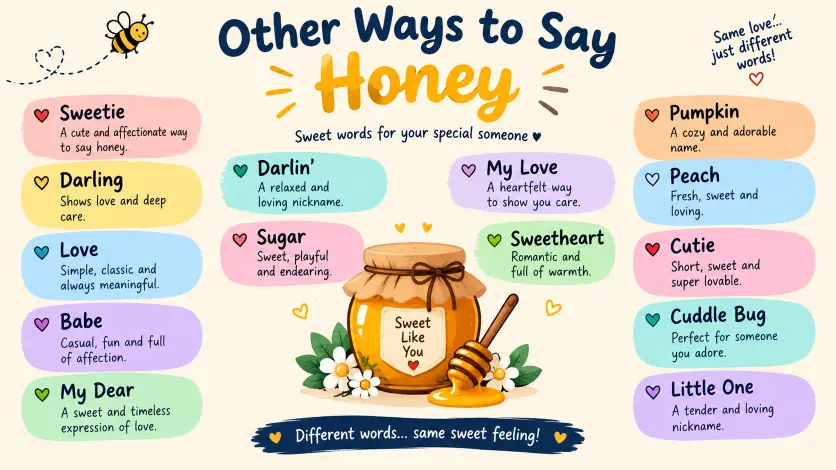
Looking for a sweeter, more natural way to say “honey”? 🍯 For you are talking to a romantic partner, a close friend, a family member, or someone you care about, choosing the right term of endearment can make your English sound warmer and more expressive.
Words such as “sweetheart,” “darling,” “dear,” and “love” can communicate affection, but they do not always fit every situation. Understanding their tone and context can help you choose an expression that sounds natural rather than forced.
Quick Categories
Formal Alternatives to “Honey”
There are very few true formal synonyms for “honey” because it is fundamentally a term of affection. In formal situations, consider:
- Dear
- My dear
- Beloved
- Dearest
Pro Tip: In professional communication, avoid pet names and use the person’s name, title, or a neutral greeting instead.
Casual Alternatives
For relaxed conversations with people you know well:
- Sweetheart
- Darling
- Sweetie
- Love
Pro Tip: Choose casual terms according to your relationship and the other person’s comfort level.
Professional Alternatives
In professional English, affectionate terms are generally replaced by neutral forms of address:
- Dear [Name]
- Mr./Ms. [Surname]
- Colleague
- Team member
Pro Tip: “Dear” can be appropriate in professional emails, but “honey” generally is not.
Informal Expressions
Among close friends, partners, or family members, you may hear:
- Babe
- Baby
- Sweetie
- Love
Pro Tip: Informal expressions in English can sound natural among close people but inappropriate when used with strangers.
“Tone matters as much as vocabulary when you want your English to sound natural.”
Common Mistakes
1. Using “Honey” With Strangers
Calling a stranger “honey” can sound overly familiar.
Example: “Excuse me, honey, can you help me?”
Better: “Excuse me, could you help me?”
2. Using “Honey” With a Professional Contact
Pet names are generally unsuitable in workplace communication.
Example: “Honey, I attached the report.”
Better: “I attached the report for your review.”
3. Assuming Everyone Likes Pet Names
Different people have different preferences about terms of affection.
Example: “Come here, sweetheart.”
Better: Use the person’s name unless you know they are comfortable with the expression.
4. Confusing “Honey” With Its Literal Meaning
“Honey” can refer to the sweet food made by bees or a person you address affectionately.
Example: “I added honey to my tea.”
Better: Understand the meaning from context.
5. Using Romantic Terms in the Wrong Context
Words such as “babe” or “darling” may sound romantic.
Example: “Thanks for your help, babe.”
Better: “Thanks for your help.”
What Does “Honey” Mean?
“Honey” has two common meanings. Literally, it refers to the sweet substance produced by bees. As a term of address, it is an informal expression used to show affection, warmth, or familiarity.
As a noun used for a person, it functions as a term of endearment rather than a description of the person’s qualities.
Example: “Thanks for helping me, honey.”
The appropriate interpretation depends heavily on context, relationship, tone, and culture.
When to Use “Honey”
You may hear or use “honey” in contexts such as:
- Romantic conversations
- Conversations between family members
- Conversations with children
- Friendly or familiar interactions
- Informal spoken English
- Certain regional varieties of English
Spoken vs. Written
Spoken: Common in informal conversations.
Written: Possible in personal messages, cards, or informal correspondence, but less common in professional writing.
Formal vs. Informal
Informal: Natural among people who are comfortable with terms of affection.
Formal: Generally avoid it in business emails, academic writing, official documents, and professional correspondence.
Is It Professional or Polite to Say “Honey”?
“Honey” can be polite when used affectionately between people who have an established relationship. However, politeness does not automatically make an expression professional.
In a workplace, “honey” can sound overly personal or patronizing, depending on the relationship and context. A neutral form of address is usually safer.
Business-style example:
Instead of: “Honey, could you send me the report?”
Use: “Could you please send me the report?”
Polite? Yes
Professional? No, in most cases
“Friendly does not always mean professional. Workplace English usually benefits from neutral, respectful language.”
Pros and Cons of Using “Honey”
Pros
- Simple and natural: Easy to understand in familiar contexts.
- Friendly tone: Can communicate warmth and affection.
- Common usage: Widely recognized in everyday English.
- Easy to understand: Its meaning is usually clear from context.
Cons
- Too informal for work: It is rarely suitable for professional communication.
- Overused: Repeating one term can make your vocabulary sound limited.
- Limited emotional range: It does not communicate every type of affection or friendliness.
- Not suitable for formal writing: Official and academic contexts usually require neutral language.
Other Ways to Say “Honey” With Examples
These alternatives will help you sound more fluent, confident, and natural in different situations.
Use them according to tone, context, and audience to express excitement, admiration, affection, or approval.
1. Phrase: Darling
- Meaning: A loving term used for someone you care about.
- Explanation: “Darling” can sound affectionate, warm, or romantic.
- Example Sentence: “Thank you for coming, darling.”
- Best Use: Romantic conversations
- Worst Use: Formal meetings
- Tone: Warm, affectionate, intimate
- Context Variability: Casual: “Hi, darling.” Professional: Avoid. Spoken: “Are you okay, darling?”
2. Phrase: Sweetheart
- Meaning: A term used to express affection or fondness.
- Explanation: It is commonly used with partners, children, or people you know well.
- Example Sentence: “You did a wonderful job, sweetheart.”
- Best Use: Close relationships
- Worst Use: Business emails
- Tone: Warm, caring, affectionate
- Context Variability: Casual: “Thanks, sweetheart.” Professional: Avoid. Spoken: “Come here, sweetheart.”
3. Phrase: Sweetie
- Meaning: An informal affectionate name for someone.
- Explanation: “Sweetie” is softer and more casual than many traditional terms of endearment.
- Example Sentence: “Are you feeling better, sweetie?”
- Best Use: Family conversations
- Worst Use: Formal workplaces
- Tone: Casual, caring, gentle
- Context Variability: Casual: “Thanks, sweetie.” Professional: Avoid. Spoken: “Are you okay, sweetie?”
4. Phrase: Dear
- Meaning: A friendly or affectionate way to address someone.
- Explanation: “Dear” has both personal and formal uses depending on context.
- Example Sentence: “Thank you for your message, dear.”
- Best Use: Familiar interactions
- Worst Use: Formal presentations
- Tone: Warm, respectful, familiar
- Context Variability: Casual: “Thanks, dear.” Professional: “Dear Mr. Khan.” Spoken: “How are you, dear?”
5. Phrase: My Dear
- Meaning: An affectionate form of address.
- Explanation: “My dear” can sound warm, traditional, or slightly old-fashioned.
- Example Sentence: “You have nothing to worry about, my dear.”
- Best Use: Personal conversations
- Worst Use: Corporate meetings
- Tone: Warm, traditional, affectionate
- Context Variability: Casual: “Come here, my dear.” Professional: Usually avoid. Spoken: “My dear, don’t worry.”
6. Phrase: Dearest
- Meaning: A very affectionate way to address someone.
- Explanation: It is often found in personal messages, letters, and romantic communication.
- Example Sentence: “I hope you are well, dearest.”
- Best Use: Personal messages
- Worst Use: Workplace communication
- Tone: Intimate, affectionate, personal
- Context Variability: Casual: “Hello, dearest.” Professional: Avoid. Written: “My dearest friend.”
7. Phrase: Beloved
- Meaning: Someone deeply loved or cherished.
- Explanation: “Beloved” has a strong emotional quality and often appears in romantic or literary language.
- Example Sentence: “She wrote a letter to her beloved.”
- Best Use: Romantic writing
- Worst Use: Casual workplace
- Tone: Romantic, literary, emotional
- Context Variability: Casual: Less common. Professional: Avoid. Written: “My beloved partner.”
8. Phrase: Love
- Meaning: An affectionate form of address.
- Explanation: “Love” is especially common in British English and can be personal or friendly depending on context.
- Example Sentence: “Thanks for your help, love.”
- Best Use: Familiar conversations
- Worst Use: Formal correspondence
- Tone: Friendly, warm, affectionate
- Context Variability: Casual: “Thanks, love.” Professional: Avoid. Spoken: “Are you all right, love?”
9. Phrase: My Love
- Meaning: A deeply affectionate term for a romantic partner or loved one.
- Explanation: It generally carries stronger romantic meaning than “dear.”
- Example Sentence: “I’ll see you tonight, my love.”
- Best Use: Romantic relationships
- Worst Use: Professional settings
- Tone: Romantic, intimate, affectionate
- Context Variability: Casual: “Good morning, my love.” Professional: Avoid. Spoken: “Take care, my love.”
10. Phrase: Sweet One
- Meaning: A gentle term referring to someone affectionately.
- Explanation: It has a soft, caring quality but is less common in everyday conversation.
- Example Sentence: “Thank you, sweet one.”
- Best Use: Personal conversations
- Worst Use: Business settings
- Tone: Gentle, affectionate, tender
- Context Variability: Casual: Possible. Professional: Avoid. Spoken: Less common.
11. Phrase: Precious
- Meaning: A term expressing that someone is deeply valued.
- Explanation: It is affectionate but can sound sentimental or highly personal.
- Example Sentence: “You are precious to me.”
- Best Use: Close relationships
- Worst Use: Professional interaction
- Tone: Tender, emotional, affectionate
- Context Variability: Casual: “You’re precious.” Professional: Avoid. Spoken: “My precious child.”
12. Phrase: Treasure
- Meaning: An affectionate way of describing someone who is highly valued.
- Explanation: It emphasizes emotional value rather than simply friendliness.
- Example Sentence: “You’re a treasure, thank you.”
- Best Use: Personal appreciation
- Worst Use: Formal business
- Tone: Warm, appreciative, affectionate
- Context Variability: Casual: “You’re a treasure.” Professional: Avoid. Spoken: “Thanks, you’re a treasure.”
13. Phrase: Sweet Thing
- Meaning: An informal affectionate expression for someone.
- Explanation: It is personal and can have romantic or playful implications.
- Example Sentence: “Come over here, sweet thing.”
- Best Use: Very close relationships
- Worst Use: Professional settings
- Tone: Playful, affectionate, intimate
- Context Variability: Casual: Possible. Professional: Avoid. Spoken: Highly informal.
14. Phrase: Babe
- Meaning: An informal term of affection, usually for a romantic partner.
- Explanation: “Babe” is common in casual spoken English and personal messages.
- Example Sentence: “I’ll call you later, babe.”
- Best Use: Romantic conversations
- Worst Use: Formal workplaces
- Tone: Casual, romantic, intimate
- Context Variability: Casual: “Thanks, babe.” Professional: Avoid. Spoken: Very common among partners.
15. Phrase: Baby
- Meaning: An informal term of affection, especially between romantic partners.
- Explanation: It does not necessarily refer to an actual infant when used as a term of endearment.
- Example Sentence: “Are you ready to go, baby?”
- Best Use: Romantic relationships
- Worst Use: Professional communication
- Tone: Intimate, casual, affectionate
- Context Variability: Casual: “See you later, baby.” Professional: Avoid. Spoken: Common among partners.
16. Phrase: Hun
- Meaning: A shortened informal form of “honey.”
- Explanation: “Hun” is common in casual messages and friendly conversations.
- Example Sentence: “Thanks for checking on me, hun.”
- Best Use: Informal messages
- Worst Use: Formal emails
- Tone: Casual, friendly, familiar
- Context Variability: Casual: Common. Professional: Avoid. Written: Common in informal texting.
17. Phrase: Sweet
- Meaning: An affectionate or approving way to refer to someone.
- Explanation: It can communicate warmth without always sounding strongly romantic.
- Example Sentence: “That’s very kind of you, sweet.”
- Best Use: Friendly conversations
- Worst Use: Formal business
- Tone: Friendly, warm, informal
- Context Variability: Casual: Possible. Professional: Usually avoid. Spoken: Informal.
18. Phrase: Cutie
- Meaning: An informal term describing someone as attractive or endearing.
- Explanation: “Cutie” is usually playful, affectionate, or romantic.
- Example Sentence: “You look adorable, cutie.”
- Best Use: Personal conversations
- Worst Use: Workplace settings
- Tone: Playful, affectionate, casual
- Context Variability: Casual: Common. Professional: Avoid. Spoken: Informal.
19. Phrase: Gorgeous
- Meaning: An affectionate compliment about someone’s appearance.
- Explanation: It is more a compliment than a direct synonym for “honey.”
- Example Sentence: “You look gorgeous today.”
- Best Use: Personal compliments
- Worst Use: Professional meetings
- Tone: Complimentary, warm, personal
- Context Variability: Casual: Common. Professional: Usually inappropriate. Spoken: Natural among close people.
20. Phrase: Beautiful
- Meaning: An affectionate compliment expressing admiration.
- Explanation: It can replace a term of endearment when the focus is admiration.
- Example Sentence: “Good morning, beautiful.”
- Best Use: Romantic conversations
- Worst Use: Formal workplace
- Tone: Romantic, complimentary, warm
- Context Variability: Casual: Natural. Professional: Avoid. Spoken: Common between partners.
21. Phrase: Handsome
- Meaning: A compliment describing an attractive man.
- Explanation: It can function as an affectionate form of address in personal conversations.
- Example Sentence: “Good morning, handsome.”
- Best Use: Romantic conversations
- Worst Use: Formal workplace
- Tone: Warm, complimentary, romantic
- Context Variability: Casual: Natural. Professional: Avoid. Spoken: Common in personal relationships.
22. Phrase: My Favorite Person
- Meaning: An affectionate way to show that someone is especially valued.
- Explanation: It communicates closeness without directly using a traditional pet name.
- Example Sentence: “Good morning to my favorite person.”
- Best Use: Personal messages
- Worst Use: Formal emails
- Tone: Warm, playful, affectionate
- Context Variability: Casual: Natural. Professional: Avoid. Written: Common in personal posts.
23. Phrase: My Sweetheart
- Meaning: A highly affectionate way to refer to someone you love.
- Explanation: It is more intimate than the neutral word “dear.”
- Example Sentence: “I missed you, my sweetheart.”
- Best Use: Romantic conversations
- Worst Use: Business communication
- Tone: Romantic, tender, intimate
- Context Variability: Casual: Natural. Professional: Avoid. Spoken: Affectionate.
24. Phrase: Dear Friend
- Meaning: A warm way to address or describe a friend.
- Explanation: It emphasizes friendship rather than romance.
- Example Sentence: “Thank you for your support, dear friend.”
- Best Use: Friendly writing
- Worst Use: Corporate emails
- Tone: Warm, respectful, friendly
- Context Variability: Casual: Natural. Professional: Limited use. Written: More common.
25. Phrase: Friend
- Meaning: A neutral and friendly way to address someone.
- Explanation: “Friend” removes the romantic or intimate quality of “honey.”
- Example Sentence: “Thanks for your help, friend.”
- Best Use: Friendly conversations
- Worst Use: Formal letters
- Tone: Friendly, neutral, casual
- Context Variability: Casual: Natural. Professional: Sometimes possible. Spoken: Informal.
26. Phrase: My Dear Friend
- Meaning: A warm expression emphasizing friendship and familiarity.
- Explanation: It is especially suitable for personal letters or heartfelt messages.
- Example Sentence: “My dear friend, I hope everything is going well.”
- Best Use: Personal correspondence
- Worst Use: Business reports
- Tone: Warm, respectful, personal
- Context Variability: Casual: Natural. Professional: Usually avoid. Written: Suitable for personal messages.
27. Phrase: Dear One
- Meaning: A gentle and affectionate way to address someone.
- Explanation: It sounds caring but is less common in everyday modern speech.
- Example Sentence: “Don’t worry, dear one.”
- Best Use: Caring conversations
- Worst Use: Corporate communication
- Tone: Gentle, tender, affectionate
- Context Variability: Casual: Possible. Professional: Avoid. Spoken: Uncommon but understandable.
28. Phrase: My Sweet
- Meaning: A shortened affectionate expression for someone close.
- Explanation: It is personal and generally used in intimate or family contexts.
- Example Sentence: “Come sit beside me, my sweet.”
- Best Use: Close relationships
- Worst Use: Workplace conversations
- Tone: Tender, intimate, affectionate
- Context Variability: Casual: Possible. Professional: Avoid. Spoken: Personal.
29. Phrase: Dearest Friend
- Meaning: A warm expression for a very valued friend.
- Explanation: It communicates strong friendship and affection rather than professional respect.
- Example Sentence: “You will always be my dearest friend.”
- Best Use: Personal writing
- Worst Use: Business correspondence
- Tone: Warm, emotional, sincere
- Context Variability: Casual: Natural. Professional: Avoid. Written: Particularly suitable.
30. Phrase: Loved One
- Meaning: A person who is deeply loved or emotionally important.
- Explanation: “Loved one” is usually a noun phrase rather than a direct form of address.
- Example Sentence: “Spend time with your loved ones whenever you can.”
- Best Use: Personal contexts
- Worst Use: Direct business address
- Tone: Warm, emotional, caring
- Context Variability: Casual: Natural. Professional: Limited. Written: Common in personal or supportive contexts.
“Fluent English means knowing not only what a phrase means, but when it belongs in the conversation.”
See Also
- See also: Other Ways to Say “Thank You for All You Do” for more natural appreciation phrases.
- See also: Professional English Guide for practical expressions suitable for workplace communication.
Mini Quiz: Test Your Usage
1. You are writing a formal email to a client. Which is most appropriate?
A. Honey
B. Babe
C. Dear Mr. Ahmed
D. Sweetie
Answer: C. Dear Mr. Ahmed
2. Your romantic partner helped you with dinner. Which sounds natural?
A. Thanks, darling.
B. Thank you, Mr. Partner.
C. Dear Customer, thanks.
D. Thank you, colleague.
Answer: A. Thanks, darling.
3. Which phrase is generally inappropriate in a professional meeting?
A. Colleague
B. Dear Ms. Khan
C. Honey
D. Team member
Answer: C. Honey
4. Which expression is especially common in informal British English?
A. Love
B. Client
C. Sir
D. Colleague
Answer: A. Love
Comparison Table: Top Alternatives
| Phrase | Tone | Best Use |
| Darling | Affectionate, warm | Romantic conversations |
| Sweetheart | Caring, affectionate | Family or romantic use |
| Sweetie | Casual, gentle | Close relationships |
| Dear | Warm, respectful | Personal or formal greetings |
| My dear | Traditional, affectionate | Personal conversations |
| Dearest | Intimate, emotional | Personal writing |
| Love | Friendly, warm | Familiar conversations |
| My love | Romantic, intimate | Romantic relationships |
| Babe | Casual, intimate | Romantic relationships |
| Beloved | Literary, romantic | Personal or literary writing |
FAQs
1. What are the best alternatives to “honey”?
Some common alternatives are darling, sweetheart, sweetie, dear, love, and my dear. The best choice depends on your relationship and the situation.
2. What is a professional alternative to “honey”?
In professional communication, use the person’s name, title, or a neutral greeting instead. For example, “Dear Ms. Khan” is appropriate in a formal email.
3. Is “honey” polite in English?
It can be polite and affectionate between people who are comfortable with it. However, it can sound too familiar when used with strangers or professional contacts.
4. Can I use “honey” in a professional email?
Generally, no. Professional emails should use neutral and respectful forms of address rather than personal terms of affection.
5. What are some informal expressions in English similar to “honey”?
Common informal expressions include sweetie, sweetheart, babe, baby, hun, darling, and love. Their appropriateness depends on culture, relationship, and context.
Conclusion
Learning different ways to say “honey” gives you more control over tone and helps you communicate naturally in English. Words such as “sweetheart,” “darling,” “dear,” and “love” can express warmth, but they do not all carry exactly the same emotional meaning. Some are romantic, some are friendly, and others can work in both personal and formal contexts.
The key is to consider your audience, relationship, setting, and purpose before choosing a term. Practice these alternatives in realistic conversations, messages, and role-play situations. With regular practice, you can expand your vocabulary, understand professional reaction phrases more easily, and choose expressions that sound appropriate and confident.









