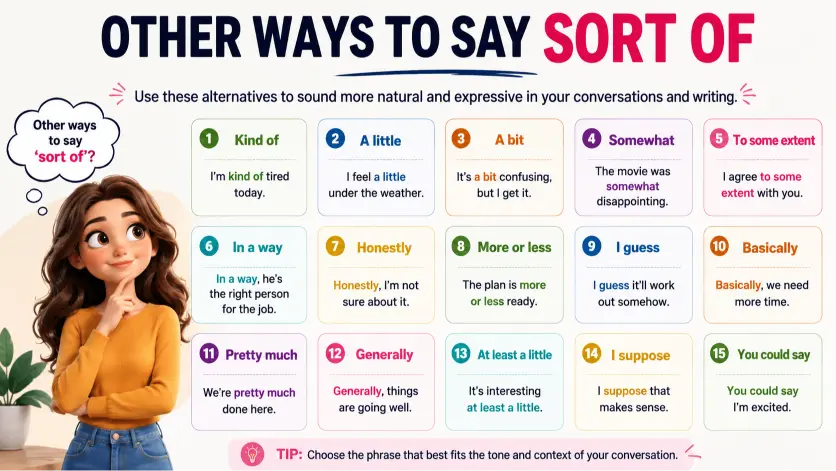
“Sort of” is a common English expression used when you want to make a statement less definite, soften an opinion, or show that something is only partly true. While it sounds natural in everyday conversation, repeating it too often can make your speaking or writing feel less precise. Learning other ways to say “sort of” can help English learners express uncertainty, approximation, similarity, or hesitation more naturally. Whether you are having a casual conversation, writing an email, participating in a meeting, or improving your vocabulary, choosing the right alternative can make your message clearer and more confident.
In this guide, you’ll discover 30 useful alternatives to “sort of,” with simple explanations and practical examples to show how each expression works in context. The list includes casual phrases for everyday speech as well as more polished options suitable for professional and academic communication. By understanding the difference between expressions such as “somewhat,” “kind of,” “to some extent,” “approximately,” and “in a way,” you can choose wording that matches your meaning and situation. These examples are designed to help intermediate and advanced English learners build vocabulary they can actually use.
Formal Alternatives to “Sort of”
When writing formally or communicating in academic and professional settings, these expressions are usually more precise.
- Somewhat
- To some extent
- To a certain degree
- Relatively
Pro Tip
Use somewhat for concise formal writing and to some extent when you want to show that an idea is only partly true.
Casual Alternatives
These expressions sound natural in everyday conversations with friends, classmates, or familiar colleagues.
- Kind of
- A little
- A bit
- Rather
Pro Tip
In casual speech, kind of and a bit sound natural, but avoid repeating them throughout the same conversation.
Professional Alternatives
Professional communication often benefits from alternatives that communicate uncertainty without sounding vague.
- To some extent
- Partially
- Relatively
- In part
Pro Tip
In reports, presentations, and emails, choose the most precise alternative available instead of using a vague conversational phrase.
Informal Expressions
Informal expressions in English are useful when the conversation is relaxed and the audience is familiar.
- Kind of
- A little bit
- More or less
- Pretty much
Pro Tip
Match informal expressions to the relationship and setting. What sounds natural with a friend may sound too casual in a formal presentation.
“A small vocabulary choice can completely change the tone of a sentence.”
Common Mistakes
1. Using “Sort of” in Every Sentence
Repeated use can make your English sound hesitant.
Example: “I sort of think we should sort of change the plan.”
Better: “I think we should change the plan.”
2. Using It in Formal Reports
“Sort of” is usually too conversational for academic or business writing.
Example: “The results are sort of significant.”
Better: “The results are somewhat significant.”
3. Using It When Exact Information Is Available
Avoid vague language when you know the precise answer.
Example: “There were sort of 50 participants.”
Better: “There were approximately 50 participants.”
4. Confusing “Sort Of” With “Kind Of” in Formal Writing
Both can express a similar idea, but neither is normally the strongest choice for formal documents.
Example: “The proposal is kind of effective.”
Better: “The proposal is relatively effective.”
5. Using It to Express Strong Confidence
“Sort of” can weaken a statement unnecessarily.
Example: “I sort of recommend this approach.”
Better: “I recommend this approach.”
What Does “Sort of” Mean?
“Sort of” is an informal expression meaning somewhat, approximately, or to a certain degree. It is often used to make a statement less definite or less direct.
Grammatically, it commonly functions as an adverbial expression that modifies an adjective, verb, or broader idea.
Example: “I’m sort of nervous about the interview.”
Here, “sort of” means somewhat nervous.
When to Use “Sort of”
You can use the phrase in several everyday situations:
- When you are unsure about something
- When an idea is partly true
- When describing an approximate feeling
- When softening an opinion
- When speaking casually
- When you do not want to sound overly definite
Spoken vs Written
Spoken English: “I’m sort of confused.”
Written English: “I’m somewhat confused.”
Formal vs Informal
Informal: “The movie was sort of interesting.”
Formal: “The movie was somewhat interesting.”
“Use casual language when the situation is casual, and precise language when the message matters.”
Is It Professional or Polite to Say “Sort of”?
“Sort of” is generally polite, because it can soften a statement and make you sound less forceful. However, politeness and professionalism are not exactly the same thing.
In professional settings, especially reports, proposals, interviews, and formal emails, a more precise alternative usually sounds stronger.
Polite? ✔️ Yes
Professional? ❌ No, in most cases
Business example:
Instead of saying, “The strategy is sort of effective,” say, “The strategy is somewhat effective based on the available results.”
Pros and Cons of Using “Sort of”
Pros
- Simple and natural: Easy to use in everyday conversation
- Friendly tone: Can make statements sound softer
- Common usage: Frequently heard in conversational English
- Easy to understand: Most English speakers immediately understand it
Cons
- Too informal for work: It may weaken professional communication
- Overused: Frequent repetition can make speech sound hesitant
- Limited emotional range: It does not communicate subtle meanings precisely
- Not suitable for formal writing: More exact vocabulary is usually preferable
Other Ways to Say “Sort of” With Examples
These alternatives to “sort of” can help you sound more fluent, confident, and natural in different situations. Choose them according to tone, context, and audience, especially when you want to express excitement in English, describe opinions, or use professional reaction phrases.
1. Phrase: Somewhat
- Meaning: To a moderate degree.
- Explanation: “Somewhat” is a concise and polished replacement in formal and neutral English.
- Example Sentence: “The new process is somewhat more efficient.”
- Best Use: Formal writing
- Worst Use: Very casual chat
- Tone: Neutral, polished
- Context Variability: Casual: “I’m somewhat tired.” Professional: “The results are somewhat encouraging.” Spoken: “It’s somewhat unusual.”
2. Phrase: Kind of
- Meaning: To some degree.
- Explanation: “Kind of” is a common conversational equivalent.
- Example Sentence: “I’m kind of surprised by the result.”
- Best Use: Casual conversation
- Worst Use: Formal reports
- Tone: Casual, conversational
- Context Variability: Casual: “It’s kind of strange.” Professional: Usually avoid it. Spoken: “I kind of agree.”
3. Phrase: Rather
- Meaning: Fairly or to a noticeable degree.
- Explanation: “Rather” can replace the phrase when describing a degree or quality.
- Example Sentence: “The task was rather challenging.”
- Best Use: Polished speech
- Worst Use: Highly technical data
- Tone: Refined, neutral
- Context Variability: Casual: “That was rather good.” Professional: “The proposal is rather detailed.” Spoken: “It seems rather complicated.”
4. Phrase: Fairly
- Meaning: To a reasonable degree.
- Explanation: “Fairly” communicates moderate intensity without sounding overly strong.
- Example Sentence: “The presentation was fairly successful.”
- Best Use: Neutral communication
- Worst Use: Exact measurements
- Tone: Neutral, measured
- Context Variability: Casual: “It’s fairly easy.” Professional: “The system is fairly reliable.” Spoken: “I’m fairly confident.”
5. Phrase: A Little
- Meaning: To a small degree.
- Explanation: “A little” works naturally when describing a mild feeling or condition.
- Example Sentence: “I’m a little concerned about the deadline.”
- Best Use: Everyday speech
- Worst Use: Formal reports
- Tone: Gentle, natural
- Context Variability: Casual: “I’m a little tired.” Professional: “The figures are a little lower.” Spoken: “That seems a little unusual.”
6. Phrase: A Bit
- Meaning: Slightly.
- Explanation: “A bit” is a natural conversational way to express a small degree.
- Example Sentence: “The instructions are a bit confusing.”
- Best Use: Casual speech
- Worst Use: Academic papers
- Tone: Casual, mild
- Context Variability: Casual: “I’m a bit hungry.” Professional: “The process is a bit slow.” Spoken: “It feels a bit awkward.”
7. Phrase: To Some Extent
- Meaning: Partly or within certain limits.
- Explanation: This phrase is useful when something is true but not completely true.
- Example Sentence: “The criticism is valid to some extent.”
- Best Use: Professional discussion
- Worst Use: Quick casual replies
- Tone: Formal, balanced
- Context Variability: Casual: “That’s true to some extent.” Professional: “The proposal addresses the issue to some extent.” Spoken: “I agree to some extent.”
8. Phrase: To a Certain Degree
- Meaning: To a particular but limited extent.
- Explanation: It emphasizes that something applies only partially.
- Example Sentence: “The decision was understandable to a certain degree.”
- Best Use: Formal explanation
- Worst Use: Casual greetings
- Tone: Formal, careful
- Context Variability: Casual: “I understand it to a certain degree.” Professional: “The policy is effective to a certain degree.” Spoken: “That is true to a certain degree.”
9. Phrase: Relatively
- Meaning: Comparatively or moderately.
- Explanation: “Relatively” is useful when comparing a quality against another standard.
- Example Sentence: “The procedure is relatively simple.”
- Best Use: Professional English
- Worst Use: Personal emotions
- Tone: Precise, neutral
- Context Variability: Casual: “It’s relatively easy.” Professional: “The system is relatively stable.” Spoken: “The process seems relatively straightforward.”
10. Phrase: Partially
- Meaning: Only partly.
- Explanation: “Partially” clearly indicates that something is incomplete or only partly applicable.
- Example Sentence: “The recommendation was partially implemented.”
- Best Use: Business writing
- Worst Use: Friendly conversation
- Tone: Formal, precise
- Context Variability: Casual: “I only partially agree.” Professional: “The plan was partially successful.” Spoken: “The issue was partially resolved.”
11. Phrase: In Part
- Meaning: Partly.
- Explanation: “In part” is concise and works especially well in formal explanations.
- Example Sentence: “The decline was in part caused by rising costs.”
- Best Use: Formal writing
- Worst Use: Casual banter
- Tone: Formal, concise
- Context Variability: Casual: “It was in part my decision.” Professional: “The increase was in part due to demand.” Spoken: “The problem was in part technical.”
12. Phrase: More or Less
- Meaning: Approximately or mostly.
- Explanation: This expression indicates that something is broadly accurate but not exact.
- Example Sentence: “The project is more or less complete.”
- Best Use: Informal discussion
- Worst Use: Precise reporting
- Tone: Casual, flexible
- Context Variability: Casual: “We’re more or less ready.” Professional: Use cautiously. Spoken: “That’s more or less what happened.”
13. Phrase: Approximately
- Meaning: Close to an exact amount or number.
- Explanation: “Approximately” is the best choice when “sort of” refers to an estimate.
- Example Sentence: “Approximately 200 people attended the event.”
- Best Use: Exact estimates
- Worst Use: Emotional opinions
- Tone: Formal, precise
- Context Variability: Casual: “It took approximately an hour.” Professional: “Approximately 30% responded.” Spoken: “There were approximately 50 attendees.”
14. Phrase: About
- Meaning: Approximately.
- Explanation: “About” is a simple way to describe an approximate amount, time, or number.
- Example Sentence: “The meeting lasted about two hours.”
- Best Use: Approximate figures
- Worst Use: Formal precision
- Tone: Neutral, natural
- Context Variability: Casual: “It costs about $20.” Professional: “About 40% responded.” Spoken: “It happened about a week ago.”
15. Phrase: Nearly
- Meaning: Almost but not completely.
- Explanation: “Nearly” is appropriate when something is very close to a particular point.
- Example Sentence: “The project is nearly finished.”
- Best Use: Near completion
- Worst Use: Broad opinions
- Tone: Clear, neutral
- Context Variability: Casual: “I’m nearly ready.” Professional: “The report is nearly complete.” Spoken: “We’re nearly there.”
16. Phrase: Almost
- Meaning: Very close to happening or being complete.
- Explanation: “Almost” expresses a strong degree of closeness.
- Example Sentence: “I’m almost certain that the meeting starts at nine.”
- Best Use: Near certainty
- Worst Use: Exact claims
- Tone: Natural, neutral
- Context Variability: Casual: “I’m almost done.” Professional: “The project is almost complete.” Spoken: “That’s almost correct.”
17. Phrase: More or Less
- Meaning: Broadly or approximately.
- Explanation: It suggests that an idea is generally accurate without claiming complete precision.
- Example Sentence: “The two proposals are more or less similar.”
- Best Use: Informal summaries
- Worst Use: Legal documents
- Tone: Informal, relaxed
- Context Variability: Casual: “We agree more or less.” Professional: Use sparingly. Spoken: “That’s more or less right.”
18. Phrase: In Some Ways
- Meaning: In certain respects.
- Explanation: This phrase is useful when a description applies only from particular perspectives.
- Example Sentence: “The approach is successful in some ways.”
- Best Use: Balanced opinions
- Worst Use: Exact statistics
- Tone: Thoughtful, neutral
- Context Variability: Casual: “It works in some ways.” Professional: “The model is effective in some ways.” Spoken: “I agree in some ways.”
19. Phrase: In Some Respects
- Meaning: In certain aspects.
- Explanation: This expression works well when evaluating something from multiple perspectives.
- Example Sentence: “The proposal is stronger in some respects.”
- Best Use: Formal analysis
- Worst Use: Quick replies
- Tone: Formal, analytical
- Context Variability: Casual: “It is better in some respects.” Professional: “The plan is stronger in some respects.” Spoken: “I agree in some respects.”
20. Phrase: To an Extent
- Meaning: Partly or within a limit.
- Explanation: It shows that something is true, but only to a limited degree.
- Example Sentence: “The concern is justified to an extent.”
- Best Use: Careful opinions
- Worst Use: Exact measurements
- Tone: Careful, neutral
- Context Variability: Casual: “That’s true to an extent.” Professional: “The criticism is justified to an extent.” Spoken: “I agree to an extent.”
21. Phrase: In a Way
- Meaning: From a particular perspective.
- Explanation: “In a way” is useful when an idea is difficult to express directly.
- Example Sentence: “In a way, the experience helped me grow.”
- Best Use: Personal reflection
- Worst Use: Formal data
- Tone: Conversational, reflective
- Context Variability: Casual: “In a way, I agree.” Professional: “In a way, the result was expected.” Spoken: “In a way, it makes sense.”
22. Phrase: To Some Degree
- Meaning: Partly or somewhat.
- Explanation: This expression is useful for carefully qualifying an opinion.
- Example Sentence: “The decision was successful to some degree.”
- Best Use: Formal discussion
- Worst Use: Casual greetings
- Tone: Formal, measured
- Context Variability: Casual: “That’s true to some degree.” Professional: “The strategy worked to some degree.” Spoken: “I agree to some degree.”
23. Phrase: Mildly
- Meaning: To a small degree.
- Explanation: “Mildly” works well when describing a limited reaction or quality.
- Example Sentence: “The announcement was mildly surprising.”
- Best Use: Moderate reactions
- Worst Use: Strong emotions
- Tone: Subtle, precise
- Context Variability: Casual: “I’m mildly annoyed.” Professional: “The results were mildly encouraging.” Spoken: “That was mildly unexpected.”
24. Phrase: Slightly
- Meaning: By a small amount.
- Explanation: “Slightly” provides a more precise alternative when the difference is small.
- Example Sentence: “The revised version is slightly clearer.”
- Best Use: Small differences
- Worst Use: Major changes
- Tone: Precise, neutral
- Context Variability: Casual: “It’s slightly better.” Professional: “Costs are slightly higher.” Spoken: “The room is slightly warmer.”
25. Phrase: Broadly
- Meaning: Generally or overall.
- Explanation: “Broadly” is useful when a statement is generally accurate without covering every detail.
- Example Sentence: “The recommendations are broadly consistent.”
- Best Use: General summaries
- Worst Use: Exact claims
- Tone: Professional, concise
- Context Variability: Casual: “That’s broadly true.” Professional: “The findings are broadly consistent.” Spoken: “I broadly agree.”
26. Phrase: Generally
- Meaning: In most cases or overall.
- Explanation: “Generally” describes what is usually or broadly true.
- Example Sentence: “The feedback was generally positive.”
- Best Use: Overall assessments
- Worst Use: Specific exceptions
- Tone: Neutral, professional
- Context Variability: Casual: “I generally agree.” Professional: “The response was generally positive.” Spoken: “People generally prefer this.”
27. Phrase: In Some Measure
- Meaning: To some extent.
- Explanation: This formal expression indicates a partial contribution or effect.
- Example Sentence: “The improvement was in some measure due to better planning.”
- Best Use: Formal analysis
- Worst Use: Casual conversation
- Tone: Formal, analytical
- Context Variability: Casual: Uncommon. Professional: “The success was in some measure due to planning.” Spoken: “The outcome was in some measure predictable.”
28. Phrase: Comparatively
- Meaning: When compared with something else.
- Explanation: “Comparatively” is useful when the degree depends on a comparison.
- Example Sentence: “The updated system is comparatively efficient.”
- Best Use: Comparative analysis
- Worst Use: Personal feelings
- Tone: Analytical, formal
- Context Variability: Casual: “It’s comparatively cheap.” Professional: “The process is comparatively efficient.” Spoken: “The new model is comparatively simple.”
29. Phrase: To a Degree
- Meaning: To a limited extent.
- Explanation: This phrase allows you to acknowledge an idea without fully agreeing with it.
- Example Sentence: “I agree with the criticism to a degree.”
- Best Use: Nuanced opinions
- Worst Use: Exact figures
- Tone: Balanced, thoughtful
- Context Variability: Casual: “I agree to a degree.” Professional: “The concern is valid to a degree.” Spoken: “That is true to a degree.”
30. Phrase: In Some Sense
- Meaning: In a particular interpretation.
- Explanation: “In some sense” works when an idea is true from one perspective but not universally.
- Example Sentence: “In some sense, the experience was a success.”
- Best Use: Abstract discussion
- Worst Use: Simple instructions
- Tone: Thoughtful, nuanced
- Context Variability: Casual: “In some sense, I agree.” Professional: “In some sense, the result was predictable.” Spoken: “In some sense, that makes sense.”
“Precision gives your English authority, while the right degree of informality keeps it natural.”
See Also
- See also: Other Ways to Say “I Think” for more natural and confident opinion statements.
- See also: Professional English Guide for practical vocabulary and communication strategies for workplace situations.
Mini Quiz and Self Check
1. Which option is best for a formal report?
A. Kind of
B. Sort of
C. Somewhat
D. Pretty much
Answer: C. Somewhat
2. Which sentence is most appropriate for a business presentation?
A. “The results are sort of positive.”
B. “The results are somewhat positive.”
C. “The results are kind of positive.”
D. “The results are pretty much positive.”
Answer: B. The results are somewhat positive.
3. You want to say that approximately 100 people attended. Which option is best?
A. “Sort of 100 people attended.”
B. “Kind of 100 people attended.”
C. “Approximately 100 people attended.”
D. “Somewhat 100 people attended.”
Answer: C. Approximately 100 people attended.
4. Which phrase best shows partial agreement?
A. To some extent
B. Absolutely
C. Completely
D. Exactly
Answer: A. To some extent
Comparison Table: Top Alternatives
| Phrase | Tone | Best Use |
| Somewhat | Formal, neutral | Professional writing |
| Kind of | Casual, conversational | Everyday speech |
| Rather | Refined, neutral | Polished English |
| Fairly | Neutral, measured | General descriptions |
| A little | Gentle, natural | Everyday conversation |
| To some extent | Formal, balanced | Professional opinions |
| Relatively | Precise, neutral | Comparisons |
| Partially | Formal, precise | Business writing |
| Approximately | Formal, exact | Numbers and estimates |
| Slightly | Neutral, precise | Small differences |
FAQs
What are the best other ways to say “sort of”?
The best choices include somewhat, kind of, rather, fairly, to some extent, relatively, and a little, depending on tone and context.
What is a formal alternative to “sort of”?
Somewhat is one of the simplest formal alternatives. To some extent and to a certain degree are also useful for formal explanations.
Is “sort of” professional English?
“Sort of” is understandable and polite, but it is usually too conversational for formal reports, business documents, and academic writing.
What is the difference between “sort of” and “kind of”?
They have very similar meanings and are often interchangeable in casual speech. Both can mean somewhat or to a certain degree.
How can I avoid saying “sort of” too often?
Identify what you actually mean. Use approximately for numbers, slightly for small differences, somewhat for degree, and to some extent for partial agreement.
Conclusion
Learning alternatives to “sort of” gives English learners more control over tone, precision, and confidence. While the phrase is perfectly natural in casual conversation, stronger vocabulary choices can make professional emails, presentations, reports, and discussions clearer. Words such as somewhat, relatively, slightly, approximately, and to some extent allow you to communicate more specific meanings.
The best way to improve is to practice replacing vague expressions with precise alternatives in everyday sentences. Pay attention to whether you are speaking casually, writing professionally, or expressing a carefully qualified opinion. With regular practice, choosing the right phrase will become automatic and your English will sound more natural, flexible, and confident.
Which alternative do you use most often? Share your favorite phrase and practice using it in a sentence today









