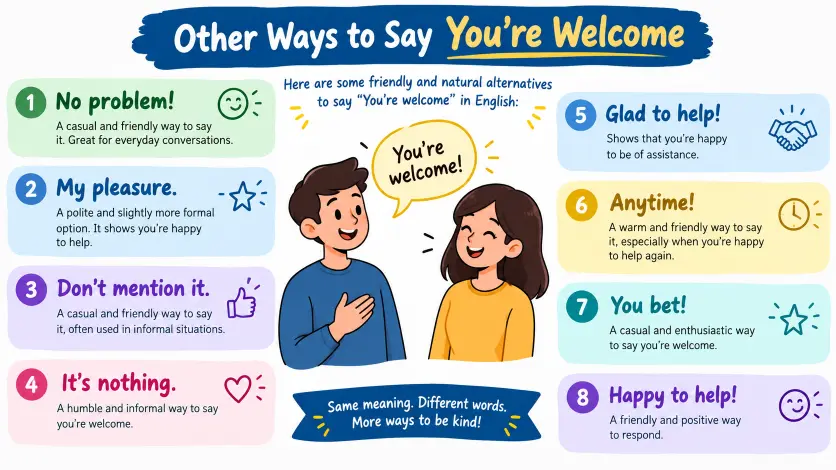
When someone says “Thank you,” replying with “You’re welcome” is perfectly correct—but it is not your only option. Learning other ways to say you are welcome in English can make your conversations sound more natural, confident, and appropriate for different situations. Whether you are speaking with friends, helping a colleague, communicating with customers, or having a formal conversation, choosing the right response can make your English sound more fluent and polished. Expressions such as “My pleasure,” “No problem,” and “Anytime” can communicate warmth while matching different levels of formality.
In this guide, you’ll discover practical alternatives to “You’re welcome,” with clear explanations of when and how to use them. The expressions are selected with real-world English communication in mind, so learners can understand the differences between casual, polite, professional, and friendly responses. By expanding your vocabulary beyond one familiar phrase, you can respond naturally, avoid repetitive language, and feel more comfortable in everyday conversations
Quick Categories
Formal alternatives to “you are welcome”
- It was my pleasure.
- You are most welcome.
- I was happy to assist.
- It was a pleasure to help.
Pro Tip: Use these expressions when speaking with clients, senior colleagues, customers, or people you do not know well.
Casual alternatives
- No problem.
- Anytime.
- Sure thing.
- Glad to help.
Pro Tip: Choose these options with friends, classmates, familiar colleagues, and people you regularly interact with.
Professional alternatives
- Happy to help.
- My pleasure.
- Glad I could assist.
- I am pleased to help.
Pro Tip: In professional settings, choose expressions that sound warm without becoming overly familiar.
Informal expressions
- No worries.
- Of course.
- You got it.
- Absolutely.
Pro Tip: Informal expressions in English work best when the relationship and situation are relaxed.
“Professional English does not have to sound cold. A simple phrase can communicate both competence and warmth.”
Common Mistakes
1. Using overly casual language with clients
Mistake: Saying “You got it” in a highly formal business interaction.
Example: “You got it, Mr. Smith.” This may sound too relaxed in some professional contexts.
2. Assuming “No problem” is always formal
Mistake: Treating “No problem” as the safest option for every workplace situation.
Example: “No problem, Professor.” A more polished choice may be “My pleasure.”
3. Using “Anytime” without considering tone
Mistake: Using “Anytime” when a highly formal response is expected.
Example: “Anytime, Doctor.” This can sound too casual depending on the relationship.
4. Repeating “You are welcome” every time
Mistake: Using the same response in every conversation.
Example: “Thank you for your help.” “You are welcome.” Repetition can make your English sound less flexible.
5. Confusing gratitude with excitement
Mistake: Assuming every positive response should communicate excitement.
Example: “I am thrilled to help you.” This may sound excessive when someone simply says thank you.
What Does “You Are Welcome” Mean?
“You are welcome” is a polite expression used in response to someone thanking you. It communicates that you are happy, willing, or comfortable with what you did for the other person.
Grammatically, “welcome” functions as an adjective after the verb “are.” The phrase literally communicates that the person receiving your help is welcome and that their thanks are not necessary.
Example: “Thank you for explaining the process.” “You are welcome.”
The phrase is widely understood and natural in both spoken and written English.
When to Use “You Are Welcome”
You can use the phrase in many everyday and professional situations.
• When someone thanks you for helping them
• After providing information or directions
• When responding to a colleague’s appreciation
• When helping a customer or client
• After doing a small favor for a friend
• In spoken conversations
• In emails when a simple polite response is appropriate
• In formal conversations when you want a neutral response
For spoken English, “You are welcome” is completely natural, although alternatives can make your speech more varied.
For written English, the phrase works well, but professional emails may benefit from alternatives such as “My pleasure” or “Happy to help.”
For formal situations, choose polished expressions.
For informal situations, shorter and warmer expressions are usually suitable.
“Context determines whether a phrase sounds friendly, professional, formal, or overly casual.”
Is “You Are Welcome” Professional or Polite to Say?
“You are welcome” is certainly polite and grammatically correct. However, in some professional situations, alternatives such as “My pleasure,” “Happy to help,” or “Glad I could assist” may sound warmer and more polished.
Polite? ✔️ Yes
Professional? ❌ No, in most cases
Business example: “Thank you for sending the revised proposal so quickly.”
“My pleasure. I am glad I could help.”
In many workplaces, “You are welcome” is acceptable, but varying your response can make your communication sound more natural and considerate.
Pros and Cons of Using “You Are Welcome”
Pros
• Simple and natural
• Friendly tone
• Common usage
• Easy to understand
Cons
• Too informal for some work situations
• Can become overused
• Has limited emotional range
• May not be ideal for highly formal writing
Other Ways to Say “You Are Welcome” With Examples
These alternatives will help you sound more fluent, confident, and natural in different situations.
Use them according to tone, context, and audience to express appreciation, warmth, approval, or even express excitement in English when the situation calls for a more enthusiastic response.
1. Phrase: My Pleasure
Meaning: You are happy that you could help.
Explanation: This is a polished and warm response to thanks.
Example Sentence: “Thank you for helping me prepare the presentation.” “My pleasure.”
Best Use: Professional conversations
Worst Use: Very casual banter
Tone: Warm, polished, courteous
Context Variability: Casual: “My pleasure.” Professional: “It was my pleasure to assist.” Spoken: “My pleasure.”
2. Phrase: No Problem
Meaning: You are saying that helping was not difficult or inconvenient.
Explanation: This is common in everyday conversation.
Example Sentence: “Thanks for picking me up.” “No problem.”
Best Use: Everyday conversations
Worst Use: Formal correspondence
Tone: Casual, relaxed, friendly
Context Variability: Casual: “No problem.” Professional: “No problem at all.” Spoken: “No problem.”
3. Phrase: Anytime
Meaning: You would be happy to help again.
Explanation: It communicates openness to helping in the future.
Example Sentence: “Thanks for your advice.” “Anytime.”
Best Use: Friendly relationships
Worst Use: Formal meetings
Tone: Friendly, generous, casual
Context Variability: Casual: “Anytime.” Professional: “I would be happy to assist again.” Spoken: “Anytime.”
4. Phrase: Happy to Help
Meaning: You are pleased that you could provide assistance.
Explanation: This is particularly useful in customer service and workplace communication.
Example Sentence: “Thank you for resolving the issue.” “Happy to help.”
Best Use: Workplace communication
Worst Use: Highly formal letters
Tone: Positive, professional, approachable
Context Variability: Casual: “Happy to help.” Professional: “I am happy to help.” Spoken: “Happy to help.”
5. Phrase: Glad to Help
Meaning: You are pleased that your assistance was useful.
Explanation: It sounds friendly while remaining appropriate for many professional situations.
Example Sentence: “Thank you for walking me through the process.” “Glad to help.”
Best Use: Work interactions
Worst Use: Ceremonial settings
Tone: Warm, positive, professional
Context Variability: Casual: “Glad to help.” Professional: “I am glad I could assist.” Spoken: “Glad to help.”
6. Phrase: You Are Most Welcome
Meaning: You are warmly accepting the person’s thanks.
Explanation: This is a more emphatic version of the standard expression.
Example Sentence: “Thank you for your generous assistance.” “You are most welcome.”
Best Use: Polite conversations
Worst Use: Very casual chats
Tone: Polite, warm, formal
Context Variability: Casual: “Most welcome.” Professional: “You are most welcome.” Spoken: “You are most welcome.”
7. Phrase: Of Course
Meaning: Helping was natural or expected.
Explanation: It reassures the other person that their request was not a burden.
Example Sentence: “Thanks for checking that for me.” “Of course.”
Best Use: Friendly interactions
Worst Use: Formal documents
Tone: Natural, warm, reassuring
Context Variability: Casual: “Of course.” Professional: “Of course, I was happy to assist.” Spoken: “Of course.”
8. Phrase: No Worries
Meaning: You are saying that the person’s request or thanks caused no concern.
Explanation: This is common in relaxed conversations.
Example Sentence: “Sorry for asking you to stay late.” “No worries.”
Best Use: Casual conversations
Worst Use: Formal business writing
Tone: Relaxed, friendly, informal
Context Variability: Casual: “No worries.” Professional: “Not a problem.” Spoken: “No worries.”
9. Phrase: Sure Thing
Meaning: You are happy to help or agree.
Explanation: This expression sounds confident and informal.
Example Sentence: “Thanks for sending that file.” “Sure thing.”
Best Use: Informal teamwork
Worst Use: Formal client emails
Tone: Casual, confident, friendly
Context Variability: Casual: “Sure thing.” Professional: “Certainly.” Spoken: “Sure thing.”
10. Phrase: It Was My Pleasure
Meaning: You enjoyed helping the other person.
Explanation: This is a polished expression suitable for professional situations.
Example Sentence: “Thank you for meeting with me.” “It was my pleasure.”
Best Use: Professional meetings
Worst Use: Very casual exchanges
Tone: Courteous, polished, warm
Context Variability: Casual: “My pleasure.” Professional: “It was my pleasure.” Spoken: “It was my pleasure.”
11. Phrase: Glad I Could Help
Meaning: You are pleased that your assistance was useful.
Explanation: It emphasizes the positive result of your help.
Example Sentence: “Thank you for helping me solve the problem.” “Glad I could help.”
Best Use: Helpful interactions
Worst Use: Formal announcements
Tone: Friendly, positive, sincere
Context Variability: Casual: “Glad I could help.” Professional: “I am glad I could assist.” Spoken: “Glad I could help.”
12. Phrase: Certainly
Meaning: You are politely confirming your willingness to help.
Explanation: It is concise and professional.
Example Sentence: “Thank you for answering my questions.” “Certainly.”
Best Use: Professional settings
Worst Use: Close friendship
Tone: Formal, confident, courteous
Context Variability: Casual: “Sure.” Professional: “Certainly.” Spoken: “Certainly.”
13. Phrase: Absolutely
Meaning: You strongly confirm that helping was fine.
Explanation: It can communicate enthusiasm when used naturally.
Example Sentence: “Thanks for reviewing my draft.” “Absolutely.”
Best Use: Positive interactions
Worst Use: Formal documents
Tone: Enthusiastic, confident, friendly
Context Variability: Casual: “Absolutely.” Professional: “Absolutely, happy to assist.” Spoken: “Absolutely.”
14. Phrase: Not at All
Meaning: You are saying that the favor was not a burden.
Explanation: It is a polite response that minimizes the inconvenience of helping.
Example Sentence: “Thank you for staying late.” “Not at all.”
Best Use: Polite conversations
Worst Use: Extremely casual chats
Tone: Courteous, modest, calm
Context Variability: Casual: “Not at all.” Professional: “Not at all, it was a pleasure.” Spoken: “Not at all.”
15. Phrase: Don’t Mention It
Meaning: You are saying that thanks are unnecessary.
Explanation: It is traditionally used after a small favor.
Example Sentence: “Thanks for carrying my bag.” “Don’t mention it.”
Best Use: Small favors
Worst Use: Formal business emails
Tone: Friendly, modest, informal
Context Variability: Casual: “Don’t mention it.” Professional: “There is no need to thank me.” Spoken: “Don’t mention it.”
16. Phrase: It Is Nothing
Meaning: You consider the help very easy or insignificant.
Explanation: This expression downplays the effort you made.
Example Sentence: “Thank you for helping me move these chairs.” “It is nothing.”
Best Use: Small favors
Worst Use: Major achievements
Tone: Humble, casual, reassuring
Context Variability: Casual: “It is nothing.” Professional: “It was no trouble.” Spoken: “It is nothing.”
17. Phrase: No Trouble at All
Meaning: Helping did not cause you any difficulty.
Explanation: It reassures the person that their request was acceptable.
Example Sentence: “Thanks for making that adjustment.” “No trouble at all.”
Best Use: Workplace conversations
Worst Use: Formal reports
Tone: Polite, reassuring, professional
Context Variability: Casual: “No trouble.” Professional: “No trouble at all.” Spoken: “No trouble at all.”
18. Phrase: I Am Happy to Assist
Meaning: You are pleased to provide assistance.
Explanation: This expression works particularly well in formal workplace communication.
Example Sentence: “Thank you for your assistance with the application.” “I am happy to assist.”
Best Use: Professional service
Worst Use: Close friends
Tone: Formal, helpful, professional
Context Variability: Casual: “Happy to help.” Professional: “I am happy to assist.” Spoken: “Happy to assist.”
19. Phrase: I Was Happy to Help
Meaning: You were pleased to provide assistance.
Explanation: It focuses on your positive attitude toward helping.
Example Sentence: “Thank you for helping us prepare.” “I was happy to help.”
Best Use: Professional follow up
Worst Use: Quick casual replies
Tone: Warm, sincere, professional
Context Variability: Casual: “Happy to help.” Professional: “I was happy to help.” Spoken: “I was happy to help.”
20. Phrase: It Was Nothing
Meaning: You consider the favor small.
Explanation: This humble expression is common after minor assistance.
Example Sentence: “Thank you for holding the door.” “It was nothing.”
Best Use: Small favors
Worst Use: Major assistance
Tone: Humble, casual, modest
Context Variability: Casual: “It was nothing.” Professional: “It was no trouble.” Spoken: “It was nothing.”
21. Phrase: I Am Pleased to Help
Meaning: You are genuinely happy to provide assistance.
Explanation: It has a formal and courteous tone.
Example Sentence: “Thank you for your support.” “I am pleased to help.”
Best Use: Formal communication
Worst Use: Casual texting
Tone: Formal, courteous, positive
Context Variability: Casual: “Happy to help.” Professional: “I am pleased to help.” Spoken: “Pleased to help.”
22. Phrase: Always Happy to Help
Meaning: You are consistently willing to assist.
Explanation: It creates a warm impression and encourages future communication.
Example Sentence: “Thank you for helping us again.” “Always happy to help.”
Best Use: Ongoing relationships
Worst Use: Formal documents
Tone: Warm, supportive, professional
Context Variability: Casual: “Always happy to help.” Professional: “I am always happy to assist.” Spoken: “Always happy to help.”
23. Phrase: Happy I Could Help
Meaning: You are pleased that your assistance was useful.
Explanation: It highlights satisfaction with the outcome.
Example Sentence: “Thanks for fixing the issue.” “Happy I could help.”
Best Use: Friendly workplace
Worst Use: Formal correspondence
Tone: Positive, friendly, confident
Context Variability: Casual: “Happy I could help.” Professional: “I am pleased I could assist.” Spoken: “Happy I could help.”
24. Phrase: I Am Glad to Assist
Meaning: You are pleased to provide support.
Explanation: This is a polished phrase for professional interactions.
Example Sentence: “Thank you for clarifying the requirements.” “I am glad to assist.”
Best Use: Business communication
Worst Use: Casual jokes
Tone: Professional, courteous, warm
Context Variability: Casual: “Glad to help.” Professional: “I am glad to assist.” Spoken: “Glad to assist.”
25. Phrase: It Is a Pleasure
Meaning: You regard helping as enjoyable or welcome.
Explanation: This short expression sounds polished and courteous.
Example Sentence: “Thank you for your support.” “It is a pleasure.”
Best Use: Formal interactions
Worst Use: Casual texting
Tone: Elegant, courteous, formal
Context Variability: Casual: “My pleasure.” Professional: “It is a pleasure.” Spoken: “It is a pleasure.”
26. Phrase: You Are Very Welcome
Meaning: You are warmly acknowledging someone’s thanks.
Explanation: It adds emphasis to the standard expression.
Example Sentence: “Thank you for your thoughtful advice.” “You are very welcome.”
Best Use: Warm conversations
Worst Use: Highly informal chat
Tone: Warm, polite, sincere
Context Variability: Casual: “Very welcome.” Professional: “You are very welcome.” Spoken: “You are very welcome.”
27. Phrase: Certainly, My Pleasure
Meaning: You are confidently confirming that helping was enjoyable.
Explanation: Combining the two ideas creates a polished response.
Example Sentence: “Thank you for arranging the meeting.” “Certainly, my pleasure.”
Best Use: Client interactions
Worst Use: Casual texting
Tone: Polished, courteous, positive
Context Variability: Casual: “My pleasure.” Professional: “Certainly, my pleasure.” Spoken: “Certainly, my pleasure.”
28. Phrase: I Am Glad It Helped
Meaning: You are pleased that your assistance produced a useful result.
Explanation: This is especially natural when someone tells you your help worked.
Example Sentence: “Your advice made the presentation much better.” “I am glad it helped.”
Best Use: Helpful feedback
Worst Use: Formal greetings
Tone: Sincere, warm, encouraging
Context Variability: Casual: “Glad it helped.” Professional: “I am glad it was helpful.” Spoken: “Glad it helped.”
29. Phrase: Always a Pleasure
Meaning: You are happy to help or interact again.
Explanation: It works particularly well in established professional relationships.
Example Sentence: “Thank you for your continued support.” “Always a pleasure.”
Best Use: Professional relationships
Worst Use: Formal reports
Tone: Warm, polished, gracious
Context Variability: Casual: “Always a pleasure.” Professional: “It is always a pleasure.” Spoken: “Always a pleasure.”
30. Phrase: I Am Happy to Be of Assistance
Meaning: You are pleased that you could provide useful support.
Explanation: This is a formal expression suited to professional communication.
Example Sentence: “Thank you for your detailed guidance.” “I am happy to be of assistance.”
Best Use: Formal business
Worst Use: Casual conversation
Tone: Formal, courteous, helpful
Context Variability: Casual: “Happy to help.” Professional: “I am happy to be of assistance.” Spoken: “Happy to assist.”
“The best alternative is not always the most formal one. Choose the expression that matches your audience and relationship.”
See Also
• See also: Explore another guide on other ways to say common English expressions to expand your everyday vocabulary.
• See also: Read our Professional English guide for practical expressions used in workplace conversations, meetings, and emails.
Mini Quiz and Self Check
Question 1
Your manager thanks you for helping with an important presentation. Which response is most appropriate?
A. No worries
B. My pleasure
C. You got it
D. Whatever works
Answer: B. My pleasure
Question 2
A close friend thanks you for giving them a ride. Which response sounds natural?
A. I am pleased to be of assistance
B. Anytime
C. I hereby acknowledge your thanks
D. It is my professional pleasure
Answer: B. Anytime
Question 3
A customer thanks you for resolving a problem. Which response is professional?
A. No worries
B. Sure thing
C. Happy to help
D. You got it
Answer: C. Happy to help
Question 4
Which phrase is most formal?
A. No problem
B. Anytime
C. I am happy to be of assistance
D. Sure thing
Answer: C. I am happy to be of assistance
Comparison Table: Top Alternatives
| Phrase | Tone | Best Use |
| My pleasure | Warm, polished | Professional conversations |
| Happy to help | Friendly, professional | Workplace communication |
| Glad to help | Warm, positive | Everyday work |
| It was my pleasure | Courteous, formal | Meetings and clients |
| You are most welcome | Polite, formal | Respectful conversations |
| No problem | Casual, relaxed | Everyday situations |
| Anytime | Friendly, casual | Friends and familiar people |
| Certainly | Formal, confident | Business settings |
| Of course | Natural, reassuring | Everyday conversations |
| I am glad to assist | Professional, courteous | Customer service |
Frequently Asked Questions
What are the best alternatives to “you are welcome”?
Some of the most useful alternatives are My pleasure, Happy to help, Glad to help, Anytime, No problem, and It was my pleasure.
What is a professional way to say “you are welcome”?
My pleasure, Happy to help, and I am glad to assist are strong professional reaction phrases for workplace conversations.
Is “no problem” a good alternative to “you are welcome”?
Yes. “No problem” is natural and friendly, but it is generally more casual than “My pleasure” or “I am glad to assist.”
How can I sound more natural when responding to thanks?
Match your response to the situation. Use relaxed expressions with friends and polished alternatives in professional communication.
Can “you are welcome” sound rude?
Usually no. The phrase is polite and widely accepted. However, repeating it mechanically or using a very formal alternative in a casual situation can make your response sound unnatural.
Conclusion
Learning different ways to respond to “thank you” gives you greater control over your English. Instead of relying on one expression, you can choose language that matches the relationship, setting, and level of formality. Expressions such as “My pleasure” and “Happy to help” work especially well in professional situations, while “Anytime” and “No problem” are more relaxed.
The key is regular practice and tone awareness. Try replacing the standard response with a different expression each day and notice how native speakers use similar phrases. Over time, these alternatives will become natural parts of your vocabulary and help you communicate with greater confidence in both spoken and written English.









