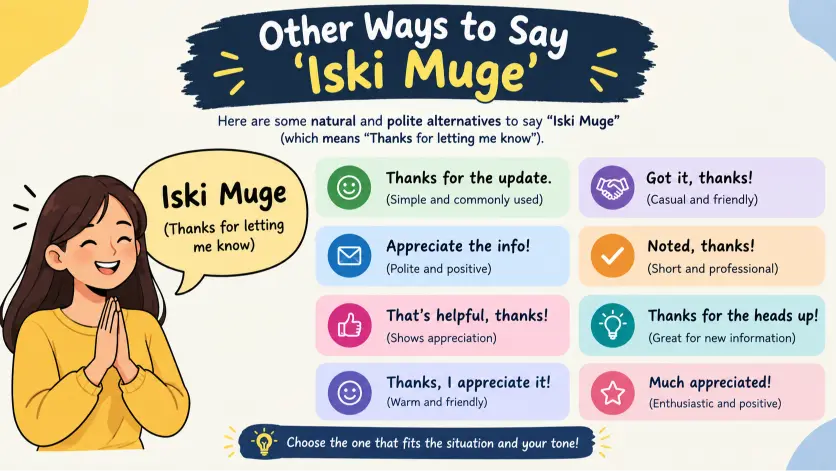
Have you ever typed “Thanks for letting me know” in an email or message and wondered if there was a more natural, professional, or friendly way to respond? 💬 This common phrase is useful, but using different alternatives can make your English sound more polished and appropriate for the situation. For you are replying to a coworker, responding to a client, acknowledging an update, or chatting with a friend, choosing the right expression can help you communicate with greater confidence and clarity.
In this guide, you’ll discover 30 other ways to say “Thanks for letting me know,” including formal, professional, polite, casual, and friendly alternatives. Each expression is explained with its meaning and practical context so English learners can understand when to use it naturally. These alternatives are especially helpful for workplace emails, everyday conversations, and professional communication. By learning how tone and context affect word choice, you can expand your vocabulary while making your spoken and written English sound more natural and effective
Quick Categories
Formal alternatives to “Thanks for Letting Me Know”
- Thank you for informing me
- I appreciate the information
- Thank you for keeping me informed
- I appreciate you bringing this to my attention
These expressions work well when communicating with clients, senior colleagues, academic professionals, or people you do not know well.
Pro Tip: Choose formal expressions when the relationship, setting, or subject requires respectful and carefully worded communication.
Casual alternatives
- Thanks for the update
- Thanks for telling me
- I appreciate the heads up
- Good to know
These phrases are natural in conversations with friends, coworkers you know well, and familiar contacts.
Pro Tip: Casual expressions are best when the situation is relaxed and the relationship is already established.
Professional alternatives
- I appreciate the update
- Thank you for the clarification
- Thank you for keeping me updated
- I appreciate you sharing this information
These phrases are particularly useful in workplace emails, meetings, project discussions, and customer communication.
Pro Tip: In professional English, choose wording that acknowledges the information without sounding overly emotional or informal.
Informal expressions
- Thanks for the heads up
- Good to know
- Thanks for telling me
- I’m glad you told me
These are useful in everyday conversations and informal expressions in English.
Pro Tip: Informal phrases should match the relationship and setting. Avoid very casual expressions in formal business correspondence.
“Fluent English is not only about knowing more words. It is about choosing the right words for the situation.”
Common Mistakes
1. Using a casual phrase in a formal email
Mistake: Writing “Thanks for the heads up” to a senior client.
Example: “Thanks for the heads up about the contract.”
A more professional choice would be “Thank you for informing me about the contract.”
2. Repeating the same phrase too often
Mistake: Using “Thanks for letting me know” in every email.
Example: “Thanks for letting me know. Thanks for letting me know about the meeting. Thanks for letting me know about the changes.”
Use alternatives such as “I appreciate the update” or “Thank you for keeping me informed.”
3. Confusing acknowledgment with agreement
Mistake: Assuming that thanking someone means you agree with what they said.
Example: “Thanks for letting me know. I agree with your decision.”
The first sentence acknowledges information, while the second expresses agreement.
4. Using overly emotional language for simple information
Mistake: Saying “I am incredibly grateful for this wonderful information” when someone simply confirms a meeting time.
Example: “I am incredibly grateful that you told me the meeting starts at three.”
A natural alternative is “Thanks for the update.”
5. Using “thank you” without considering the context
Mistake: Choosing a phrase without thinking about whether the situation is formal or casual.
Example: “Thanks for the heads up” may sound perfectly natural among coworkers but may be unsuitable in a formal client email.
What Does “Thanks for Letting Me Know” Mean?
“Thanks for letting me know” means “I appreciate you telling me this information.”
The phrase contains “thanks,” which expresses gratitude, and “letting me know,” which means giving someone information or making them aware of something.
It is grammatically natural and widely used in spoken and written English.
Example:
“Thanks for letting me know that the meeting has been postponed.”
The phrase does not necessarily mean that you agree with the information. It simply acknowledges that someone has communicated something to you.
When to Use “Thanks for Letting Me Know”
You can use this expression in many situations, including:
• When someone gives you an update
• When someone tells you about a change
• When someone provides useful information
• When someone confirms a detail
• When someone warns you about a possible issue
• When someone explains what happened
• When someone informs you about an appointment
• When someone shares workplace information
Spoken English
“Thanks for letting me know” sounds very natural in everyday conversation.
Example:
“Thanks for letting me know. I’ll be there at six.”
Written English
The phrase is also acceptable in emails and messages, especially when the tone is friendly or moderately informal.
Example:
“Thanks for letting me know about the schedule change.”
Formal English
In formal situations, alternatives such as “Thank you for informing me” or “I appreciate the information” may sound more appropriate.
Informal English
With friends and familiar coworkers, “Thanks for the update” or “Good to know” can sound more relaxed.
“Professional communication is often about adjusting your tone, not simply changing your vocabulary.”
Is “Thanks for Letting Me Know” Professional or Polite to Say?
“Thanks for letting me know” is polite, but it is not always the most formal professional expression.
It is completely acceptable in many workplace conversations, internal messages, and friendly professional emails. However, when communicating with senior executives, clients, external organizations, or in highly formal correspondence, a more formal alternative may be preferable.
Polite? ✔ Yes
Professional? No, in most formal situations
Business example:
“Thank you for keeping me informed about the changes to the project schedule.”
This sounds more polished than a casual acknowledgment while still being friendly.
Pros and Cons of Using “Thanks for Letting Me Know”
Pros
• Simple and natural: Easy for almost every English speaker to understand.
• Friendly tone: Shows appreciation without sounding overly formal.
• Common usage: Frequently heard in everyday English and workplace conversations.
• Easy to understand: Clearly acknowledges that information has been received.
Cons
• Too informal for some work situations: Formal correspondence may require more polished wording.
• Overused: Repeating it frequently can make your communication predictable.
• Limited emotional range: It does not clearly communicate excitement, concern, appreciation, or urgency.
• Not suitable for formal writing: Some academic, legal, or highly formal business contexts may call for different wording.
Other Ways to Say “Thanks for Letting Me Know” With Examples
These alternatives to “thanks for letting me know” can help you sound more fluent, confident, and natural in different situations.
Use them according to tone, context, and audience. Some expressions communicate simple acknowledgment, while others can show appreciation, concern, enthusiasm, or other professional reaction phrases.
1. Phrase: Thank you for informing me
Meaning: I appreciate you providing this information.
Explanation: This is a formal and respectful way to acknowledge information.
Example Sentence: Thank you for informing me about the change in the meeting schedule.
Best Use: Formal communication
Worst Use: Casual conversation
Tone: Formal, respectful, polished
Context Variability: Casual: less natural. Professional: highly suitable. Spoken: suitable in formal settings.
2. Phrase: I appreciate the information
Meaning: I am grateful that you provided this information.
Explanation: This phrase sounds professional while remaining warm and natural.
Example Sentence: I appreciate the information and will review the documents today.
Best Use: Workplace emails
Worst Use: Very casual chats
Tone: Professional, appreciative, courteous
Context Variability: Casual: slightly formal. Professional: excellent fit. Spoken: natural at work.
3. Phrase: Thanks for the update
Meaning: Thank you for giving me new information.
Explanation: This is one of the most natural alternatives for everyday professional communication.
Example Sentence: Thanks for the update. I’ll adjust the schedule accordingly.
Best Use: Workplace updates
Worst Use: Formal letters
Tone: Friendly, professional, natural
Context Variability: Casual: natural. Professional: very common. Spoken: highly natural.
4. Phrase: Thank you for the update
Meaning: I appreciate receiving this new information.
Explanation: This sounds slightly more polished than “Thanks for the update.”
Example Sentence: Thank you for the update regarding the delivery timeline.
Best Use: Business emails
Worst Use: Intimate conversations
Tone: Polite, professional, neutral
Context Variability: Casual: acceptable. Professional: excellent. Spoken: natural.
5. Phrase: Thank you for keeping me informed
Meaning: I appreciate being kept aware of developments.
Explanation: This phrase is useful when someone regularly provides important information.
Example Sentence: Thank you for keeping me informed about the project’s progress.
Best Use: Ongoing communication
Worst Use: Simple greetings
Tone: Formal, appreciative, professional
Context Variability: Casual: somewhat formal. Professional: excellent. Spoken: appropriate.
6. Phrase: I appreciate you telling me
Meaning: I am grateful that you shared the information.
Explanation: This sounds warm and personal while remaining natural.
Example Sentence: I appreciate you telling me about the change before the meeting.
Best Use: Personal communication
Worst Use: Formal reports
Tone: Warm, appreciative, conversational
Context Variability: Casual: excellent. Professional: acceptable. Spoken: very natural.
7. Phrase: I appreciate the update
Meaning: I am grateful for the new information.
Explanation: This is a concise professional alternative that works especially well in emails.
Example Sentence: I appreciate the update and will take the next steps this afternoon.
Best Use: Professional emails
Worst Use: Casual greetings
Tone: Polished, concise, professional
Context Variability: Casual: somewhat formal. Professional: excellent. Spoken: natural.
8. Phrase: Thank you for sharing this
Meaning: I appreciate you sharing this information with me.
Explanation: This phrase works well when someone provides useful details, news, or an opinion.
Example Sentence: Thank you for sharing this. I’ll take it into consideration.
Best Use: Information sharing
Worst Use: Routine greetings
Tone: Polite, appreciative, neutral
Context Variability: Casual: natural. Professional: excellent. Spoken: natural.
9. Phrase: Thanks for telling me
Meaning: Thank you for giving me this information.
Explanation: This is a simple and conversational alternative.
Example Sentence: Thanks for telling me. I didn’t realize the office would be closed.
Best Use: Everyday conversation
Worst Use: Formal correspondence
Tone: Casual, friendly, direct
Context Variability: Casual: excellent. Professional: limited. Spoken: very natural.
10. Phrase: Good to know
Meaning: This information is useful or helpful to me.
Explanation: This short expression acknowledges information without directly using “thank you.”
Example Sentence: Good to know. I’ll make sure to arrive early.
Best Use: Quick responses
Worst Use: Formal emails
Tone: Casual, concise, relaxed
Context Variability: Casual: excellent. Professional: limited. Spoken: highly natural.
“A short response can still sound professional when the wording matches the situation.”
11. Phrase: Thanks for the heads up
Meaning: Thank you for warning or informing me about something.
Explanation: This informal expression is commonly used when information helps you prepare for something.
Example Sentence: Thanks for the heads up about the road closure.
Best Use: Informal communication
Worst Use: Formal emails
Tone: Casual, friendly, conversational
Context Variability: Casual: excellent. Professional: limited. Spoken: highly natural.
12. Phrase: I appreciate the heads up
Meaning: I am grateful that you warned or informed me.
Explanation: This is a slightly more appreciative version of “Thanks for the heads up.”
Example Sentence: I appreciate the heads up about the deadline change.
Best Use: Familiar coworkers
Worst Use: Formal clients
Tone: Friendly, casual, appreciative
Context Variability: Casual: excellent. Professional: acceptable with familiar colleagues. Spoken: very natural.
13. Phrase: Thank you for the clarification
Meaning: Thank you for making something clearer.
Explanation: Use this when someone explains confusing or incomplete information.
Example Sentence: Thank you for the clarification. I now understand what needs to be completed.
Best Use: Clarifying details
Worst Use: Casual greetings
Tone: Professional, polite, precise
Context Variability: Casual: slightly formal. Professional: excellent. Spoken: appropriate.
14. Phrase: I appreciate the clarification
Meaning: I am grateful that you explained the matter.
Explanation: This is a polished professional expression for situations involving confusion or misunderstanding.
Example Sentence: I appreciate the clarification regarding the revised policy.
Best Use: Business communication
Worst Use: Friendly banter
Tone: Formal, polished, respectful
Context Variability: Casual: formal. Professional: excellent. Spoken: suitable in meetings.
15. Phrase: Thank you for bringing this to my attention
Meaning: Thank you for making me aware of an issue or detail.
Explanation: This expression is particularly useful when someone points out something important.
Example Sentence: Thank you for bringing this issue to my attention. I’ll investigate it immediately.
Best Use: Workplace issues
Worst Use: Casual chats
Tone: Formal, respectful, professional
Context Variability: Casual: too formal. Professional: excellent. Spoken: suitable for work.
16. Phrase: I’m glad you told me
Meaning: I am pleased that you shared the information.
Explanation: This phrase often communicates relief or appreciation in personal situations.
Example Sentence: I’m glad you told me about the change before I made the trip.
Best Use: Personal situations
Worst Use: Formal reports
Tone: Warm, sincere, conversational
Context Variability: Casual: excellent. Professional: selective. Spoken: highly natural.
17. Phrase: Thank you for the notice
Meaning: Thank you for informing me in advance.
Explanation: This can be used when someone provides advance information about a change or event.
Example Sentence: Thank you for the notice regarding the scheduled maintenance.
Best Use: Advance information
Worst Use: Friendly chats
Tone: Polite, formal, neutral
Context Variability: Casual: formal. Professional: suitable. Spoken: acceptable.
18. Phrase: I’m grateful for the information
Meaning: I sincerely appreciate receiving the information.
Explanation: This expression communicates stronger appreciation than a simple “thanks.”
Example Sentence: I’m grateful for the information because it will help us prepare.
Best Use: Meaningful updates
Worst Use: Routine notifications
Tone: Sincere, appreciative, formal
Context Variability: Casual: somewhat formal. Professional: suitable. Spoken: natural when genuine.
19. Phrase: Thanks for keeping me posted
Meaning: Thank you for continuing to give me updates.
Explanation: This is a friendly expression for ongoing information.
Example Sentence: Thanks for keeping me posted on the project’s progress.
Best Use: Ongoing updates
Worst Use: Formal letters
Tone: Friendly, conversational, professional
Context Variability: Casual: excellent. Professional: good for familiar teams. Spoken: highly natural.
20. Phrase: Thank you for keeping me updated
Meaning: Thank you for continuing to provide new information.
Explanation: This is a professional version of “Thanks for keeping me posted.”
Example Sentence: Thank you for keeping me updated throughout the process.
Best Use: Workplace communication
Worst Use: Casual greetings
Tone: Polite, professional, appreciative
Context Variability: Casual: acceptable. Professional: excellent. Spoken: natural.
21. Phrase: I appreciate you sharing the details
Meaning: I am grateful that you provided the relevant details.
Explanation: Use this when someone gives you specific information that helps you understand a situation.
Example Sentence: I appreciate you sharing the details before our meeting.
Best Use: Detailed information
Worst Use: Simple announcements
Tone: Professional, appreciative, courteous
Context Variability: Casual: somewhat formal. Professional: excellent. Spoken: natural.
22. Phrase: Thank you for the information
Meaning: Thank you for providing useful facts or details.
Explanation: This is one of the safest professional alternatives to the original phrase.
Example Sentence: Thank you for the information. We’ll review the proposal and respond shortly.
Best Use: Professional emails
Worst Use: Close friendships
Tone: Polite, neutral, professional
Context Variability: Casual: slightly formal. Professional: excellent. Spoken: natural.
23. Phrase: I appreciate you letting me know
Meaning: I appreciate that you informed me.
Explanation: This keeps the original meaning while sounding slightly more polished.
Example Sentence: I appreciate you letting me know about the schedule change.
Best Use: Professional messages
Worst Use: Formal reports
Tone: Polite, warm, professional
Context Variability: Casual: natural. Professional: excellent. Spoken: very natural.
24. Phrase: Thank you for notifying me
Meaning: Thank you for officially informing me.
Explanation: This phrase is more formal and is often appropriate for official communication.
Example Sentence: Thank you for notifying me of the change in appointment time.
Best Use: Official communication
Worst Use: Friendly conversations
Tone: Formal, precise, official
Context Variability: Casual: unnatural. Professional: excellent. Spoken: formal.
25. Phrase: I appreciate being informed
Meaning: I am grateful that I received the information.
Explanation: This is a formal expression suitable for professional situations.
Example Sentence: I appreciate being informed about the revised procedures.
Best Use: Formal workplace
Worst Use: Casual chats
Tone: Formal, polished, neutral
Context Variability: Casual: too formal. Professional: excellent. Spoken: formal.
26. Phrase: Thank you for the heads up
Meaning: Thank you for warning or informing me in advance.
Explanation: This phrase is conversational and useful when someone helps you prepare for something.
Example Sentence: Thank you for the heads up about the upcoming deadline.
Best Use: Familiar colleagues
Worst Use: Formal letters
Tone: Friendly, conversational, appreciative
Context Variability: Casual: excellent. Professional: suitable with familiar colleagues. Spoken: very natural.
27. Phrase: That’s helpful to know
Meaning: The information you provided is useful to me.
Explanation: This expression acknowledges useful information without sounding overly formal.
Example Sentence: That’s helpful to know. I’ll plan accordingly.
Best Use: Useful information
Worst Use: Formal notices
Tone: Friendly, appreciative, natural
Context Variability: Casual: excellent. Professional: good. Spoken: highly natural.
28. Phrase: I’m glad you mentioned that
Meaning: I am pleased that you brought this information up.
Explanation: Use this when someone’s information is particularly relevant to the conversation.
Example Sentence: I’m glad you mentioned that because I had the same question.
Best Use: Relevant details
Worst Use: Formal notices
Tone: Conversational, warm, appreciative
Context Variability: Casual: excellent. Professional: good. Spoken: very natural.
29. Phrase: Thank you for making me aware
Meaning: Thank you for helping me become aware of something.
Explanation: This formal phrase is useful when someone points out an issue, fact, or concern.
Example Sentence: Thank you for making me aware of the potential issue with the report.
Best Use: Professional concerns
Worst Use: Casual conversation
Tone: Formal, respectful, professional
Context Variability: Casual: too formal. Professional: excellent. Spoken: suitable in serious settings.
30. Phrase: I appreciate you keeping me informed
Meaning: I am grateful that you continue to provide important updates.
Explanation: This is a polished expression for ongoing professional communication.
Example Sentence: I appreciate you keeping me informed about the project’s development.
Best Use: Ongoing projects
Worst Use: Casual greetings
Tone: Professional, appreciative, polished
Context Variability: Casual: formal. Professional: excellent. Spoken: appropriate in workplace discussions.
“The best alternative depends on who you are speaking to, what you are discussing, and how formal the situation is.”
How to Choose the Right Alternative
Choosing among other ways to say “thanks for letting me know” becomes easier when you identify the purpose of your response.
When you simply acknowledge information
Use:
• Thanks for the update
• Thank you for the information
• Good to know
• That’s helpful to know
When you want to sound professional
Use:
• I appreciate the update
• Thank you for informing me
• Thank you for keeping me informed
• I appreciate you sharing the details
When someone gives you a warning
Use:
• Thanks for the heads up
• I appreciate the heads up
• Thank you for the heads up
When someone explains something
Use:
• Thank you for the clarification
• I appreciate the clarification
• I appreciate you sharing the details
When the information is personally important
Use:
• I’m glad you told me
• I appreciate you telling me
• I’m glad you mentioned that
See Also
See also: Other Ways to Say Thank You for All You Do
See also: Professional English: Useful Phrases for Workplace Communication
Pull Quotes and Key Takeaways
“Use ‘Thanks for the update’ when you want a natural phrase that works especially well at work.”
“Use ‘Thank you for informing me’ when you need a more formal and respectful tone.”
“Use ‘Thanks for the heads up’ when the situation is informal and someone has warned you about something.”
“Tone awareness is one of the simplest ways to make your English sound more fluent.”
Mini Quiz and Self Check
1. You receive an important project update from your manager. Which response is most appropriate?
A. Thanks for the heads up, dude.
B. Good to know, whatever happens.
C. I appreciate the update.
D. Cool, thanks.
Answer: C. I appreciate the update.
2. Your friend tells you that a restaurant is closed today. What sounds natural?
A. Thank you for notifying me in accordance with our communication standards.
B. Thanks for letting me know.
C. I appreciate being informed.
D. Thank you for making me aware of this matter.
Answer: B. Thanks for letting me know.
3. A colleague explains why a deadline has changed. Which response is most suitable?
A. Thank you for the clarification.
B. Whatever, thanks.
C. Nice one.
D. Cool story.
Answer: A. Thank you for the clarification.
4. You want to tell a client that you appreciate receiving important information. Which option fits best?
A. Thanks for telling me.
B. Good to know.
C. I appreciate the information.
D. Thanks for the heads up.
Answer: C. I appreciate the information.
Comparison Table: Top Alternatives
| Phrase | Tone | Best Use |
| Thank you for informing me | Formal | Official communication |
| I appreciate the information | Professional | Business emails |
| Thanks for the update | Friendly | Workplace updates |
| Thank you for the update | Professional | Business communication |
| Thank you for keeping me informed | Formal | Ongoing communication |
| I appreciate the update | Professional | Workplace emails |
| Thanks for telling me | Casual | Everyday conversation |
| Good to know | Casual | Quick responses |
| Thanks for the heads up | Informal | Warnings and advance information |
| Thank you for the clarification | Professional | Explanations |
FAQs
What are the best alternatives to “thanks for letting me know”?
Some useful alternatives include “I appreciate the update,” “Thank you for the information,” “Thanks for the update,” and “Thank you for keeping me informed.”
What is a professional way to say “thanks for letting me know”?
“I appreciate the information” and “Thank you for informing me” are professional choices that work well in business communication.
Is “thanks for letting me know” polite?
Yes. It is a polite and natural expression used to acknowledge information. However, some formal situations may require more professional wording.
What is a casual way to say “thanks for letting me know”?
“Thanks for telling me,” “Good to know,” and “Thanks for the heads up” are natural casual alternatives.
How can I avoid repeating “thanks for letting me know”?
Vary your language according to context. Try “I appreciate the update,” “Thank you for the clarification,” “That’s helpful to know,” or “Thank you for keeping me informed.”
Conclusion
Learning other ways to say “thanks for letting me know” gives you more control over your English. Instead of relying on one expression, you can select language that matches your relationship, audience, purpose, and level of formality. Professional settings may call for “I appreciate the information,” while casual conversations may sound more natural with “Good to know” or “Thanks for telling me.”
The key is to practice these expressions in realistic situations. Try replacing one familiar phrase with a different alternative each day. Pay attention to tone, especially when moving between casual conversations, workplace messages, customer communication, and formal writing. With regular practice, these professional reaction phrases will become easier to use naturally and confidently.









