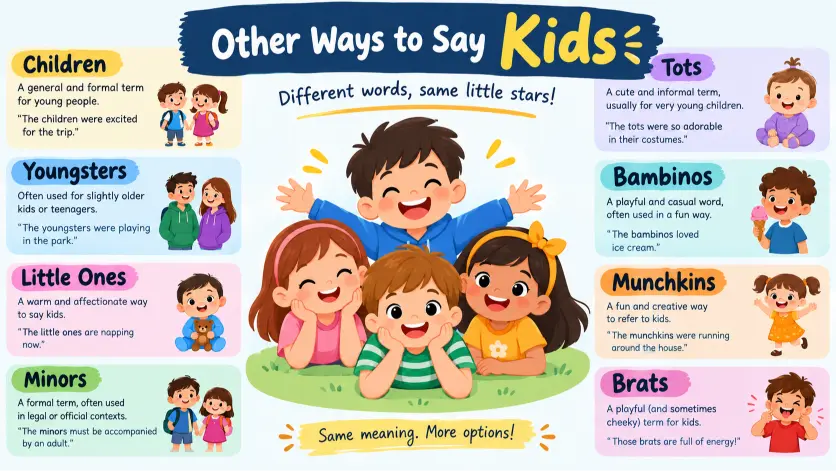
Looking for a better way to say “kids” without repeating the same word again and again? For you’re writing an article, speaking with others, teaching English, or simply expanding your vocabulary, choosing the right alternative can make your communication clearer and more natural. Words such as children, youngsters, little ones, youngsters, minors, and youth can fit different situations, but they don’t all have the same tone or meaning.
In this guide, you’ll discover 30+ other ways to say kids, organized to help you understand which expressions work best in casual conversations, formal writing, educational settings, and everyday English. Each alternative is explained with practical context so English learners can use it confidently and accurately. As an English-focused vocabulary resource, this guide emphasizes natural usage, appropriate tone, and context rather than simply listing dictionary synonyms. By the end, you’ll have a useful range of alternatives for choosing the right word for your audience and situation.
Quick Categories
Formal alternatives to “kids”
- Children
- Young people
- Minors
- Juveniles
Pro Tip: Use children as the safest formal alternative. Use minors when age or legal status is relevant.
Casual alternatives
- Little ones
- Youngsters
- Boys and girls
- The younger ones
Pro Tip: Choose casual expressions when speaking with friends, family members, or people you already know well.
Professional alternatives
- Children
- Young learners
- Young people
- Students
Pro Tip: In professional communication, select a term that describes the children’s role or setting rather than simply their age.
Informal expressions
- Little ones
- Youngsters
- The children
- Boys and girls
Pro Tip: Informal expressions can make conversation warmer, but avoid overly affectionate terms in formal workplace communication.
“A simple vocabulary change can completely change the tone of a sentence.”
Common Mistakes When Using “Kids”
1. Using “kids” in highly formal documents
Incorrect context: The report evaluates the performance of kids in the program.
Better: The report evaluates the performance of children in the program.
2. Using “children” when discussing adults
The word children generally refers to young people, not adult participants.
Example: The program is designed for children aged 6 to 12.
3. Using “minors” as a friendly everyday substitute
Minors is more technical and can sound legal or official.
Example: The hotel requires an adult to accompany all minors.
4. Using “youngsters” in every professional situation
Although grammatically correct, youngsters can sound less formal.
Example: The organization provides activities for young people.
5. Assuming every alternative has the same meaning
Some expressions describe age, while others describe a role, such as students or young learners.
Example: The teacher encouraged the young learners to participate.
What Does “Kids” Mean?
Kids is an informal noun meaning children or young people, usually those who have not reached adulthood.
It is extremely common in spoken English and casual writing. Grammatically, kids is a plural countable noun, so it can be used with plural verbs.
Example: The kids are playing outside.
In many everyday situations, kids and children communicate essentially the same basic idea. The main difference is tone and formality.
When to Use “Kids”
You can use kids in:
- Everyday conversations
- Family discussions
- Friendly messages
- Casual social media posts
- Informal storytelling
- Conversations about parenting
- Informal school discussions
Spoken vs. Written English
Spoken: “The kids are having fun.”
Formal written: “The children are participating in the activity.”
Formal vs. Informal
Informal: “The kids loved the museum.”
More formal: “The children enjoyed the museum.”
Professional: “The young learners responded positively to the educational program.”
Is It Professional or Polite to Say “Kids”?
Polite? ✔️ Yes
Professional? ❌ No, in most formal professional contexts
The word kids is not rude or offensive. It is simply more informal than children. In business reports, academic writing, official communications, and formal presentations, children is usually a safer choice.
Business-style example:
“The program provides educational resources for children from underserved communities.”
“Polite does not always mean professional. Context determines which word sounds appropriate.”
Pros and Cons of Using “Kids”
Pros
- Simple and natural: Easy to understand and commonly used.
- Friendly tone: Creates a relaxed conversational feeling.
- Common usage: Frequently heard in everyday English.
- Easy to understand: Suitable for most general audiences.
Cons
- Too informal for some workplaces: Formal documents usually benefit from more precise vocabulary.
- Overused: Repeating the same word can make your writing less varied.
- Limited emotional range: It does not communicate specific relationships or age groups.
- Not suitable for formal writing: Official and academic contexts often favor alternatives such as children.
Other Ways to Say “Kids” With Examples
These other ways to say kids will help you sound more fluent, confident, and natural in different situations.
Use them according to tone, context, and audience to communicate warmth, precision, professionalism, or approval.
1. Phrase: Children
- Meaning: Young human beings who have not reached adulthood.
- Explanation: This is the most standard and versatile formal alternative to kids.
- Example Sentence: The school provides healthy meals for all children.
- Best Use: Formal communication
- Worst Use: Highly casual banter
- Tone: Neutral, formal, clear
- Context Variability: casual: “The children are outside.” / professional: “The program supports children.”
2. Phrase: Young people
- Meaning: People who are relatively young.
- Explanation: This broad expression can include teenagers and young adults depending on context.
- Example Sentence: The organization creates opportunities for young people.
- Best Use: Public communication
- Worst Use: Specific age groups
- Tone: Neutral, inclusive, professional
- Context Variability: casual: “Young people love technology.” / professional: “The initiative supports young people.”
3. Phrase: Youngsters
- Meaning: Young people, especially children or teenagers.
- Explanation: This is a friendly alternative that is less formal than children.
- Example Sentence: The youngsters enjoyed the outdoor activities.
- Best Use: Friendly conversation
- Worst Use: Legal documents
- Tone: Friendly, informal, warm
- Context Variability: casual: “The youngsters are playing.” / professional: “The program welcomes young people.”
4. Phrase: Little ones
- Meaning: A warm expression for young children.
- Explanation: It emphasizes affection rather than simply age.
- Example Sentence: The little ones were excited about the school trip.
- Best Use: Family conversation
- Worst Use: Business reports
- Tone: Warm, affectionate, informal
- Context Variability: casual: “The little ones are sleeping.” / professional: “Children under five are eligible.”
5. Phrase: Young learners
- Meaning: Children or young people who are learning.
- Explanation: This phrase emphasizes their role as students.
- Example Sentence: The course uses games to engage young learners.
- Best Use: Education settings
- Worst Use: Family conversations
- Tone: Educational, professional, positive
- Context Variability: casual: “The young learners enjoyed it.” / professional: “The program supports young learners.”
6. Phrase: Students
- Meaning: People who are studying at an educational institution.
- Explanation: Use this when the children’s role as learners is relevant.
- Example Sentence: The students completed their assignments on time.
- Best Use: School contexts
- Worst Use: Nonacademic settings
- Tone: Neutral, professional, precise
- Context Variability: casual: “The students are outside.” / professional: “Students participated in the workshop.”
7. Phrase: Minors
- Meaning: People legally below the age of adulthood.
- Explanation: This term is commonly used in legal, official, and policy contexts.
- Example Sentence: Minors must be accompanied by an adult.
- Best Use: Legal contexts
- Worst Use: Family chats
- Tone: Formal, technical, legal
- Context Variability: casual: “The children need supervision.” / professional: “Minors require parental consent.”
8. Phrase: Juveniles
- Meaning: Young people who are not legally adults.
- Explanation: This is a formal or technical term, particularly common in legal contexts.
- Example Sentence: The facility provides services for juveniles.
- Best Use: Legal contexts
- Worst Use: Warm conversations
- Tone: Technical, formal, official
- Context Variability: casual: “The children joined the activity.” / professional: “Services are available to juveniles.”
9. Phrase: Boys and girls
- Meaning: Male and female children.
- Explanation: This phrase directly identifies children by gender.
- Example Sentence: The teacher asked the boys and girls to form a line.
- Best Use: Group activities
- Worst Use: Gender-neutral contexts
- Tone: Friendly, direct, traditional
- Context Variability: casual: “The boys and girls are ready.” / professional: “The children are ready.”
10. Phrase: The younger generation
- Meaning: A younger age group within a population.
- Explanation: This phrase usually refers broadly to young people rather than small children specifically.
- Example Sentence: The initiative aims to inspire the younger generation.
- Best Use: Public discussions
- Worst Use: Preschool settings
- Tone: Formal, broad, thoughtful
- Context Variability: casual: “The younger generation uses technology.” / professional: “The campaign targets the younger generation.”
11. Phrase: Younger people
- Meaning: People who are younger than another group.
- Explanation: It is useful when comparing generations or age groups.
- Example Sentence: Younger people may approach social media differently.
- Best Use: Comparisons
- Worst Use: Specific children
- Tone: Neutral, descriptive, professional
- Context Variability: casual: “Younger people enjoy the event.” / professional: “Younger people were included in the survey.”
12. Phrase: Young children
- Meaning: Children who are at an early stage of childhood.
- Explanation: This phrase is more specific than the general word kids.
- Example Sentence: Young children need clear and simple instructions.
- Best Use: Educational contexts
- Worst Use: Adult groups
- Tone: Clear, neutral, precise
- Context Variability: casual: “Young children love stories.” / professional: “The research focuses on young children.”
13. Phrase: Schoolchildren
- Meaning: Children who attend school.
- Explanation: This word specifically connects children with school attendance.
- Example Sentence: Schoolchildren visited the science museum.
- Best Use: Education writing
- Worst Use: Preschool groups
- Tone: Formal, educational, specific
- Context Variability: casual: “The schoolchildren are excited.” / professional: “Schoolchildren participated in the study.”
14. Phrase: Pupils
- Meaning: Students, especially children attending school.
- Explanation: This term is especially common in British English and formal educational contexts.
- Example Sentence: The pupils completed the activity successfully.
- Best Use: School writing
- Worst Use: Family conversation
- Tone: Formal, educational, British
- Context Variability: casual: “The pupils enjoyed the lesson.” / professional: “Pupils participated in the assessment.”
15. Phrase: Dependents
- Meaning: People who rely on another person for financial or practical support.
- Explanation: This term describes dependency rather than childhood itself.
- Example Sentence: Employees can add eligible dependents to their benefits plan.
- Best Use: Administrative contexts
- Worst Use: Everyday conversation
- Tone: Administrative, formal, technical
- Context Variability: casual: “The children live with their parents.” / professional: “Employees may register dependents.”
16. Phrase: Offspring
- Meaning: A person’s or animal’s children or young.
- Explanation: It is formal and often sounds scientific or detached when referring to people.
- Example Sentence: The study examined how parents influence their offspring.
- Best Use: Academic writing
- Worst Use: Friendly conversation
- Tone: Formal, scientific, detached
- Context Variability: casual: “Their children are here.” / professional: “Parents influence their offspring.”
17. Phrase: Descendants
- Meaning: People who come from a particular ancestor.
- Explanation: This term refers to family lineage rather than children in general.
- Example Sentence: The family has descendants living across several countries.
- Best Use: Family history
- Worst Use: Everyday children
- Tone: Formal, historical, specific
- Context Variability: casual: “Their children live nearby.” / professional: “The descendants were documented.”
18. Phrase: Family members
- Meaning: People who belong to the same family.
- Explanation: This expression can refer to children as well as adults, so context is important.
- Example Sentence: All family members were invited to the event.
- Best Use: Family contexts
- Worst Use: Child-specific contexts
- Tone: Neutral, inclusive, warm
- Context Variability: casual: “Family members joined us.” / professional: “Family members may attend.”
19. Phrase: Young attendees
- Meaning: Young people attending an event.
- Explanation: This is useful when describing participants at an event.
- Example Sentence: Young attendees received educational activity packs.
- Best Use: Event communication
- Worst Use: Family chats
- Tone: Professional, descriptive, neutral
- Context Variability: casual: “The young attendees had fun.” / professional: “Young attendees were provided with materials.”
20. Phrase: Young participants
- Meaning: Young people taking part in an activity.
- Explanation: This phrase emphasizes participation rather than age alone.
- Example Sentence: Young participants completed the workshop activities.
- Best Use: Programs and research
- Worst Use: Informal family talk
- Tone: Professional, precise, neutral
- Context Variability: casual: “The young participants enjoyed it.” / professional: “Young participants completed the survey.”
21. Phrase: Young members
- Meaning: Younger people who belong to a group or organization.
- Explanation: Use it when membership is more relevant than childhood.
- Example Sentence: The club offers special activities for young members.
- Best Use: Organizations
- Worst Use: General children
- Tone: Professional, inclusive, neutral
- Context Variability: casual: “Our young members loved the event.” / professional: “Young members receive additional support.”
22. Phrase: Young residents
- Meaning: Young people who live in a particular area.
- Explanation: This expression works well in community and government communication.
- Example Sentence: The project provides recreational opportunities for young residents.
- Best Use: Community contexts
- Worst Use: Family conversations
- Tone: Formal, civic, descriptive
- Context Variability: casual: “Young residents joined the event.” / professional: “Young residents were consulted.”
23. Phrase: Young visitors
- Meaning: Young people visiting a place.
- Explanation: It is useful when discussing museums, attractions, events, or public spaces.
- Example Sentence: The museum offers interactive exhibits for young visitors.
- Best Use: Visitor information
- Worst Use: Family discussions
- Tone: Professional, friendly, descriptive
- Context Variability: casual: “Young visitors loved the exhibit.” / professional: “Young visitors can access educational materials.”
24. Phrase: Young audience members
- Meaning: Young people watching or listening to a performance or presentation.
- Explanation: This phrase focuses on the audience’s role.
- Example Sentence: The speaker used simple language for young audience members.
- Best Use: Events and media
- Worst Use: Everyday conversation
- Tone: Professional, descriptive, formal
- Context Variability: casual: “The young audience enjoyed it.” / professional: “Young audience members responded positively.”
25. Phrase: Young family members
- Meaning: Younger people who belong to a family.
- Explanation: It is useful when discussing family groups without repeatedly saying children.
- Example Sentence: Young family members enjoyed the outdoor activities.
- Best Use: Family events
- Worst Use: Legal writing
- Tone: Warm, neutral, descriptive
- Context Variability: casual: “The young family members joined us.” / professional: “Activities are available for young family members.”
26. Phrase: Children and teenagers
- Meaning: A group consisting of children and adolescents.
- Explanation: Use this when you need to make the age range clearer.
- Example Sentence: The program is designed for children and teenagers.
- Best Use: Age-specific writing
- Worst Use: Very short conversation
- Tone: Clear, precise, neutral
- Context Variability: casual: “Children and teenagers attended.” / professional: “The study includes children and teenagers.”
27. Phrase: Adolescents
- Meaning: Young people who are developing from childhood toward adulthood.
- Explanation: This is a more technical term generally associated with teenagers.
- Example Sentence: The program supports adolescents during a critical stage of development.
- Best Use: Academic contexts
- Worst Use: Preschool groups
- Tone: Academic, formal, precise
- Context Variability: casual: “Teenagers joined the program.” / professional: “The research focuses on adolescents.”
28. Phrase: Teenagers
- Meaning: People between the ages of 13 and 19.
- Explanation: This is more specific than kids and should only be used when the age range fits.
- Example Sentence: The workshop teaches teenagers practical communication skills.
- Best Use: Age-specific contexts
- Worst Use: Young children
- Tone: Neutral, specific, conversational
- Context Variability: casual: “The teenagers enjoyed the concert.” / professional: “The program supports teenagers.”
29. Phrase: Youth
- Meaning: Young people considered collectively.
- Explanation: It is commonly used in formal, social, educational, and community contexts.
- Example Sentence: The organization develops programs for local youth.
- Best Use: Community programs
- Worst Use: Individual toddlers
- Tone: Formal, collective, professional
- Context Variability: casual: “Youth participated in the event.” / professional: “The program supports local youth.”
30. Phrase: Young people in the community
- Meaning: Younger members of a particular community.
- Explanation: This phrase provides both an age reference and a social context.
- Example Sentence: The initiative creates opportunities for young people in the community.
- Best Use: Community communication
- Worst Use: Family chats
- Tone: Professional, inclusive, community-focused
- Context Variability: casual: “Young people in the community joined.” / professional: “The initiative supports young people in the community.”
“The best alternative depends on what you want to emphasize: age, education, participation, legal status, or relationship.”
See Also
- See also: Explore our guide to [Other Ways to Say “Children”] for additional vocabulary choices and context-based examples.
- See also: Read our Professional English Guide to improve vocabulary, tone, and clarity in workplace communication.
Professional Reaction Phrases Related to Children
When discussing children’s achievements or activities professionally, avoid relying repeatedly on kids. Instead, use precise professional reaction phrases, such as:
- “The children responded positively to the activity.”
- “The young learners demonstrated strong engagement.”
- “The participants showed considerable enthusiasm.”
- “The students made significant progress.”
- “The young participants performed exceptionally well.”
These alternatives can make professional English sound more polished without becoming unnecessarily complicated.
Informal Expressions in English
In relaxed conversations, you can naturally use:
- Kids
- Little ones
- Youngsters
- Boys and girls
- The younger ones
For example:
“The kids are excited about the trip.”
In a formal report, you could write:
“The children expressed enthusiasm about the upcoming trip.”
The meaning is similar, but the tone changes.
Mini Quiz / Self-Check
1. Which alternative is most suitable for a legal document?
A. Little ones
B. Kids
C. Minors
D. Youngsters
Answer: C. Minors
2. Which phrase is best for an educational program?
A. Young learners
B. Little ones
C. Offspring
D. Dependents
Answer: A. Young learners
3. Which sentence sounds most natural in casual conversation?
A. “The minors are playing outside.”
B. “The juveniles are having lunch.”
C. “The kids are playing outside.”
D. “The offspring are playing outside.”
Answer: C. “The kids are playing outside.”
4. Which alternative specifically refers to people aged 13 to 19?
A. Teenagers
B. Children
C. Young children
D. Schoolchildren
Answer: A. Teenagers
Comparison Table: Top Alternatives
| Phrase | Tone | Best Use |
| Children | Neutral, formal | General and formal writing |
| Young people | Neutral, professional | Public communication |
| Youngsters | Friendly, informal | Casual conversation |
| Little ones | Warm, affectionate | Family conversations |
| Young learners | Educational, professional | Education |
| Students | Neutral, professional | School settings |
| Minors | Technical, formal | Legal contexts |
| Teenagers | Neutral, specific | Ages 13–19 |
| Youth | Formal, collective | Community programs |
| Young participants | Professional, precise | Events and research |
FAQs
1. What are the best alternatives to “kids”?
The most useful alternatives include children, young people, youngsters, young learners, little ones, students, and minors. The best choice depends on context and tone.
2. What is a formal way to say “kids”?
Children are usually the safest formal alternative. In specific contexts, minors, young people, young learners, or schoolchildren may be more precise.
3. Is “kids” professional English?
Kids are polite but informal. It is natural in casual conversation but may be replaced by children or a more specific term in formal workplace or academic communication.
4. What is another way to say “kids” in professional writing?
Depending on the context, use children, young learners, young participants, students, young people, or young residents.
5. Can I use “young people” instead of “kids”?
Yes, but the meanings are not always identical. Young people can refer to teenagers and young adults, while kids usually refers to children in everyday usage.
Conclusion
Learning different ways to refer to children gives you greater control over your English. Kids are natural and friendly, while children are more neutral and formal. Other expressions such as young learners, students, minors, teenagers, youth, and young participants provide greater precision when the situation calls for it.
The key is to practice choosing vocabulary based on your audience and purpose. When speaking casually, kids may sound completely natural. In professional, academic, legal, or formal writing, a more specific alternative can make your communication clearer and more polished. Practice these expressions in real sentences, and gradually you will develop stronger awareness of tone and context.









