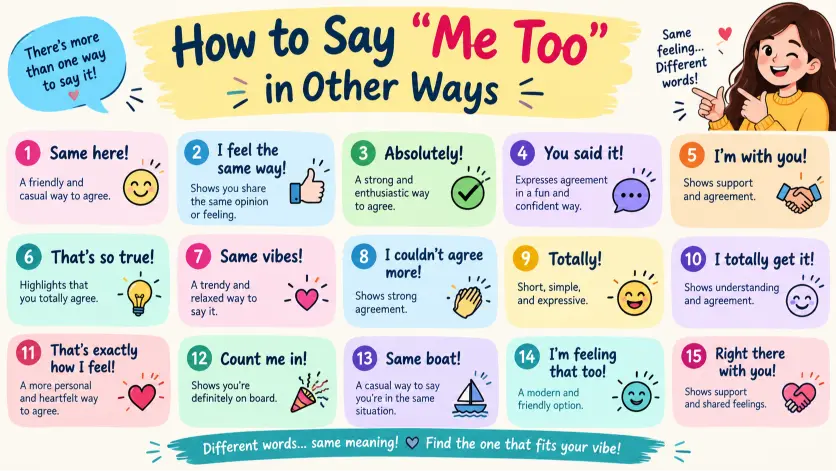
Sometimes, simply saying “Me too” can feel repetitive, especially when you want your English to sound more natural, expressive, or professional. For you are agreeing with a friend, responding in a workplace conversation, or speaking with someone in everyday English, there are many useful alternatives that can make your communication more engaging. From simple expressions like “Same here” and “I feel the same way” to more polished phrases such as “I completely agree”, choosing the right expression depends on the situation and tone
Quick Categories
Formal alternatives to “how to say me too in other ways”
- I feel the same way
- I share the same view
- I agree with you
- I share your perspective
Pro Tip: Choose a complete agreement phrase when speaking in formal or respectful situations. It sounds more deliberate than a short conversational response.
Casual alternatives
- Same here
- So do I
- I do too
- Same for me
Pro Tip: Use short responses when the conversation is relaxed and the meaning is already clear from context.
Professional alternatives
- I agree
- I share that view
- I have the same perspective
- I’m of the same opinion
Pro Tip: In professional communication, connect your agreement to the topic when possible. This makes your response sound more thoughtful and useful.
Informal expressions
- Me as well
- Count me in
- I’m with you
- Absolutely, same here
Pro Tip: Check the situation before using informal expressions. A phrase that sounds friendly with colleagues may be less suitable in a formal email.
“Fluent English is not only about knowing more words. It is about choosing the right words for the situation.”
Common Mistakes
1. Using “Me too” with every grammatical structure
“Me too” works naturally as a general agreement response, but more precise structures may be better.
Example: “I am tired.” “So am I.”
2. Confusing positive and negative agreement
Use structures such as “Neither do I” when agreeing with a negative statement.
Example: “I do not like spicy food.” “Neither do I.”
3. Using overly casual phrases in formal writing
“Same here” can sound too conversational in a formal business email.
Example: Instead of “Same here,” write “I share the same perspective.”
4. Saying “Me too” when you mean “I agree”
“Me too” usually shows that you share an experience, feeling, or preference. “I agree” more directly communicates agreement with an opinion.
Example: “This policy needs revision.” “I agree.”
5. Repeating the same expression too often
Using “me too” in every conversation can make your English sound repetitive.
Example: Alternate between “I do too,” “Same here,” and “I feel the same way.”
“Small changes in response phrases can make everyday English sound much more natural.”
What Does “How to Say Me Too in Other Ways” Mean?
The phrase refers to different expressions you can use instead of “me too” when you want to communicate that you share another person’s feeling, experience, preference, or opinion.
Grammatically, “me too” is a short conversational response. More complete alternatives may use auxiliary verbs or full clauses.
Example:
“I love working from home.”
“Me too.”
“I do too.”
The correct alternative often depends on the grammar of the original statement.
When to Use “Me Too”
You can use “me too” when:
- Someone shares an experience you also have.
- Someone expresses a preference you share.
- Someone describes a feeling you currently have.
- You want to show quick agreement in conversation.
- You are speaking with friends, classmates, or familiar colleagues.
Spoken vs Written
Spoken English: “Me too” is extremely common and natural.
Informal writing: It can work well in texts, chats, comments, and casual messages.
Formal writing: A more specific expression such as “I agree” or “I share that view” is usually better.
Formal vs Informal
“Me too” is generally informal to neutral. It is not rude, but it does not always communicate the level of precision or formality expected in professional writing.
Is It Professional or Polite to Say “Me Too”?
“Me too” is polite when used appropriately, but it is generally more conversational than professional. In a business meeting, a complete response can communicate your agreement more clearly.
Business example:
“I believe we should prioritize customer feedback.”
“I agree. I think that should guide our next steps.”
Polite? ✔️ Yes
Professional? ❌ No, in most formal situations
Pros and Cons of Using “Me Too”
Pros
- Simple and natural
- Friendly tone
- Common usage
- Easy to understand
Cons
- Too informal for some work situations
- Can become overused
- Has limited emotional range
- Not suitable for formal writing in many contexts
“The best professional reaction phrases do more than agree. They show that you understood the idea.”
Other Ways to Say “Me Too” With Examples
These alternatives will help you sound more fluent, confident, and natural in different situations.
Use them according to tone, context, and audience to express excitement, admiration, or approval.
1. Phrase: Same here
- Meaning: I feel or experience the same thing.
- Explanation: This is a short and natural conversational alternative.
- Example Sentence: “I’m really looking forward to the weekend.” “Same here.”
- Best Use: Casual conversation
- Worst Use: Formal reports
- Tone: Friendly, casual, natural
- Context Variability: Casual: “Same here.” Professional: “I feel the same way.” Spoken: “Same here.”
2. Phrase: So do I
- Meaning: I also do the same thing.
- Explanation: This structure is used after positive statements involving “do.”
- Example Sentence: “I enjoy reading before bed.” “So do I.”
- Best Use: Everyday agreement
- Worst Use: Negative statements
- Tone: Natural, conversational, clear
- Context Variability: Casual: “So do I.” Professional: “I do as well.” Spoken: “So do I.”
3. Phrase: I do too
- Meaning: I also have the same preference or action.
- Explanation: It provides slightly more emphasis than simply saying “me too.”
- Example Sentence: “I enjoy working early.” “I do too.”
- Best Use: Spoken agreement
- Worst Use: Formal correspondence
- Tone: Friendly, direct, natural
- Context Variability: Casual: “I do too.” Professional: “I do as well.” Spoken: “I do too.”
4. Phrase: I feel the same way
- Meaning: I have the same feelings or opinion.
- Explanation: This phrase is especially useful for emotional or personal topics.
- Example Sentence: “I’m worried about the changes.” “I feel the same way.”
- Best Use: Emotional agreement
- Worst Use: Simple preferences
- Tone: Warm, thoughtful, empathetic
- Context Variability: Casual: “I feel the same way.” Professional: “I share that concern.” Spoken: “I feel the same way.”
5. Phrase: I agree
- Meaning: I have the same opinion.
- Explanation: This is one of the clearest professional alternatives.
- Example Sentence: “We need better communication.” “I agree.”
- Best Use: Workplace discussions
- Worst Use: Shared experiences
- Tone: Professional, clear, direct
- Context Variability: Casual: “I agree.” Professional: “I agree with that assessment.” Spoken: “I agree.”
6. Phrase: I agree with you
- Meaning: I share your opinion.
- Explanation: It directly identifies the person whose viewpoint you support.
- Example Sentence: “I think customer service should come first.” “I agree with you.”
- Best Use: Opinion sharing
- Worst Use: Emotional reactions
- Tone: Respectful, direct, supportive
- Context Variability: Casual: “I agree with you.” Professional: “I agree with your assessment.” Spoken: “I agree with you.”
7. Phrase: I share that view
- Meaning: I have the same opinion.
- Explanation: This polished expression works particularly well in professional settings.
- Example Sentence: “We should focus on long term customer relationships.” “I share that view.”
- Best Use: Business discussion
- Worst Use: Casual texting
- Tone: Formal, polished, professional
- Context Variability: Casual: “I agree.” Professional: “I share that view.” Spoken: “I share that view.”
8. Phrase: I share your perspective
- Meaning: I see the situation similarly.
- Explanation: This phrase shows agreement with someone’s way of understanding an issue.
- Example Sentence: “The project needs a more practical approach.” “I share your perspective.”
- Best Use: Professional discussion
- Worst Use: Casual greetings
- Tone: Professional, thoughtful, respectful
- Context Variability: Casual: “I see it the same way.” Professional: “I share your perspective.” Spoken: “I share your perspective.”
9. Phrase: I have the same opinion
- Meaning: My opinion is the same as yours.
- Explanation: This is a straightforward way to communicate agreement.
- Example Sentence: “The proposal needs more detail.” “I have the same opinion.”
- Best Use: Clear agreement
- Worst Use: Emotional support
- Tone: Neutral, clear, formal
- Context Variability: Casual: “I agree.” Professional: “I have the same opinion.” Spoken: “I have the same opinion.”
10. Phrase: I’m of the same opinion
- Meaning: I hold the same view.
- Explanation: This expression has a formal and polished style.
- Example Sentence: “The current process is inefficient.” “I’m of the same opinion.”
- Best Use: Formal discussion
- Worst Use: Casual texting
- Tone: Formal, measured, polished
- Context Variability: Casual: “I agree.” Professional: “I’m of the same opinion.” Spoken: “I’m of the same opinion.”
11. Phrase: Me as well
- Meaning: I also share that feeling or preference.
- Explanation: This is slightly more polished than “me too” while remaining conversational.
- Example Sentence: “I’m excited about the event.” “Me as well.”
- Best Use: Polite conversation
- Worst Use: Formal reports
- Tone: Polite, neutral, friendly
- Context Variability: Casual: “Me as well.” Professional: “I am as well.” Spoken: “Me as well.”
12. Phrase: I am too
- Meaning: I have the same condition or feeling.
- Explanation: This works naturally after statements using “am.”
- Example Sentence: “I’m exhausted after that meeting.” “I am too.”
- Best Use: Spoken English
- Worst Use: Unrelated opinions
- Tone: Natural, simple, conversational
- Context Variability: Casual: “I am too.” Professional: “I am as well.” Spoken: “I am too.”
13. Phrase: I’m with you
- Meaning: I agree with your position.
- Explanation: This expression shows support for another person’s viewpoint.
- Example Sentence: “We should give the team another week.” “I’m with you.”
- Best Use: Team discussions
- Worst Use: Formal documentation
- Tone: Supportive, informal, confident
- Context Variability: Casual: “I’m with you.” Professional: “I agree with your position.” Spoken: “I’m with you.”
14. Phrase: Absolutely, same here
- Meaning: I strongly share your feeling or opinion.
- Explanation: “Absolutely” adds emphasis to the agreement.
- Example Sentence: “I can’t wait for the conference.” “Absolutely, same here.”
- Best Use: Enthusiastic agreement
- Worst Use: Formal emails
- Tone: Enthusiastic, friendly, positive
- Context Variability: Casual: “Absolutely, same here.” Professional: “I completely agree.” Spoken: “Absolutely, same here.”
15. Phrase: I feel similarly
- Meaning: My feelings are similar to yours.
- Explanation: This is useful when the agreement is close but not necessarily identical.
- Example Sentence: “I’m concerned about the deadline.” “I feel similarly.”
- Best Use: Thoughtful discussion
- Worst Use: Quick texting
- Tone: Thoughtful, neutral, polished
- Context Variability: Casual: “I feel similarly.” Professional: “I share that concern.” Spoken: “I feel similarly.”
16. Phrase: I think so too
- Meaning: I have the same belief or thought.
- Explanation: This phrase works well when agreeing with an opinion or prediction.
- Example Sentence: “I think this is the best option.” “I think so too.”
- Best Use: Opinion agreement
- Worst Use: Emotional statements
- Tone: Natural, neutral, conversational
- Context Variability: Casual: “I think so too.” Professional: “I agree with that assessment.” Spoken: “I think so too.”
17. Phrase: I agree entirely
- Meaning: I completely agree.
- Explanation: This stronger expression clearly emphasizes full agreement.
- Example Sentence: “We need to improve communication.” “I agree entirely.”
- Best Use: Formal agreement
- Worst Use: Casual texting
- Tone: Formal, confident, emphatic
- Context Variability: Casual: “I totally agree.” Professional: “I agree entirely.” Spoken: “I agree entirely.”
18. Phrase: I couldn’t agree more
- Meaning: I agree very strongly.
- Explanation: This idiomatic expression emphasizes complete agreement.
- Example Sentence: “Preparation makes presentations easier.” “I couldn’t agree more.”
- Best Use: Strong agreement
- Worst Use: Neutral disagreement
- Tone: Confident, emphatic, natural
- Context Variability: Casual: “I couldn’t agree more.” Professional: “I completely agree.” Spoken: “I couldn’t agree more.”
19. Phrase: That’s true for me too
- Meaning: The same statement applies to me.
- Explanation: This makes the shared experience especially clear.
- Example Sentence: “I find mornings more productive.” “That’s true for me too.”
- Best Use: Shared experience
- Worst Use: Formal reports
- Tone: Clear, conversational, friendly
- Context Variability: Casual: “That’s true for me too.” Professional: “I have experienced the same.” Spoken: “That’s true for me too.”
20. Phrase: I have the same experience
- Meaning: I have experienced the same situation.
- Explanation: This is useful when discussing personal or professional experiences.
- Example Sentence: “Customers often ask for faster responses.” “I have the same experience.”
- Best Use: Experience sharing
- Worst Use: Simple preferences
- Tone: Neutral, professional, informative
- Context Variability: Casual: “Same here.” Professional: “I have the same experience.” Spoken: “I have the same experience.”
21. Phrase: I share your enthusiasm
- Meaning: I am equally enthusiastic about something.
- Explanation: This is a polished way to respond positively to excitement.
- Example Sentence: “I’m excited about launching the new product.” “I share your enthusiasm.”
- Best Use: Professional excitement
- Worst Use: Negative topics
- Tone: Positive, professional, warm
- Context Variability: Casual: “I’m excited too.” Professional: “I share your enthusiasm.” Spoken: “I share your enthusiasm.”
22. Phrase: I feel exactly the same
- Meaning: My feelings are identical to yours.
- Explanation: “Exactly” emphasizes strong emotional agreement.
- Example Sentence: “I’m disappointed by the result.” “I feel exactly the same.”
- Best Use: Emotional agreement
- Worst Use: Technical opinions
- Tone: Empathetic, strong, natural
- Context Variability: Casual: “I feel exactly the same.” Professional: “I share the same concern.” Spoken: “I feel exactly the same.”
23. Phrase: I’m in agreement
- Meaning: I agree with the stated idea.
- Explanation: This expression is formal and suitable for structured discussions.
- Example Sentence: “The team should review the proposal.” “I’m in agreement.”
- Best Use: Formal meetings
- Worst Use: Friendly chats
- Tone: Formal, professional, measured
- Context Variability: Casual: “I agree.” Professional: “I’m in agreement.” Spoken: “I’m in agreement.”
24. Phrase: I hold the same view
- Meaning: I have the same opinion.
- Explanation: This is a formal alternative suitable for serious discussions.
- Example Sentence: “We should invest more in training.” “I hold the same view.”
- Best Use: Formal communication
- Worst Use: Casual conversation
- Tone: Formal, serious, polished
- Context Variability: Casual: “I agree.” Professional: “I hold the same view.” Spoken: “I hold the same view.”
25. Phrase: That applies to me too
- Meaning: The statement is also true about me.
- Explanation: Use this when someone describes a situation that includes you.
- Example Sentence: “Everyone here has struggled with the new system.” “That applies to me too.”
- Best Use: Shared situation
- Worst Use: Formal opinion
- Tone: Clear, natural, conversational
- Context Variability: Casual: “That applies to me too.” Professional: “I have experienced that as well.” Spoken: “That applies to me too.”
26. Phrase: I have the same reaction
- Meaning: I respond emotionally in the same way.
- Explanation: This works well when discussing responses to events, news, or experiences.
- Example Sentence: “That announcement surprised me.” “I have the same reaction.”
- Best Use: Emotional response
- Worst Use: Formal agreement
- Tone: Natural, neutral, expressive
- Context Variability: Casual: “Same here.” Professional: “I had the same reaction.” Spoken: “I have the same reaction.”
27. Phrase: I share your sentiment
- Meaning: I have the same feeling or attitude.
- Explanation: This polished phrase is useful in professional and formal communication.
- Example Sentence: “We appreciate the team’s hard work.” “I share your sentiment.”
- Best Use: Formal appreciation
- Worst Use: Casual texting
- Tone: Formal, respectful, polished
- Context Variability: Casual: “I feel the same.” Professional: “I share your sentiment.” Spoken: “I share your sentiment.”
28. Phrase: I’m in the same boat
- Meaning: I am experiencing the same situation.
- Explanation: This idiomatic expression emphasizes a shared circumstance.
- Example Sentence: “I’m struggling to finish everything today.” “I’m in the same boat.”
- Best Use: Shared situation
- Worst Use: Formal writing
- Tone: Informal, friendly, idiomatic
- Context Variability: Casual: “I’m in the same boat.” Professional: “I’m facing the same challenge.” Spoken: “I’m in the same boat.”
29. Phrase: I can relate to that
- Meaning: I understand because I have experienced something similar.
- Explanation: This phrase emphasizes shared experience rather than exact agreement.
- Example Sentence: “I always get nervous before presentations.” “I can relate to that.”
- Best Use: Shared experience
- Worst Use: Exact agreement
- Tone: Friendly, empathetic, natural
- Context Variability: Casual: “I can relate to that.” Professional: “I have had a similar experience.” Spoken: “I can relate to that.”
30. Phrase: I feel the same
- Meaning: I have the same feeling or opinion.
- Explanation: This concise expression is natural in both personal and professional conversations.
- Example Sentence: “I think we made the right decision.” “I feel the same.”
- Best Use: General agreement
- Worst Use: Technical evidence
- Tone: Neutral, natural, confident
- Context Variability: Casual: “I feel the same.” Professional: “I share that view.” Spoken: “I feel the same.”
“The strongest English response is not always the longest one. Choose the phrase that matches the context.”
How to Choose the Right Alternative
The best expression depends on what you are agreeing with.
When sharing a feeling
Use:
- I feel the same way
- I feel exactly the same
- I feel the same
When sharing an opinion
Use:
- I agree
- I agree with you
- I share that view
- I hold the same view
When sharing an experience
Use:
- Same here
- I have the same experience
- That applies to me too
- I can relate to that
When responding professionally
Use:
- I agree
- I share your perspective
- I share that view
- I’m of the same opinion
When showing enthusiasm
Use:
- I share your enthusiasm
- Absolutely, same here
- I feel the same way
- I couldn’t agree more
See Also
- Other Ways to Say Thank You: Learn polished alternatives for expressing appreciation naturally in personal and professional English.
- Professional English Guide: Explore practical phrases for meetings, emails, workplace discussions, and confident business communication.
Mini Quiz / Self Check
1. Your manager says, “I think we should review the proposal again.” What is the most professional response?
A. Same here
B. I agree with that assessment.
C. Me too
D. I’m in the same boat
Answer: B
2. A friend says, “I’m really excited about the concert.” Which response sounds natural and enthusiastic?
A. I share your perspective.
B. I’m of the same opinion.
C. Absolutely, same here.
D. I hold the same view.
Answer: C
3. Someone says, “I’m nervous before every presentation.” Which response focuses on shared experience?
A. I can relate to that.
B. I share that view.
C. I agree entirely.
D. I’m in agreement.
Answer: A
4. Someone says, “I don’t enjoy working late.” Which response correctly agrees with the negative statement?
A. So do I.
B. Me too.
C. Neither do I.
D. I do too.
Answer: C
Comparison Table: Top Alternatives
| Phrase | Tone | Best Use |
| Same here | Casual | Everyday conversation |
| So do I | Neutral | Spoken agreement |
| I do too | Casual | Shared preferences |
| I feel the same way | Warm | Feelings and opinions |
| I agree | Professional | Workplace discussions |
| I agree with you | Neutral | Direct agreement |
| I share that view | Formal | Business communication |
| I share your perspective | Professional | Meetings and discussions |
| I couldn’t agree more | Emphatic | Strong agreement |
| I can relate to that | Friendly | Shared experiences |
FAQs
What is the most natural alternative to “me too”?
“Same here” is one of the most natural alternatives in casual conversation. “I agree” is generally better when you are responding to an opinion.
What are professional alternatives to “me too”?
Useful professional alternatives include “I agree,” “I share that view,” “I share your perspective,” and “I’m of the same opinion.”
Is “same here” more informal than “me too”?
Yes. “Same here” is strongly conversational and is best suited to relaxed spoken English, chats, and informal messages.
Can I use “so do I” instead of “me too”?
Yes, when the original sentence uses a structure that works with “do.” For example, “I enjoy reading” can be followed by “So do I.”
How can English learners avoid repeating “me too”?
Choose an expression based on the meaning. Use “I agree” for opinions, “I feel the same way” for feelings, and “I can relate to that” for shared experiences.
Conclusion
Learning different ways to respond with agreement gives you greater control over your English. Instead of relying on one short expression, you can choose language that communicates your exact meaning, whether you are sharing an opinion, describing a similar experience, showing empathy, or expressing enthusiasm.
Practice several alternatives in real conversations and pay attention to tone. Use relaxed expressions with friends and more polished professional reaction phrases at work. With regular practice, these alternatives will become automatic and help you communicate with greater confidence, clarity, and naturalness.









