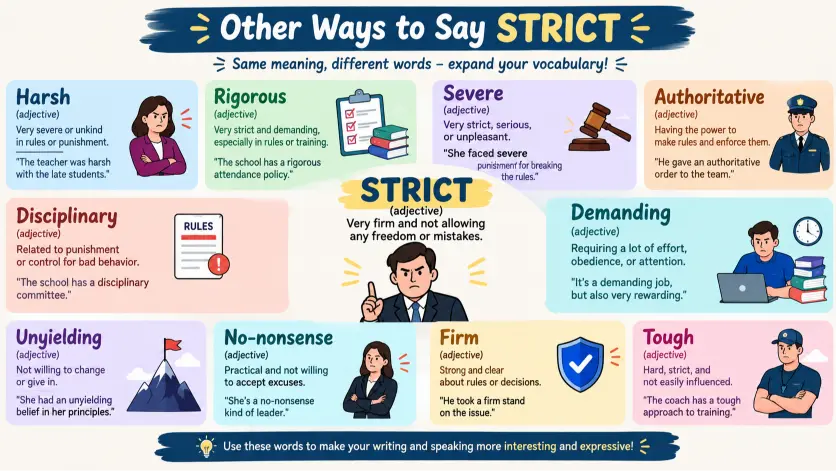
Being strict can describe a person, rule, teacher, parent, manager, policy, or standard but using the same word repeatedly can make your English sound less flexible. Fo you are writing an email, describing workplace expectations, improving your vocabulary, or speaking more naturally, knowing different ways to say “strict” can help you communicate with greater precision. From firm and disciplined to rigorous, stringent, and inflexible, each alternative carries a slightly different meaning and level of formality
Formal alternatives to “strict”
- Stringent
- Rigorous
- Uncompromising
- Exacting
Pro Tip: Use these choices in reports, policies, academic writing, and formal communication when precision matters.
Casual alternatives
- Firm
- Tough
- Hard-line
- No-nonsense
Pro Tip: In conversation, choose a word that communicates firmness without accidentally making someone sound unreasonable.
Professional alternatives
- Disciplined
- Demanding
- Highly regulated
- Firmly enforced
Pro Tip: For workplace communication, describe the specific standard or policy whenever possible instead of simply labeling someone “strict.”
Informal expressions
- Tough
- Hard on
- Not lenient
- Pretty firm
Pro Tip: Informal expressions in English work best in conversations, personal messages, and relaxed discussions rather than formal reports.
“A small vocabulary change can completely change how firm, respectful, or professional your message sounds.”
Common Mistakes When Using “Strict”
1. Using “strict” when you mean “difficult”
Mistake: Treating every difficult requirement as strict.
Example: “The exam was strict.”
Better: “The exam was difficult.”
2. Confusing “strict” with “rude”
Being strict does not automatically mean being disrespectful.
Example: “My manager is strict, but she is always respectful.”
3. Using “strict” for a person when describing a rule
Sometimes the rule itself is strict, rather than the person enforcing it.
Example: “The company has strict safety regulations.”
4. Using a strong synonym in the wrong context
Words such as uncompromising can sound more negative than firm.
Example: “Our teacher is firm about deadlines.”
5. Using formal vocabulary in casual conversation
Words such as stringent may sound unnecessarily formal in everyday speech.
Example: “The dress code is pretty strict.”
“Synonyms are not always interchangeable. Tone and context determine which word sounds natural.”
What Does “Strict” Mean?
Strict means requiring rules, standards, instructions, or expectations to be followed closely, with little tolerance for exceptions.
It is an adjective and can describe people, rules, policies, standards, schedules, requirements, or procedures.
Example:
“The school has strict attendance rules.”
The word can be neutral, positive, or negative depending on context. A strict safety policy may suggest careful protection, while a strict teacher may suggest someone who allows few exceptions.
When to Use “Strict”
Use strict when talking about:
- Rules that must be followed carefully
- Policies with few exceptions
- Teachers or managers who enforce standards closely
- Parents who set firm boundaries
- Deadlines that cannot easily be extended
- Safety procedures
- Dress codes
- Academic requirements
- Legal or regulatory requirements
Spoken vs. Written
Spoken:
“My coach is pretty strict about practice.”
Written:
“The organization maintains strict compliance requirements.”
Formal vs. Informal
Formal:
“The company operates under stringent security regulations.”
Informal:
“My boss is pretty strict about being on time.”
Is It Professional or Polite to Say “Strict”?
Polite? ✔️ Yes
Professional? ✔️ Yes, depending on context
The word strict is not inherently rude or unprofessional. However, describing a person as “strict” can sometimes sound critical. In professional settings, terms such as firm, consistent, or rigorous can communicate the same idea more positively.
Business example:
“Our manager is firm about meeting project deadlines, which helps the team stay organized.”
Pros and Cons of Using “Strict”
Pros
- Simple and natural
- Friendly tone when used carefully
- Common usage
- Easy to understand
Cons
- Can sound negative when describing people
- May be overused
- Has limited emotional range
- Can be less precise in formal writing
“When professionalism matters, describe the behavior or standard instead of relying on a single label.”
Other Ways to Say “Strict” With Examples
These alternatives will help you sound more fluent, confident, and natural in different situations.
Use them according to tone, context, and audience to express firmness, authority, discipline, or approval.
1. Phrase: Firm
- Meaning: Strong and consistent about rules or decisions.
- Explanation: Firm often sounds more positive and professional than strict.
- Example Sentence: “Our supervisor is firm about meeting deadlines.”
- Best Use: Workplace communication
- Worst Use: Extreme authority
- Tone: Professional, balanced, confident
- Context Variability: Casual: “She is firm about bedtime.” Professional: “The manager is firm about deadlines.” Spoken: “He is pretty firm about that.”
2. Phrase: Rigorous
- Meaning: Extremely thorough and demanding.
- Explanation: It emphasizes high standards and careful requirements.
- Example Sentence: “Candidates must complete a rigorous training program.”
- Best Use: Academic settings
- Worst Use: Casual chat
- Tone: Formal, demanding, precise
- Context Variability: Casual: “The workout was rigorous.” Professional: “The process is rigorous.” Spoken: “It was a rigorous course.”
3. Phrase: Stringent
- Meaning: Very strict and allowing few exceptions.
- Explanation: This is a strong formal alternative commonly used for rules and requirements.
- Example Sentence: “The laboratory follows stringent safety standards.”
- Best Use: Formal policies
- Worst Use: Casual conversation
- Tone: Formal, serious, authoritative
- Context Variability: Casual: “Those rules are tough.” Professional: “The requirements are stringent.” Spoken: “They have stringent regulations.”
4. Phrase: Demanding
- Meaning: Requiring considerable effort, attention, or discipline.
- Explanation: It focuses more on difficulty and expectations than rule enforcement.
- Example Sentence: “The position has demanding performance standards.”
- Best Use: Work expectations
- Worst Use: Simple rules
- Tone: Professional, challenging, neutral
- Context Variability: Casual: “My coach is demanding.” Professional: “The role is demanding.” Spoken: “The course is demanding.”
5. Phrase: Uncompromising
- Meaning: Unwilling to relax standards or make exceptions.
- Explanation: It suggests a particularly strong or inflexible approach.
- Example Sentence: “The company takes an uncompromising approach to safety.”
- Best Use: Strong standards
- Worst Use: Friendly requests
- Tone: Strong, serious, inflexible
- Context Variability: Casual: “He is uncompromising.” Professional: “The policy is uncompromising.” Spoken: “She is uncompromising about quality.”
6. Phrase: Disciplined
- Meaning: Characterized by strong control and consistent behavior.
- Explanation: It often has a positive meaning when describing people or organizations.
- Example Sentence: “The team follows a disciplined training schedule.”
- Best Use: Positive descriptions
- Worst Use: Flexible situations
- Tone: Positive, controlled, professional
- Context Variability: Casual: “He is very disciplined.” Professional: “The team is disciplined.” Spoken: “She has a disciplined routine.”
7. Phrase: Exacting
- Meaning: Requiring a very high level of quality or performance.
- Explanation: It emphasizes demanding expectations.
- Example Sentence: “The editor has exacting standards for accuracy.”
- Best Use: High standards
- Worst Use: Basic instructions
- Tone: Formal, demanding, precise
- Context Variability: Casual: “He has high standards.” Professional: “The client is exacting.” Spoken: “She is exacting about details.”
8. Phrase: Tough
- Meaning: Firm or difficult to satisfy.
- Explanation: Tough is a natural conversational choice when describing demanding people or rules.
- Example Sentence: “Our coach is tough but fair.”
- Best Use: Everyday conversation
- Worst Use: Formal reports
- Tone: Casual, direct, strong
- Context Variability: Casual: “My teacher is tough.” Professional: “The standards are demanding.” Spoken: “She is tough but fair.”
9. Phrase: Hard-line
- Meaning: Firmly opposed to changing rules or positions.
- Explanation: It suggests an inflexible approach, often in discussions about policy.
- Example Sentence: “The organization has a hard-line approach to compliance.”
- Best Use: Policy discussions
- Worst Use: Friendly feedback
- Tone: Strong, firm, political
- Context Variability: Casual: “He takes a hard-line view.” Professional: “The company has a hard-line policy.” Spoken: “They are taking a hard-line approach.”
10. Phrase: No-nonsense
- Meaning: Practical, direct, and unwilling to tolerate unnecessary behavior.
- Explanation: It usually describes a person’s straightforward approach.
- Example Sentence: “She has a no-nonsense approach to workplace rules.”
- Best Use: Personal style
- Worst Use: Formal documents
- Tone: Informal, direct, practical
- Context Variability: Casual: “He is no-nonsense.” Professional: “She has a direct management style.” Spoken: “My boss is very no-nonsense.”
11. Phrase: Inflexible
- Meaning: Unwilling or unable to change.
- Explanation: It usually carries a negative implication.
- Example Sentence: “The schedule is too inflexible for the project.”
- Best Use: Criticism
- Worst Use: Praise
- Tone: Negative, formal, direct
- Context Variability: Casual: “He won’t budge.” Professional: “The policy is inflexible.” Spoken: “They are pretty inflexible.”
12. Phrase: Exact
- Meaning: Requiring precise adherence to details or instructions.
- Explanation: It can describe standards where accuracy matters.
- Example Sentence: “The laboratory follows exact procedures.”
- Best Use: Technical contexts
- Worst Use: Personal behavior
- Tone: Neutral, precise, technical
- Context Variability: Casual: “Follow the exact steps.” Professional: “Use the exact procedure.” Spoken: “These are the exact requirements.”
13. Phrase: Highly regulated
- Meaning: Controlled by detailed rules or official requirements.
- Explanation: This phrase works especially well for industries and systems.
- Example Sentence: “The pharmaceutical industry is highly regulated.”
- Best Use: Business writing
- Worst Use: Personal traits
- Tone: Formal, technical, neutral
- Context Variability: Casual: “There are lots of rules.” Professional: “The sector is highly regulated.” Spoken: “That industry is highly regulated.”
14. Phrase: Firmly enforced
- Meaning: Applied consistently without frequent exceptions.
- Explanation: It describes how rules are implemented rather than simply labeling them.
- Example Sentence: “The building’s safety rules are firmly enforced.”
- Best Use: Workplace policies
- Worst Use: Personal opinions
- Tone: Professional, clear, authoritative
- Context Variability: Casual: “They really enforce the rules.” Professional: “The policy is firmly enforced.” Spoken: “Those rules are strictly enforced.”
15. Phrase: Closely controlled
- Meaning: Carefully managed according to established standards.
- Explanation: It is useful when describing processes, access, or activities.
- Example Sentence: “Access to the facility is closely controlled.”
- Best Use: Security contexts
- Worst Use: Casual people
- Tone: Formal, technical, controlled
- Context Variability: Casual: “They control access carefully.” Professional: “Access is closely controlled.” Spoken: “Entry is closely controlled.”
16. Phrase: Highly disciplined
- Meaning: Characterized by consistent control and adherence to standards.
- Explanation: It is generally positive when describing people or teams.
- Example Sentence: “The organization has a highly disciplined approach to quality.”
- Best Use: Positive evaluation
- Worst Use: Relaxed settings
- Tone: Positive, formal, controlled
- Context Variability: Casual: “She is very disciplined.” Professional: “The team is highly disciplined.” Spoken: “They have a disciplined process.”
17. Phrase: Demanding of compliance
- Meaning: Requiring people to follow rules or requirements.
- Explanation: It directly emphasizes adherence to established standards.
- Example Sentence: “The regulator is demanding of compliance with safety requirements.”
- Best Use: Regulatory writing
- Worst Use: Casual conversation
- Tone: Formal, technical, serious
- Context Variability: Casual: “They expect everyone to follow the rules.” Professional: “The regulator demands compliance.” Spoken: “Compliance is required.”
18. Phrase: Precise
- Meaning: Requiring accuracy and careful attention to details.
- Explanation: It is a useful alternative when firmness relates specifically to exactness.
- Example Sentence: “The instructions must be precise.”
- Best Use: Technical instructions
- Worst Use: Describing personality
- Tone: Neutral, technical, clear
- Context Variability: Casual: “Follow the steps exactly.” Professional: “The instructions must be precise.” Spoken: “Be precise with the measurements.”
19. Phrase: Regulated
- Meaning: Controlled by established rules or authorities.
- Explanation: It is particularly useful for industries, processes, and activities.
- Example Sentence: “Financial services are heavily regulated.”
- Best Use: Business contexts
- Worst Use: Personal traits
- Tone: Formal, neutral, technical
- Context Variability: Casual: “There are many rules.” Professional: “The industry is regulated.” Spoken: “It’s a heavily regulated field.”
20. Phrase: Authoritative
- Meaning: Showing strong authority or control.
- Explanation: It can describe a person’s manner, voice, or approach.
- Example Sentence: “Her authoritative leadership style helped establish clear expectations.”
- Best Use: Leadership contexts
- Worst Use: Friendly requests
- Tone: Formal, confident, commanding
- Context Variability: Casual: “He sounds authoritative.” Professional: “She has an authoritative style.” Spoken: “His voice sounded authoritative.”
21. Phrase: Conservative
- Meaning: Cautious about changing established standards or practices.
- Explanation: In some contexts, it can describe a cautious approach rather than strictness itself.
- Example Sentence: “The company takes a conservative approach to risk.”
- Best Use: Risk management
- Worst Use: Direct rule enforcement
- Tone: Cautious, formal, measured
- Context Variability: Casual: “They are cautious.” Professional: “The company takes a conservative approach.” Spoken: “They are pretty conservative about risk.”
22. Phrase: Restrictive
- Meaning: Limiting freedom, choices, or available actions.
- Explanation: This word emphasizes limitations rather than discipline.
- Example Sentence: “Employees considered the new policy too restrictive.”
- Best Use: Policy criticism
- Worst Use: Positive standards
- Tone: Formal, negative, limiting
- Context Variability: Casual: “The rules feel limiting.” Professional: “The policy is restrictive.” Spoken: “That rule is too restrictive.”
23. Phrase: Demanding high standards
- Meaning: Expecting a high level of performance or quality.
- Explanation: This phrase is useful when you want a positive and specific description.
- Example Sentence: “The company demands high standards from every department.”
- Best Use: Professional writing
- Worst Use: Casual small talk
- Tone: Positive, professional, ambitious
- Context Variability: Casual: “She expects a lot.” Professional: “The company demands high standards.” Spoken: “He expects everyone to do their best.”
24. Phrase: Strictly regulated
- Meaning: Controlled by rules that must be followed carefully.
- Explanation: It is especially common in professional, legal, and technical contexts.
- Example Sentence: “The use of these materials is strictly regulated.”
- Best Use: Legal contexts
- Worst Use: Casual speech
- Tone: Formal, serious, authoritative
- Context Variability: Casual: “There are tight rules.” Professional: “The activity is strictly regulated.” Spoken: “It’s strictly regulated.”
25. Phrase: Unyielding
- Meaning: Refusing to change or become less demanding.
- Explanation: It conveys a very strong form of firmness.
- Example Sentence: “The organization remained unyielding on its safety requirements.”
- Best Use: Strong positions
- Worst Use: Friendly feedback
- Tone: Strong, formal, inflexible
- Context Variability: Casual: “He won’t change his mind.” Professional: “The company was unyielding.” Spoken: “She was completely unyielding.”
26. Phrase: Stern
- Meaning: Serious and firm in manner or behavior.
- Explanation: Stern is commonly used for people whose authority feels serious.
- Example Sentence: “The teacher gave the students a stern warning.”
- Best Use: Personal authority
- Worst Use: Positive friendliness
- Tone: Serious, firm, authoritative
- Context Variability: Casual: “Dad looked stern.” Professional: “The supervisor issued a stern warning.” Spoken: “She sounded stern.”
27. Phrase: Rigorous in its requirements
- Meaning: Requiring careful and demanding compliance.
- Explanation: This phrase adds precision when describing formal standards.
- Example Sentence: “The certification process is rigorous in its requirements.”
- Best Use: Certification contexts
- Worst Use: Everyday conversation
- Tone: Formal, precise, demanding
- Context Variability: Casual: “The process is tough.” Professional: “The requirements are rigorous.” Spoken: “The certification has rigorous requirements.”
28. Phrase: Firmly regulated
- Meaning: Controlled through consistently applied rules.
- Explanation: It works well when discussing systems, industries, or procedures.
- Example Sentence: “The sector is firmly regulated to protect consumers.”
- Best Use: Industry discussions
- Worst Use: Personal descriptions
- Tone: Formal, neutral, controlled
- Context Variability: Casual: “There are tight controls.” Professional: “The sector is firmly regulated.” Spoken: “That area is closely regulated.”
29. Phrase: Rule-bound
- Meaning: Strongly limited or guided by established rules.
- Explanation: It can describe an organization or system that follows rules closely.
- Example Sentence: “The process is highly rule-bound and leaves little room for flexibility.”
- Best Use: Critical analysis
- Worst Use: Friendly praise
- Tone: Formal, critical, restrictive
- Context Variability: Casual: “They follow every rule.” Professional: “The system is rule-bound.” Spoken: “The process is very rule-bound.”
30. Phrase: Non-negotiable
- Meaning: Not open to discussion, change, or exceptions.
- Explanation: This phrase is powerful when a requirement must be followed.
- Example Sentence: “Meeting the safety requirements is non-negotiable.”
- Best Use: Essential requirements
- Worst Use: Minor preferences
- Tone: Direct, firm, authoritative
- Context Variability: Casual: “That rule isn’t negotiable.” Professional: “Compliance is non-negotiable.” Spoken: “This deadline is non-negotiable.”
“Use ‘firm’ for balanced professionalism, ‘stringent’ for formal requirements, and ‘tough’ for natural conversation.”
See Also
- Other Ways to Say “Important”: Learn precise alternatives for describing priority, value, and significance.
- Professional English Guide: Improve workplace vocabulary, tone, and communication skills for clearer professional interactions.
Mini Quiz / Self-Check
1. Which word best fits a formal safety policy?
A. Tough
B. Stringent
C. No-nonsense
D. Stern
Answer: B. Stringent
2. Which option sounds most natural in casual conversation?
A. Stringent
B. Rigorous
C. Tough
D. Uncompromising
Answer: C. Tough
3. Your manager consistently expects deadlines to be met. Which phrase sounds professional and balanced?
A. The manager is firm about deadlines.
B. The manager is unyielding about everything.
C. The manager is restrictive.
D. The manager is rule-bound.
Answer: A. The manager is firm about deadlines.
4. Which phrase means that something cannot be changed or negotiated?
A. Disciplined
B. Precise
C. Non-negotiable
D. Demanding
Answer: C. Non-negotiable
Comparison Table: Top Alternatives
| Phrase | Tone | Best Use |
| Firm | Professional, balanced | Workplace communication |
| Rigorous | Formal, demanding | Academic standards |
| Stringent | Formal, serious | Rules and policies |
| Demanding | Neutral, challenging | Expectations |
| Uncompromising | Strong, serious | High standards |
| Disciplined | Positive, controlled | People and teams |
| Exacting | Formal, precise | Quality standards |
| Tough | Casual, direct | Everyday conversation |
| Restrictive | Negative, formal | Policy criticism |
| Non-negotiable | Direct, authoritative | Essential requirements |
FAQs
What is a professional way to say “strict”?
Firm, rigorous, stringent, and disciplined are useful professional alternatives. The best choice depends on whether you are describing a person, standard, or policy.
What is a polite alternative to “strict”?
Firm is often the safest polite alternative when describing a person because it communicates authority without necessarily sounding negative.
What is a formal word for “strict”?
Stringent is one of the strongest formal alternatives, especially for rules, regulations, requirements, and standards.
What is the difference between “strict” and “rigorous”?
Strict focuses on close rule enforcement, while rigorous emphasizes thoroughness, difficulty, and demanding standards.
What is an informal way to say “strict”?
Tough, no-nonsense, and pretty firm are natural choices in informal conversations, depending on the situation.
Conclusion
Learning different ways to describe firmness helps you communicate more accurately in everyday conversations, academic writing, and professional situations. Instead of relying on one word repeatedly, you can choose firm for balanced communication, rigorous for demanding standards, or stringent for formal rules and requirements.
The key is to consider your audience, purpose, and desired tone before choosing a synonym. Practice replacing familiar vocabulary with context-appropriate alternatives in emails, conversations, and writing exercises. With regular practice, your English will become more precise, flexible, and confident.









