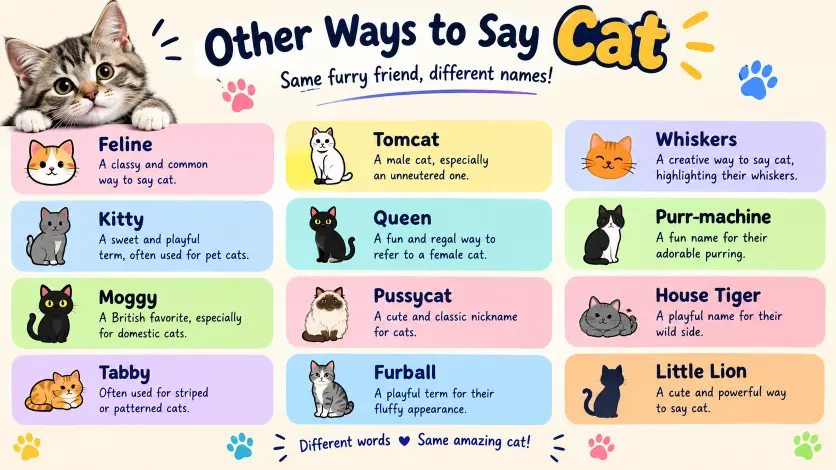
Looking for a more interesting way to say “cat”? For you are writing a blog post, describing a pet, improving your English vocabulary, or simply looking for a cute and creative expression, there are plenty of alternatives to explore.
Words such as feline, kitty, kitten, and mouser can describe cats in different ways, but each term has its own meaning, tone, and context. Choosing the right word can make your writing more natural, engaging, and precise
Quick Categories
Formal alternatives to “cat”
- Feline
- Domestic feline
- Domestic cat
- Felis catus
Pro Tip: Use feline in academic, scientific, veterinary, and formal writing. Avoid it when a simple everyday conversation is more natural.
Casual alternatives
- Kitty
- Kitten
- House cat
- Pet cat
Pro Tip: Use kitty for a warm or affectionate tone, but remember that kitten specifically refers to a young cat.
Professional alternatives
- Domestic cat
- Feline
- Companion animal
- Pet feline
Pro Tip: In professional writing, choose precise terms such as domestic cat or feline rather than overly affectionate expressions.
Informal expressions
- Kitty
- Little cat
- Pet kitty
- Fluffy cat
Pro Tip: Informal expressions in English work best in conversations, social posts, family communication, and casual storytelling.
“Context determines whether a synonym sounds natural, overly formal, affectionate, or unusual.”
Common Mistakes When Using “Cat”
1. Using “kitten” for every cat
A kitten is a young cat, not simply another word for an adult cat.
Example: “I adopted an adult cat last year.”
Not: “I adopted an adult kitten.”
2. Treating “feline” as an exact everyday replacement
Although feline means relating to cats, it can sound formal in ordinary conversation.
Example: “The veterinarian examined the feline carefully.”
3. Confusing “pet” with “cat”
A pet can be a dog, bird, rabbit, fish, or another domesticated animal.
Example: “My cat is my favorite pet.”
4. Using “house cat” for every cat
A house cat generally refers to a cat that lives primarily indoors.
Example: “Our house cat spends most of the day sleeping indoors.”
5. Using affectionate words in formal writing
Words such as kitty may sound inappropriate in academic or professional contexts.
Example: “The domestic cat was observed for behavioral changes.”
What Does “Cat” Mean?
A cat is a small domesticated mammal belonging to the feline family. The domestic cat is scientifically known as Felis catus and is commonly kept as a companion animal.
Grammatically, cat is a countable noun.
Singular: cat
Plural: cats
Article examples: a cat, the cat, one cat
Example:
“My cat likes sleeping near the window.”
The word can also appear in compound nouns such as cat food, cat owner, cat behavior, and cat litter.
When to Use “Cat”
You can use cat in almost any ordinary situation where you are talking about the animal.
Common contexts include:
- Talking about a household pet
- Describing an animal you saw
- Discussing pet ownership
- Writing basic educational content
- Talking about animal behavior
- Discussing veterinary care
- Describing different breeds
- Writing casual messages or social media posts
Spoken English
Cat is completely natural in everyday conversation.
Example:
“Did you see that cat outside?”
Written English
The word is also appropriate in emails, articles, reports, stories, and educational materials.
Example:
“The cat was observed interacting with the other animals.”
Formal English
For technical or scientific contexts, feline or domestic cat may provide greater precision.
Informal English
Expressions such as kitty can create a warmer and more affectionate tone.
Is It Professional or Polite to Say “Cat”?
Polite? Yes
Professional? Yes, when referring to the animal accurately
There is nothing impolite or unprofessional about the word cat. It is the standard English term. However, more specific terminology may be preferable in veterinary, scientific, academic, or technical writing.
Business-style example:
“The employee has requested permission to bring a trained therapy cat into the designated office area.”
Pros and Cons of Using “Cat”
Pros
- Simple and natural: Everyone understands the word.
- Friendly tone: It sounds neutral and approachable.
- Common usage: It is used widely in spoken and written English.
- Easy to understand: English learners can use it confidently.
Cons
- Too informal for work: This is generally not true; however, specialized contexts may require more precise terminology.
- Overused: Repetition can make descriptive writing less interesting.
- Limited emotional range: The word does not communicate affection or personality by itself.
- Not suitable for formal writing: This is only an issue when technical precision is required.
“You do not always need a synonym. Sometimes the original word is the clearest choice.”
Other Ways to Say “Cat” With Examples
These alternatives will help you sound more fluent, confident, and natural in different situations.
Use them according to tone, context, and audience to describe affection, personality, appearance, or approval. Some expressions can also support broader vocabulary when you want to express excitement in English about animals or pets.
1. Phrase: Feline
- Meaning: A feline is a member of the cat family.
- Explanation: It is a formal and widely used alternative in scientific, veterinary, and professional contexts.
- Example Sentence: “The veterinarian examined the feline for signs of infection.”
- Best Use: Scientific writing
- Worst Use: Casual greetings
- Tone: Formal, precise, technical
- Context Variability: casual: unusual; professional: excellent; spoken: formal
2. Phrase: Kitty
- Meaning: Kitty is an affectionate way to refer to a cat.
- Explanation: It is especially common when speaking to children or talking warmly about a pet.
- Example Sentence: “Our kitty likes sitting beside the fireplace.”
- Best Use: Casual conversation
- Worst Use: Formal reports
- Tone: Warm, affectionate, friendly
- Context Variability: casual: natural; professional: unsuitable; spoken: common
3. Phrase: Kitten
- Meaning: A kitten is a young cat.
- Explanation: Use it when the animal is young rather than as a general synonym for every cat.
- Example Sentence: “The kitten followed its mother across the garden.”
- Best Use: Young cats
- Worst Use: Adult cats
- Tone: Neutral, warm, descriptive
- Context Variability: casual: common; professional: appropriate; spoken: natural
4. Phrase: Domestic Cat
- Meaning: A domestic cat is a cat species commonly kept by humans.
- Explanation: This expression is useful when you need a more precise or formal term.
- Example Sentence: “The domestic cat has adapted well to living alongside humans.”
- Best Use: Formal writing
- Worst Use: Casual chat
- Tone: Formal, neutral, precise
- Context Variability: casual: formal; professional: excellent; spoken: acceptable
5. Phrase: House Cat
- Meaning: A house cat generally refers to a cat that lives in a home.
- Explanation: It emphasizes the cat’s domestic or indoor lifestyle.
- Example Sentence: “Unlike outdoor cats, our house cat rarely leaves the apartment.”
- Best Use: Pet descriptions
- Worst Use: Wild felines
- Tone: Neutral, familiar, descriptive
- Context Variability: casual: natural; professional: acceptable; spoken: common
6. Phrase: Pet Cat
- Meaning: A pet cat is a cat kept as a companion animal.
- Explanation: It highlights the cat’s role as a household pet.
- Example Sentence: “Her pet cat sleeps beside her desk while she works.”
- Best Use: Pet discussions
- Worst Use: Wildlife contexts
- Tone: Neutral, friendly, clear
- Context Variability: casual: natural; professional: appropriate; spoken: common
7. Phrase: Companion Animal
- Meaning: A companion animal is an animal kept primarily for companionship.
- Explanation: It is broader than cat but can describe a domestic cat in professional contexts.
- Example Sentence: “The organization provides resources for people caring for companion animals.”
- Best Use: Professional contexts
- Worst Use: Simple introductions
- Tone: Professional, respectful, neutral
- Context Variability: casual: formal; professional: excellent; spoken: appropriate
8. Phrase: Pet Feline
- Meaning: A pet feline is a domesticated cat kept as a companion.
- Explanation: It combines the professional term feline with the everyday concept of a pet.
- Example Sentence: “The clinic offers nutritional advice for pet felines.”
- Best Use: Veterinary contexts
- Worst Use: Casual chat
- Tone: Formal, technical, precise
- Context Variability: casual: uncommon; professional: appropriate; spoken: formal
9. Phrase: Little Cat
- Meaning: Little cat is a descriptive expression for a small cat.
- Explanation: It can also communicate affection depending on context.
- Example Sentence: “A little cat was waiting outside the shelter.”
- Best Use: Casual descriptions
- Worst Use: Scientific writing
- Tone: Casual, warm, descriptive
- Context Variability: casual: natural; professional: limited; spoken: natural
10. Phrase: Fluffy Cat
- Meaning: A fluffy cat is a cat with noticeably soft or abundant fur.
- Explanation: It describes appearance rather than replacing the word cat in every context.
- Example Sentence: “A fluffy cat was sitting comfortably on the sofa.”
- Best Use: Appearance descriptions
- Worst Use: Hairless cats
- Tone: Friendly, descriptive, informal
- Context Variability: casual: excellent; professional: limited; spoken: natural
11. Phrase: Furry Companion
- Meaning: A furry companion is an affectionate description of a pet with fur.
- Explanation: It focuses on companionship rather than species.
- Example Sentence: “Her furry companion keeps her company while she reads.”
- Best Use: Personal writing
- Worst Use: Scientific classification
- Tone: Warm, affectionate, descriptive
- Context Variability: casual: natural; professional: limited; spoken: natural
12. Phrase: House Pet
- Meaning: A house pet is an animal kept as a companion in a home.
- Explanation: It can describe a cat but is not limited to cats.
- Example Sentence: “The family treats their cat as a beloved house pet.”
- Best Use: General descriptions
- Worst Use: Breed identification
- Tone: Neutral, familiar, general
- Context Variability: casual: natural; professional: acceptable; spoken: common
13. Phrase: Domestic Feline
- Meaning: A domestic feline is a domesticated member of the cat family.
- Explanation: It provides a formal alternative when writing about cats scientifically or professionally.
- Example Sentence: “The study examined behavioral patterns in domestic felines.”
- Best Use: Academic writing
- Worst Use: Casual conversation
- Tone: Formal, academic, precise
- Context Variability: casual: unusual; professional: excellent; spoken: formal
14. Phrase: Feline Companion
- Meaning: A feline companion is a cat that provides companionship.
- Explanation: It combines a formal animal term with a relationship-focused description.
- Example Sentence: “Many people consider their feline companions important members of the household.”
- Best Use: Pet articles
- Worst Use: Scientific naming
- Tone: Warm, formal, respectful
- Context Variability: casual: acceptable; professional: excellent; spoken: somewhat formal
15. Phrase: Household Cat
- Meaning: A household cat is a cat living as part of a household.
- Explanation: It emphasizes the animal’s place within a domestic environment.
- Example Sentence: “The household cat has become an important part of the family.”
- Best Use: Family contexts
- Worst Use: Wild animals
- Tone: Neutral, descriptive, familiar
- Context Variability: casual: natural; professional: acceptable; spoken: natural
16. Phrase: Domestic Pet
- Meaning: A domestic pet is an animal kept by humans for companionship.
- Explanation: It is broader than cat and should be used when the exact species is not important.
- Example Sentence: “The regulations cover the care of domestic pets.”
- Best Use: General policies
- Worst Use: Specific identification
- Tone: Formal, neutral, general
- Context Variability: casual: acceptable; professional: excellent; spoken: formal
17. Phrase: Feline Friend
- Meaning: A feline friend is an affectionate way to describe a cat.
- Explanation: It emphasizes the bond between a person and a cat.
- Example Sentence: “She enjoys spending quiet evenings with her feline friend.”
- Best Use: Lifestyle writing
- Worst Use: Technical reports
- Tone: Warm, friendly, affectionate
- Context Variability: casual: excellent; professional: limited; spoken: natural
18. Phrase: Furry Friend
- Meaning: A furry friend is an affectionate expression for a pet or animal.
- Explanation: It can describe cats, dogs, and other furry animals.
- Example Sentence: “Our furry friend always greets us at the door.”
- Best Use: Casual writing
- Worst Use: Scientific articles
- Tone: Warm, friendly, affectionate
- Context Variability: casual: excellent; professional: limited; spoken: natural
19. Phrase: Pet Companion
- Meaning: A pet companion is an animal kept for companionship.
- Explanation: It focuses on the relationship between the owner and animal.
- Example Sentence: “A pet companion can become an important part of everyday family life.”
- Best Use: Lifestyle content
- Worst Use: Species classification
- Tone: Warm, neutral, respectful
- Context Variability: casual: natural; professional: acceptable; spoken: natural
20. Phrase: Domestic Companion
- Meaning: A domestic companion is a domesticated animal that lives with people.
- Explanation: It is a broader and more formal expression than cat.
- Example Sentence: “The animal serves as a domestic companion for the elderly resident.”
- Best Use: Formal contexts
- Worst Use: Casual introductions
- Tone: Formal, respectful, neutral
- Context Variability: casual: unusual; professional: appropriate; spoken: formal
21. Phrase: Pet Animal
- Meaning: A pet animal is an animal kept primarily for companionship.
- Explanation: It can refer to cats but is not specific to them.
- Example Sentence: “The shelter provides care for abandoned pet animals.”
- Best Use: General contexts
- Worst Use: Breed discussions
- Tone: Neutral, formal, general
- Context Variability: casual: acceptable; professional: common; spoken: natural
22. Phrase: Indoor Cat
- Meaning: An indoor cat is a cat that primarily lives inside.
- Explanation: This term describes lifestyle and environment rather than simply replacing cat.
- Example Sentence: “Our indoor cat enjoys watching birds through the window.”
- Best Use: Lifestyle descriptions
- Worst Use: Outdoor cats
- Tone: Neutral, descriptive, clear
- Context Variability: casual: natural; professional: appropriate; spoken: common
23. Phrase: Outdoor Cat
- Meaning: An outdoor cat is a cat that spends significant time outside.
- Explanation: It distinguishes the animal based on its living habits.
- Example Sentence: “The outdoor cat returns home every evening.”
- Best Use: Lifestyle descriptions
- Worst Use: Indoor-only pets
- Tone: Neutral, descriptive, clear
- Context Variability: casual: natural; professional: appropriate; spoken: common
24. Phrase: Stray Cat
- Meaning: A stray cat is a cat found without a known owner or home.
- Explanation: The term describes circumstances rather than the species itself.
- Example Sentence: “A stray cat was found near the local shelter.”
- Best Use: Animal welfare
- Worst Use: Owned pets
- Tone: Neutral, descriptive, factual
- Context Variability: casual: natural; professional: appropriate; spoken: common
25. Phrase: Rescue Cat
- Meaning: A rescue cat is a cat that has been taken from a difficult situation and placed into care.
- Explanation: It commonly describes cats adopted from shelters or rescue organizations.
- Example Sentence: “They adopted a rescue cat from the local shelter.”
- Best Use: Adoption stories
- Worst Use: Wild felines
- Tone: Positive, warm, descriptive
- Context Variability: casual: excellent; professional: appropriate; spoken: natural
26. Phrase: Adopted Cat
- Meaning: An adopted cat is a cat that has been formally taken into someone’s care.
- Explanation: It highlights the animal’s adoption history.
- Example Sentence: “Their adopted cat quickly became comfortable in its new home.”
- Best Use: Adoption contexts
- Worst Use: Wild animals
- Tone: Neutral, warm, positive
- Context Variability: casual: natural; professional: appropriate; spoken: natural
27. Phrase: Purebred Cat
- Meaning: A purebred cat belongs to a recognized breed with a documented lineage.
- Explanation: This expression describes breed background rather than cats generally.
- Example Sentence: “The breeder specializes in purebred cats.”
- Best Use: Breed discussions
- Worst Use: Mixed-breed cats
- Tone: Neutral, specific, descriptive
- Context Variability: casual: natural; professional: appropriate; spoken: natural
28. Phrase: Domestic Feline Companion
- Meaning: A domestic feline companion is a domesticated cat kept for companionship.
- Explanation: It is a highly formal and descriptive expression.
- Example Sentence: “The research examined the relationship between owners and their domestic feline companions.”
- Best Use: Formal articles
- Worst Use: Casual conversation
- Tone: Academic, formal, precise
- Context Variability: casual: unnatural; professional: excellent; spoken: very formal
29. Phrase: Beloved Pet
- Meaning: A beloved pet is an animal that its owner cares for deeply.
- Explanation: It emphasizes emotional attachment rather than identifying the species.
- Example Sentence: “Her beloved pet has been part of the family for many years.”
- Best Use: Personal stories
- Worst Use: Scientific classification
- Tone: Warm, emotional, affectionate
- Context Variability: casual: excellent; professional: limited; spoken: natural
30. Phrase: Companion Feline
- Meaning: A companion feline refers to a cat kept primarily for companionship.
- Explanation: It is a formal descriptive expression suitable for specialized discussions.
- Example Sentence: “The program provides educational resources for owners of companion felines.”
- Best Use: Professional content
- Worst Use: Casual chat
- Tone: Formal, neutral, technical
- Context Variability: casual: unusual; professional: appropriate; spoken: formal
“Choose a synonym for meaning and context, not simply for variety.”
How to Choose the Right Alternative
Choosing the right expression depends on what you want to communicate.
For everyday conversation
Use:
- Cat
- Kitty
- House cat
- Pet cat
For affectionate communication
Use:
- Kitty
- Feline friend
- Furry friend
- Beloved pet
For professional writing
Use:
- Feline
- Domestic cat
- Domestic feline
- Companion animal
For veterinary or scientific contexts
Use:
- Feline
- Domestic feline
- Domestic cat
- Felis catus
For describing age
Use:
- Kitten
For describing lifestyle
Use:
- Indoor cat
- Outdoor cat
- House cat
For animal welfare
Use:
- Stray cat
- Rescue cat
- Adopted cat
Other Useful Vocabulary for Talking About Cats
If you are expanding your English vocabulary, you can combine these expressions with descriptive words.
Appearance
- Fluffy
- Short-haired
- Long-haired
- Spotted
- Striped
- Black
- White
- Gray
Personality
- Playful
- Affectionate
- Curious
- Independent
- Gentle
- Energetic
- Calm
- Friendly
Behavior
- Purring
- Climbing
- Scratching
- Sleeping
- Hunting
- Exploring
- Grooming
These combinations allow you to create more specific descriptions instead of repeating the same noun.
Example:
“An affectionate, fluffy house cat was sleeping on the sofa.”
Professional Reaction Phrases for Talking About Cats
When discussing an interesting or impressive cat, English learners can use professional reaction phrases such as:
- “That is an impressive example of the breed.”
- “The animal displays interesting behavior.”
- “That is a particularly distinctive feline.”
- “The cat appears calm and well socialized.”
- “Its behavior is quite interesting.”
- “That is a remarkably well-trained companion animal.”
These phrases are more appropriate in professional discussions than highly emotional informal expressions.
See Also
- Other Ways to Say “Thank You for All You Do”: Learn natural alternatives for expressing appreciation in personal and professional English.
- Professional English Guide: Improve your workplace vocabulary, tone, email language, and professional communication skills.
Mini Quiz / Self-Check
1. Which word is most appropriate in a veterinary report?
A. Kitty
B. Feline
C. Little cat
D. Fluffy friend
Answer: B. Feline
2. Which word specifically refers to a young cat?
A. House cat
B. Feline
C. Kitten
D. Companion animal
Answer: C. Kitten
3. You are talking affectionately about your pet. Which phrase sounds natural?
A. Domestic feline
B. Furry friend
C. Felis catus
D. Companion animal
Answer: B. Furry friend
4. Which phrase describes a cat that primarily lives indoors?
A. Indoor cat
B. Rescue cat
C. Purebred cat
D. Stray cat
Answer: A. Indoor cat
Comparison Table: Top Alternatives
| Phrase | Tone | Best Use |
| Feline | Formal | Scientific and professional writing |
| Kitty | Affectionate | Casual conversation |
| Kitten | Neutral | Young cats |
| Domestic cat | Formal | Educational writing |
| House cat | Neutral | Household pets |
| Pet cat | Neutral | Everyday descriptions |
| Companion animal | Professional | Formal pet discussions |
| Furry friend | Warm | Casual personal writing |
| Indoor cat | Descriptive | Lifestyle descriptions |
| Rescue cat | Positive | Adoption contexts |
FAQs About Other Ways to Say Cat
1. What is a formal way to say cat?
Feline, domestic cat, and domestic feline are formal alternatives. Feline is particularly common in veterinary, scientific, and professional contexts.
2. What is a cute way to say cat?
Kitty is the most common affectionate alternative. Furry friends and feline friends can also create a warm tone.
3. Is “feline” another word for cat?
Yes, but it is more formal. Feline can function as a noun referring to a cat or as an adjective describing something related to cats.
4. Is “kitten” another word for cat?
Not exactly. A kitten specifically means a young cat, so it should not normally be used for an adult cat.
5. What is a professional way to describe a pet cat?
Domestic cat, feline, companion animal, and domestic feline can work well depending on the context and the level of technical precision required.
Conclusion
Learning different ways to describe a cat gives English learners more control over tone, precision, and vocabulary. Words such as feline, domestic cat, and companion animal work well in formal or professional contexts, while kitty, furry friend, and feline friend create a warmer and more personal tone.
The goal is not to replace cats every time you write or speak. Instead, practice choosing the expression that best matches your audience and situation. Try using one new term each day in a sentence, conversation, or short paragraph. Over time, this simple habit can make your English sound more natural, precise, and confident.









